11 min read


© IE Online Media Services Pvt Ltd



 UPSC Key April 2023: Here's what you should be reading from the April 19, 2023 edition of The Indian Express
 Important topics and their relevance in UPSC CSE exam for April 19, 2023. If you missed the April 18, 2023 UPSC key from the Indian Express, read it here
FRONT PAGE
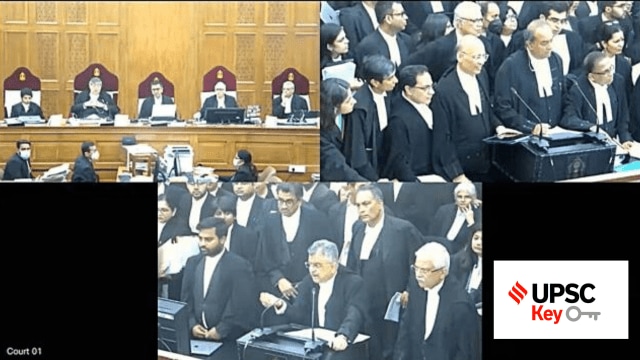
Avoid personal law, let’s look at Spl Marriage Act: Supreme Court
Syllabus:
Preliminary Examination: Current events of national and international importance
Main Examination: General Studies II: Structure, organization and functioning of the Executive and the Judiciary—Ministries and Departments of the Government; pressure groups and formal/informal associations and their role in the Polity.
Key Points to Ponder:
• What’s the ongoing story- The Supreme Court bench hearing petitions seeking legal recognition of same-sex marriages Tuesday said it will steer clear of the area of personal laws but will only examine if the right can be conferred under The Special Marriage Act (SMA), 1954. Crucially, in response to an argument that the “legislative intent” of marriage throughout has been a “relationship between a biological man and a biological female”, the apex court underlined that “there is no absolute concept” of a man or woman.
• What exactly Supreme Court said?
• What is the Special Marriage Act, 1954?
• Who can get married under the Special Marriage Act?
• What is the “legislative intent” of marriage
• What is government’s objections to the maintainability of the same sex marriage petitions?
• What is the stigma attached to homosexual relations even after the strike down of IPC Section 377?
• “The legislative intent of the legislature throughout has been a relationship between a biological male and a biological female, including SMA”-Analyse
• “There is a very important value judgment that you are making – that the very notion of a biological man is absolute or that notion of a biological woman is also absolute which is incorrect. There is no absolute concept of a man or absolute concept of a woman at all”-Critically Analyse
• What is a civil union?
• How is a civil union different from marriage?
Other Important Articles Covering the same topic:
📍How civil union is different from marriage
📍Supreme Court hearing on same-sex marriage: Top quotes
Bilkis case: SC underlines gravity of crime, Centre and Gujarat refuse files
Syllabus:
Preliminary Examination: Current events of national and international importance
Mains Examination:
• General Studies I: Social empowerment, communalism
• General Studies II: Structure, organization and functioning of the Executive and the Judiciary—Ministries and Departments of the Government; pressure groups and formal/informal associations and their role in the Polity.
• General Studies IV: Public/Civil service values and Ethics in Public administration
Key Points to Ponder:
• What’s the ongoing story- The Supreme Court questioned the Gujarat government Tuesday over its decision to prematurely release 11 men convicted of the gangrape of Bilkis Bano and the murder of 14 of her family members during the 2002 Gujarat riots. “The question is whether the government applied its mind and what material formed the basis of its decision to grant remission,” said Justice K M Joseph, heading a bench that also comprised Justice B V Nagarathna, before adding, “Today it is this lady, tomorrow it can be you or me.”
• Who is Bilkis Bano?
• Bilkis Bano case: What did the CBI find in its investigation?
• How did the trial in the case proceed?
• What are the laws on remission?
• Quick Revision– Eleven men who were sentenced to life imprisonment in the Bilkis Bano gangrape case of 2002 were released from Godhra sub-jail on August 15 after a panel set up by the Gujarat government approved their application for remission of the sentence.
• What is the role of Civil Servants in Sentence Review Board to exercise the powers under Section 432 of the CrPC?
• As per the 1992 policy, “the Inspector General of Jail is mandated to obtain the opinion of the District Police Officer, District Magistrate, Jail Superintendent and Advisory Board Committee for early release of a convict-What was the stand of district collector, superintendent of police, or jail superintendent, in this entire case?
• What you know about Gujarat’s remission policy?
• How Gujarat’s remission policy applied to Bilkis case?
• What are the grounds for remission?
• What is the 1992 policy in this case?
• Articles 72 and 161 of the Constitution-Know in detail
• What is collective conscience of society?
• Why is collective conscience important?
• Bilkis Bano case and collective conscience of society-connect the dots
• For Your Information-Established case law in D Krishna Kumar vs State of Telangana had the high court lay down that the appropriate authority deciding a remission should consider the opinion of the presiding judge of the court before or by which the conviction was had or confirmed.
• What are the legal remedy available to Bilkis now?
Other Important Articles Covering the same topic:
📍Explained: Who is Bilkis Bano, who was gangraped during the 2002 Gujarat riots?
📍Tavleen Singh writes: Why I felt ashamed as an Indian last week
📍‘Is this how justice ends?’: Bilkis Bano’s question should haunt the Indian republic
THE IDEAS PAGE
Syllabus:
Preliminary Examination: Current events of national and international importance.
Main Examination: General Studies II: Effect of policies and politics of developed and developing countries on India’s interests
Key Points to Ponder:
• What’s the ongoing story-C Raja Mohan writes: Last week, French President Emmanuel Macron declared France is “an ally but not a vassal of the United States”. Macron was defending his comments to the press on his way back from China that Paris does not share Washington’s hostility to China and that he does not see the Taiwan crisis as a threat to Europe.
• France is “an ally but not a vassal of the United States; in what context was this sentence said?
• What is strategic autonomy?
• What does open strategic autonomy mean?
• Some analysts are accusing Russia of becoming a “vassal” of China-Why?
• What does vassal mean?
• How is the term vassal relevant in this context?
• The debate on the “vassalisation” of Europe and Russia, however, highlights five important trends-What are those?
• “Europe has to grow out of the mindset that Europe’s problems are the world’s problems, but the world’s problems are not Europe’s problems”-Discuss
• “Weaker and divided Europe is enhancing the prospects for a bipolar world”-How?
• India, USA and Europe-Connect the dots
Other Important Articles Covering the same topic:
📍C Raja Mohan writes: Russia and China’s plan is to divide and rule the West
EXPLAINED
Plant ‘cries’: Recalling JC Bose
Syllabus:
Preliminary Examination: Current events of national and international importance.
Main Examination: General Studies III: Achievements of Indians in science & technology; indigenization of technology and developing new technology.
Key Points to Ponder:
• What’s the ongoing story– Late last month, a group of researchers from Tel Aviv University in Israel reported that they had been able to pick up distress noises made by plants. The researchers said these plants had been making very distinct, high-pitched sounds in the ultrasonic range when faced with some kind of stress, like when they were in need of water.
• Personality in News-Jagadish Chandra Bose
• What did JC Bose discover?
• “The discovery that plants ‘cry’ in distress, therefore, did not come as much of a surprise to them. It seemed just a logical extension of J C Bose’s work”-Know the background
• Do You Know-A physicist-turned-biologist, Bose, who lived between 1858 and 1937, made pioneering contributions in both the fields and was the first Indian to have made a powerful impact on modern science, much before Srinivasa
Ramanujan, C V Raman, or Satyendra Nath Bose, a student of Jagadish, arrived on the scene.
• “J C Bose could many believe he deservedly should very well have been India’s first Nobel Prize winner, ahead of his life-long friend and confidant Rabindranath Tagore, with whom he used to have a prolific, and often poetic, correspondence”-Connect the dots between JC Bose and Nobel Prize
• For Your Information-Jagadish Chandra Bose is remembered for two things — his work on wireless transmission of signals, and on the physiology of plants. He is also credited as one of the first contributors to solid state physics. Sir Neville Mott, Nobel Prize winner in 1977, is said to have remarked that Bose was “at least 60 years ahead of his time and he had anticipated the p-type and n-type semiconductors”, according to an account in Remembering J C Bose, a 2009 publication by D P Sen Gupta, M H Engineer and V A Shepherd.
• Guglielmo Marconi, an Italian scientist who carried out the first transmission of signals across the Atlantic in 1901, is recognised as the sole inventor of the radio and not the JC Bose-Why?
• Know JC Bose’s contributions to the communication systems in biology
• Bose was possibly the world’s first biophysicist. But some of his work became controversial as well-what controversies?
Other Important Articles Covering the same topic:
📍Incredible Indians: How Jagdish Chandra Bose helped invent wireless telecommunication
ECONOMY
India to appeal WTO panel ruling on ICT import tariffs; ‘limited’ PLI impact
Syllabus:
Preliminary Examination: Current events of national and international importance.
Main Examination: General Studies II: Important International institutions, agencies and fora- their structure, mandate.
Key Points to Ponder:
• What’s the ongoing story– India is expected to appeal a recent ruling by a panel of the World Trade Organization (WTO) on its imposition of tariffs on mobile phones and electronic components in a bid to ensure that the ruling does not impact the country’s domestic manufacturing goals, especially in a sector which has seen capacity building, a senior government official said.
• What is WTO dispute settlement system?
• Which panel helps the dispute settlement body of WTO?
• The current dispute settlement system was created as part of the WTO Agreement during the Uruguay Round-True or False?
• What are the functions, objectives and key features of the dispute settlement system?
• The dispute settlement panel of the World Trade Organization (WTO) ruled that India’s imposition of tariffs on mobile phones and electronic components violates its commitment under the Information Technology (IT) Act-Discuss
• For Your Information-In 2019, the EU had challenged the import duty of 7.5 per cent – later increased to 15 per cent – levied by India in 2017 on a wide range of IT products, such as mobile phones and components, as well as integrated circuits, to curb imports and step up domestic production. Japan and Taiwan filed similar complaints later that year. Later, India raised the duty to 20 per cent despite opposition from a number of the trade organisation’s members. India is a signatory to the Information Technology Agreement (ITA) which came into effect in July 1997 and accounts for more than 95 per cent of the world trade in products such as computers, telecom equipment, semiconductors and scientific instruments. As part of a signatory to the agreement, India is required to eliminate tariffs on these products.
• What Is a Tariff?
• Imposition of tariffs on mobile phones and electronic components-how it impacts?
• Why Government Imposed Tariffs?
• What is difference between tariff and quota?
Other Important Articles Covering the same topic:
📍What Is a Tariff and Why Are They Important?
For any queries and feedback, contact priya.shukla@indianexpress.com
The Indian Express UPSC Hub is now on Telegram. Click here to join our channel and stay updated with the latest Updates.

Read UPSC Magazine