© IE Online Media Services Pvt Ltd
Latest Comment
Post Comment
Read Comments
 9 min read


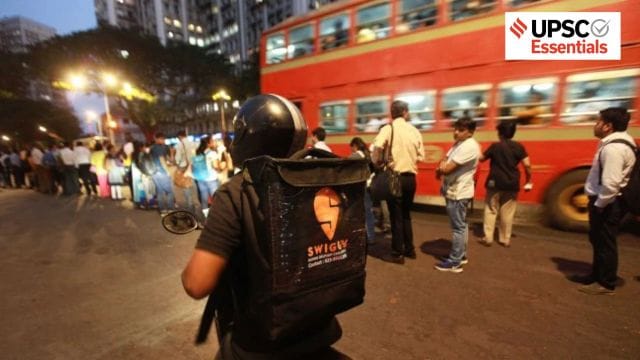 The new labour codes represent an important beginning towards the formalisation of India’s large informal economy. However, it is important to remember that formalisation is more than the number. (File)
— Ritwika Patgiri
Around 80 per cent of India’s 570 million workers are employed in the informal sector. Against this backdrop, measures aimed at formalising the informal part of the Indian economy are seen as an important component of India’s growth structure.
Formalisation is associated with access to social security benefits, greater economic stability, and reduced precarity for workers. The government has pursued this through four pathways: legal reforms, systemic transformation, sectoral interventions, and social protection. The legal reforms include the labour law reforms.
Let’s understand how exactly the new labour codes offer security to gig and platform workers. But first, a brief overview of the four Labour Codes that consolidated 29 laws.
The Union Ministry of Labour and Employment has notified the rules for four Labour Codes by absorbing and repealing the existing 29 labour laws. The four codes are: the Code on Wages (2019), the Industrial Relations Code (2020), the Code on Social Security (2020) and the Occupational Safety, Health and Working Conditions Code (2020).
Code on Wages (2019)
It absorbs four laws, including the Minimum Wages Act, 1948, and has been largely hailed for the provision of equal wages to women. However, one important concern relates to the national minimum wage, which has been fixed at Rs 168 per day by the Central Government. Almost all state governments have a minimum wage higher than this. Some experts have cautioned that the new Labour Codes may bring down the minimum wages across states.
Industrial Relations Code (2020)
It consolidates three existing laws and covers matters related to layoffs, strikes, retrenchment, etc. As per the previous labour laws, establishments with 100 or more workers required government permission for retrenchment or closure. The new code raises this threshold to 300 or more workers. Further, some critiques have pointed out that the Code discourages the provision of permanent tenure to workers as well as strikes.
Code on Social Security (2020)
It merges nine laws. This code has been hailed for recognising and defining “gig workers” and “platform workers” for the first time. A “gig worker” is defined as a person who performs work or participates in a work arrangement and earns from such activities outside of traditional employer-employee relationship.
However, one critique against the new Social Security Code is that the code fails to define “gig workers” as “employees”, where platforms like Zomato and Swiggy are not liable for standard contributions to the workers. The code mandates that aggregators contribute 1-2 per cent of their annual turnover to a Social Security Fund.
Occupational Safety, Health and Working Conditions Code (2020)
It replaces 13 existing laws and redefines the term “factory”. According to the redefinition, a “factory” implies a manufacturing premise with 20 or more workers using power or 40 or more workers without power, thereby increasing the threshold of workers. As a result, thousands of small manufacturing units fall outside the purview of labour regulations.
The four Labour Codes imply a shift of legislative powers to the Executive (both Union and State governments). This also implies that important details, which were earlier mentioned in “Acts”, can now be modified through notifications, reducing the need for parliamentary approval.
Nonetheless, the new labour codes have also been seen as a continuous effort towards formalising India’s large informal economy.
The precarious nature of the informal sector, particularly its predominant migrant workforce, was brought to the fore by the Covid-19 pandemic. In 2021, the Ministry of Labour and Employment launched the e-SHRAM National Database. The portal provides a comprehensive database of unorganised workers and forms a major systemic intervention aimed at enumerating informal workers and making them eligible for social security benefits.
As of November 2025, more than 31.38 crore unorganised workers are registered on the portal designed to provide access to various social security schemes. The portal includes construction workers, gig and platform workers, domestic workers, street vendors, beauticians, waiters, and rickshaw drivers. Registration requires an Aadhar card, mobile phone, and a bank account (both linked to Aadhar). This requirement aligns the database with other previous government policies on banking/financial inclusion and digital identification of citizens.
Registration on the e-SHRAM portal provides workers with insurance under the Pradhan Mantri Suraksha Bima Yojana, which offers them coverage of Rs 2 lakh in case of an accident and Rs 1 lakh in case of any disability caused by an accident. The website also lists several other schemes like Pradhan Mantri Awas Yojana – Gramin (PMAY-G), Atal Pension Yojana, and Pradhan Mantri Jeevan Jyoti Yojana. However, registration on the e-SHRAM portal does not necessarily imply direct benefits from all the mentioned schemes, as separate applications are required on their respective sites.
Other systemic efforts to formalise the informal economy include the implementation of the Goods and Services Tax (GST). Sectoral interventions focus on the revitalisation of Micro, Small, and Medium Enterprises (MSMEs) through registration on the Udyam portal, promotion of Start-Ups through relaxed norms, funding, tax exemption, and the convergence of MSMEs with other credit-linked schemes like the Prime Minister’s Employment Generation Programme (PMEGP), the Pradhan Mantri Formalisation of Micro Food Processing Enterprises Scheme (PMFME), and Mudra loans.
In addition, social protection for informal workers includes a range of schemes like Ayushman Bharat, Pradhan Mantri Jeevan Jyoti Bima Yojana, Pradhan Mantri Suraksha Bima Yojana, and Atal Pension Yojana. There has also been a focus on the Employees’ Provident Fund Organisation (EPFO) benefits.
For instance, a recent report by Quess Corp on “India’s Workforce Trends & Quess Corp Role in Formalisation” indicates that EPFO recorded the highest ever enrollment in 2024-25, with new subscribers increasing from 61 lakh in FY 2019 to 139.78 lakh in FY 2025. This suggests the increasing importance of formalisation policies targeting the informal workforce.
At the heart of the formalisation process lies the provision of decent work. Initiatives such as Udyam registration, digitization, and e-SHRAM registration are important efforts towards this. However, formalisation cannot be assessed merely through the number of registrations or quantitative indicators. Instead, it needs to imply less precarity, better wages, occupational safety, and social protection. The case of gig workers with the new labour codes suggests how informal workers may remain inadequately protected despite formal recognition.
While the Social Security Code (2020) recognises gig workers and extends social security benefits, it does not mention any time frame or specific benefits that gig workers can avail. The code mandates that aggregators contribute 1-2 per cent of their annual turnover – subject to a cap of 5 per cent of payments made or payable to gig/platform workers – to a Social Security Fund. This contribution would offer a very minimal benefit to an already vulnerable and precarious group of workers. Thus, gig workers have become “recognised” but do not yet have full labour rights or employer-backed social security.
Moreover, gig workers bear the high cost of operation, including expenses related to transportation, internet, safety equipment, and healthcare. In this context, the mandated contribution appears inadequate, offers only minimal protection, and falls far short of meaningful social security.
At the same time, the wage gap between permanent workers and gig workers remains significant. Notably, women gig workers remain vulnerable due to “double burden” of paid and unpaid work. Research also suggests that gig workers in India are extremely overworked, which is largely overlooked in the labour codes.
Additionally, the algorithmic management of gig work and the lack of transparency in platform operations contribute to what has been described as a process of “glorified informalisation”, where workers have little recourse if their accounts are arbitrarily deactivated or work allocations are cancelled. The case of the European Union warrants a mention here, as it places full responsibility on the employer of gig workers for providing social security benefits, full employment rights, and algorithmic transparency.
To sum up, the new labour codes do represent an important beginning towards the formalisation of India’s large informal economy. However, it is important to remember that formalisation is more than the number of Udyam and e-SHRAM registrations – it is about decent work and dignified lives for workers. While the recognition of gig workers is an important step, other structural vulnerabilities also demand policy interventions.
To what extent does the contribution framework for aggregators under the Social Security Code provide meaningful social protection to gig and platform workers?
Discuss whether the new Labour Codes represent a shift from worker protection to labour market flexibility, with special reference to gig workers.
Analyse the concept of ‘glorified informalisation’ in relation to algorithm-managed gig work in India.
Examine the gendered dimensions of gig work in India and assess whether the new Labour Codes adequately address women gig workers’ vulnerabilities.
How do wage disparities, high operational costs, and lack of job security compound precarity among gig workers despite their legal recognition?
(Ritwika Patgiri is a doctoral candidate at the Faculty of Economics, South Asian University.)
Share your thoughts and ideas on UPSC Special articles with ashiya.parveen@indianexpress.com.
Click Here to read the UPSC Essentials magazine for November 2025. Subscribe to our UPSC newsletter and stay updated with the news cues from the past week.
Stay updated with the latest UPSC articles by joining our Telegram channel – IndianExpress UPSC Hub, and follow us on Instagram and X.


Read UPSC Magazine