21 min read


© IE Online Media Services Pvt Ltd



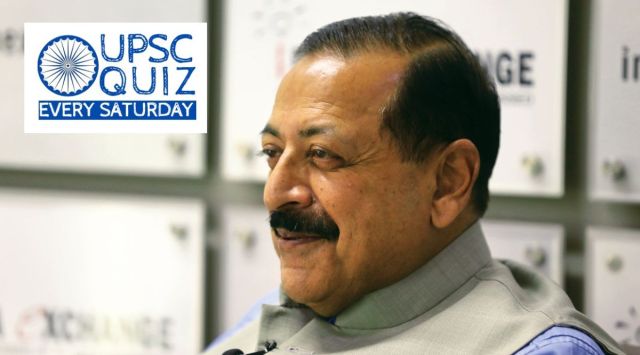 Addressing a press conference, Jitendra Singh, Minister (Independent charge), Department of Science and Technology (DST), said, “ The National Quantum Mission will help India take a quantum leap in this area of research. It will have wide-scale applications ranging from healthcare and diagnostics, defence, energy and data security.” National Quantum Mission finds a place in our weekly quiz. (Express image)
UPSC Weekly Quiz is a current affairs-based quiz on certain relevant topics from the past week, curated for the aspirants of competitive examinations. Attempt the weekly quiz every Saturday and find answers to the MCQs with explanations at the end of the article.
As the Ganges approaches the coastal plain, the river fans out over the flat terrain of Bangladesh and West Bengal, India, as numerous meandering channels. It branches off the Ganges about 200 kilometers north of Calcutta, and the river flows past the city before emptying into the Bay of Bengal. By the end of this year, commuters could be taking a Metro train, through the country’s first underwater transport tunnel, across this river.
Which of the following rivers is described in the above explanation?
(a) Mahananda
(b) Teesta
(c) Hoogly
(d) Damodar
With respect to State of World Population (SOWP) report, ‘8 Billion Lives, Infinite Possibilities’, consider the following statements:
1. The largest share of population is of people between the ages of 10-24 years.
2. While numbers will continue to grow for several decades, latest projections suggest that the rate of global population growth has fallen.
Which of the above statements is/are correct?
(a) Only 1
(b) Only 2
(c) Both 1 and 2
(d) Neither 1 nor 2
Consider the following pairs:
| Case | Judgement/ruling |
| 1. NALSA v Union of India | affirmed the constitutional rights of transgender persons under Articles 14, 15, 19 and 21 of the Constitution. |
| 2. KS Puttaswamy v Union of India | recognised the right to privacy as a fundamental right under the Constitution. |
| 3. Shafin Jahan v Union of India | recognised the right to choose one’s partner as a facet of the fundamental right to liberty and dignity. |
| 4. Shakti Vahini v Union of India | recognised “atypical” families, including queer marriages, which could not be confined in the traditional parenting roles. |
| 5. Navtej Johar v Union of India | essentially said that the LGBTQ community are equal citizens and underlined that there cannot be discrimination in law based on sexual orientation and gender. |
| 6. Deepika Singh vs Central Administrative Tribunal | issued directives to prevent honour killings at the behest of khap panchayats and protect persons who marry without the approval of the panchayats. |
Which of the above pairs is/are correctly matched?
(a) 1, 2, 3 and 5
(b) 2, 4, 5 and 6
(c) 1, 2 ,3 and 4
(d) 1, 2, 3, 4, 5 and 6
With reference to ‘Hakki Pikki’, consider the following statements:
1. It is a tribe traditionally of bird catchers and hunters that lives in several states in north-eastern India.
2. Recently seen in news because many members of this community are stuck in violence-hit Sudan.
Which of the above statements is/are true?
(a) Only 1
(b) Only 2
(c) Both 1 and 2
(d) Neither 1 nor 2
With reference to offset projects, consider the following statements:
1. Removal offset describes actions which actively take carbon out of the air and store it permanently, such as by planting trees or direct air capture — which is not a technology available at scale.
2. Avoidance offsets are from projects that stop the release of greenhouse gases, such as protecting trees from being logged.
Which of the above statements are correct?
(a) Only 1
(b) Only 2
(c) Both 1 and 2
(d) Neither 1 nor 2
Which of the following statements is not correct with reference to Jagadish Chandra Bose?
(a) He is widely believed to be the first one to generate electromagnetic signals in the microwave range.
(b) He is remembered for his work on the physiology of plants.
(c) He was India’s first scientist to win the Nobel Prize .
(d) He is credited as one of the first contributors to solid state physics.
With reference to National Quantum Mission, consider the following statements:
1. India has joined research and development works in quantum technologies which are underway in six nations US, Canada, France, Finland, China and Austria.
2. Indian Institute of Science will lead this national mission focusing on four broad themes — Quantum Computing, Quantum Communication , Quantum Sensing and Metrology and Quantum Material and Devices.
Which of the above statements are not correct?
(a) Only 1
(b) Only 2
(c) Both 1 and 2
(d) Neither 1 nor 2
With reference to civil services in India, consider the following statements:
1. Following the report of Lee Commission, the concept of a merit based modern Civil Service in India was introduced.
2. April 21 was chosen as Civil Services Day because it is on this day in 1947 that the first Home Minister of India, Sardar Vallabhbhai Patel, addressed the probationers of Administrative Services Officers.
Which of the above statements is/are true?
(a) Only 1
(b) Only 2
(c) Both 1 and 2
(d) Neither 1 nor 2
With reference to environment, Artificial Intelligence can be put to use in which of the following?
1. Saving trees
2. Shrinking the carbon footprint of steel
3. Cutting energy waste in buildings
4. Fighting poaching
5. Smart farming
6. Plotting clouds
Select the correct answer using the code given below:
(a) 1, 2, 5 and 6
(b) 2, 3, 4, 5 and 6
(c) 1, 2, 3, 5 and 6
(d) 1, 2, 3, 4, 5 and 6
Alice holds a digital wallet that securely manages her identity, data, and authorizations for external apps and connections. Alice uses her wallet to sign in to a new decentralized social media app. However, because Alice has connected to the app with her decentralized identity, she does not need to create a profile, and all the connections, relationships, and posts she creates through the app are stored with her, in her decentralized web node.
With which web/s from the options below, can Alice switch apps whenever she wants, taking her social persona with her?
(a) Web 2
(b) Web 2 and Web 3 only
(c) Web 5
(d) Web 2 and 5 only
FYI:
— India’s Hugli River (sometimes spelled “Hooghly”) is a Ganges River distributary, one of the many branches of the river that are collectively known as the “Mouths of the Ganges.” As the Ganges approaches the coastal plain, the river fans out over the flat terrain of Bangladesh and West Bengal, India, as numerous meandering channels. The Hugli branches off the Ganges about 200 kilometers north of Calcutta, and the river flows past the city before emptying into the Bay of Bengal.
(source: earthobservatory.nasa.gov)
— By the end of this year, commuters could be taking a Metro train across the Hooghly, which separates Kolkata from Howrah, its smaller twin city on the opposite bank, travelling under the mighty river. The passage, 520 metres from one bank to the other and more than 30 metres (100 feet) below the river surface at its deepest points, is India’s first underwater transport tunnel.
Therefore, option (b) is the correct answer.
FYI:
— India is now the most populous country in the world, having overtaken China in population, the United Nations Population Fund (UNFPA) said in its State of World Population (SOWP) report, ‘8 Billion Lives, Infinite Possibilities’, released on April 19. In November 2022, the UN had announced that the world’s population had crossed the 8 billion mark.
— The UNFPA has said the population of the world is 8,045 million, of which the largest share (65%) is of people between the ages of 15 and 64 years, followed by those in the 10-24 years group (24%). 10 per cent of the population is above 65 years of age. Hence, statement 1 is wrong.
— The 2023 report has said that while numbers will continue to grow for several decades, latest projections suggest that the rate of global population growth has fallen, and has been at less than 1 per cent since 2020. Hence, statement 2 is correct.
— This is largely due to declining fertility; around two thirds of people live in a country or area with a total fertility rate at or below 2.1 children per woman (widely considered the “replacement fertility” rate, also called “zero-growth fertility” rate). In 1950 the global fertility rate stood at 5.
Therefore, option (b) is the correct answer.
FYI:
— The Supreme Court is hearing a batch of pleas seeking legal recognition for same-sex marriages. On the second day of the hearing, the court heard arguments on the changing legal landscape on LGBTQ rights and the evolution of the right to choose one’s partner. Here are some of the key cases that trace the shift in the law over the years.
| Case | Judgement/ruling |
| 1. NALSA v Union of India | affirmed the constitutional rights of transgender persons under Articles 14, 15, 19 and 21 of the Constitution. |
| 2. KS Puttaswamy v Union of India | recognised the right to privacy as a fundamental right under the Constitution. |
| 3. Shafin Jahan v Union of India | recognised the right to choose one’s partner as a facet of the fundamental right to liberty and dignity. |
| 4. Shakti Vahini v Union of India | issued directives to prevent honour killings at the behest of khap panchayats and protect persons who marry without the approval of the panchayats. |
| 5. Navtej Johar v Union of India | essentially said that the LGBTQ community are equal citizens and underlined that there cannot be discrimination in law based on sexual orientation and gender. |
| 6. Deepika Singh vs Central Administrative Tribunal | recognised “atypical” families, including queer marriages, which could not be confined in the traditional parenting roles. |
Therefore, option (a) is the correct answer.
FYI:
— The Hakki Pikki is a tribe that lives in several states in west and south India, especially near forest areas. Hakki Pikkis (Hakki in Kannada means ‘bird’ and Pikki means ‘catchers’) are a semi-nomadic tribe, traditionally of bird catchers and hunters. Hence, statement 1 is not correct.
— More than 181 members of the Hakki Pikki tribal community from Karnataka are stuck in violence-hit Sudan, even as the government is making efforts to bring them back.
Therefore, option (b) is the correct answer.
FYI:
— Offsets have come under fire as a way for companies to compensate for carbon emissions through eco projects elsewhere.
— Buying offsets is a way to “compensate” for environmental damage. Companies make a financial contribution to projects that reduce the amount of carbon dioxide in the atmosphere, and in exchange can keep polluting themselves.
— Offset projects can be broadly split into two categories: removals and avoidances. Removal describes actions which actively take carbon out of the air and store it permanently, such as by planting trees or direct air capture — which is not a technology available at scale. Currently carbon dioxide removal represents just a small percentage of the carbon credits in circulation. Hence, statement 1 is true.
— Avoidance offsets are from projects that stop the release of greenhouse gases, such as protecting trees from being logged. For example, the asset management arm of the US bank JP Morgan Chase has bought 250,000 acres of forest for more than $500 million “for carbon capture and timber.” As such, the bank has paid timberland owners to not cut the trees down, thereby allowing them to absorb carbon from the atmosphere, and in turn, itself profits by generating potential carbon credits for investors. Hence, statement 2 is true.
Therefore, option (c) is the correct answer.
FYI:
— Late last month, a group of researchers from Tel Aviv University in Israel reported that they had been able to pick up distress noises made by plants. The researchers said these plants had been making very distinct, high-pitched sounds in the ultrasonic range when faced with some kind of stress, like when they were in need of water.
— This was the first time that plants had been caught making any kind of noise, and the breakthrough research findings made global headlines. But many Indians just had a sense of déjà vu. Several previous generations of Indians had grown up hearing that Jagadish Chandra Bose had shown, more than a century ago, that plants experienced sensations and were able to feel pleasure and pain just like animals.
— Children were often advised not to pluck leaves, flowers or twigs because that could cause pain to the plants or trees. The discovery that plants ‘cry’ in distress, therefore, did not come as much of a surprise to them. It seemed just a logical extension of J C Bose’s work.
— Jagadish Chandra Bose is remembered for two things — his work on wireless transmission of signals, and on the physiology of plants. He is also credited as one of the first contributors to solid state physics. Bose is widely believed to be the first one to generate electromagnetic signals in the microwave range. In 1895, just a year after he began his active research, he demonstrated, before an audience in Kolkata, how microwaves could be used, wirelessly, to ring an electric bell on the other side of a building. Hence, a, b, and d are true.
— A physicist-turned-biologist, Bose, who lived between 1858 and 1937, made pioneering contributions in both the fields and was the first Indian to have made a powerful impact on modern science, much before Srinivasa Ramanujan, C V Raman, or Satyendra Nath Bose, a student of Jagadish, arrived on the scene.
— J C Bose could — many believe he deservedly should — very well have been India’s first Nobel Prize winner, ahead of his life-long friend and confidant Rabindranath Tagore, with whom he used to have a prolific, and often poetic, correspondence. Note that Jagadish Chandra Bose was not awarded the Nobel Prize. Hence, c is not true.
Therefore, option (c) is the correct answer.
FYI:
— The Union Cabinet Wednesday approved the National Quantum Mission (NQM) in a bid to aid scientific and industrial research and development in quantum technology.
— The mission involves a cost of Rs 6,003.65 crore from 2023-24 to 2030-31, and aims to put India among the top six leading nations involved in the research and development in quantum technologies.
— Department of Science and Technology within the Ministry of Science and Technology will lead this national mission, supported by other departments. Hence, statement 2 is not correct.
— Presently, R&D works in quantum technologies are underway in the US, Canada, France, Finland, China and Austria. Hence, statement 1 is correct.
Therefore, option (b) is the correct answer.
FYI:
— According to http://www.upsc.gov.in
“Following Lord Macaulay’s Report of the Select Committee of British Parliament, the concept of a merit based modern Civil Service in India was introduced in 1854. The Report recommended that patronage based system of East India Company should be replaced by a permanent Civil Service based on a merit based system with entry through competitive examinations. For this purpose, a Civil Service Commission was setup in 1854 in London and competitive examinations were started in 1855. Initially, the examinations for Indian Civil Service were conducted only in London. Maximum age was 23 years and minimum age was 18 years.” Hence, statement 1 is not correct.
— April 21 was chosen as Civil Services Day because it is on this day in 1947 that the first Home Minister of India, Sardar Vallabhbhai Patel, addressed the probationers of Administrative Services Officers. Hence, statement 2 is correct.
— The day is marked to celebrate the exemplary work done by our civil servants, and as an opportunity for them to recommit themselves to the cause of citizens. The theme for this year’s Civil Services Day is ‘Viksit Bharat: Empowering Citizens and Reaching the Last Mile’.
Therefore, option (b) is the correct answer.
FYI:
— A recent study commissioned by tech giant Microsoft estimated that AI applications in the sectors of agriculture, water, energy and transport could lead to a 4% cut in greenhouse gas emissions by 2030 — equivalent to the annual emissions of Australia, Canada and Japan combined.
Here are six ways it’s being put to use to help the environment:
— Saving trees with AI ‘guardians’
Deforestation and land use changes cause more than 10% of global greenhouse gas emissions. Trees absorb carbon dioxide and store it for long periods of time, and when they’re cut down, much of that CO2 escapes into the atmosphere.
To curb illegal land clearing, the nonprofit Rainforest Connection attaches acoustic monitoring sensors to trees that “eavesdrop” on the surrounding forest and transmit that audio in real-time to the cloud.
A recent report estimated that by empowering authorities to use AI tools to preempt the destruction of rainforests, governments could save around 29 gigatons of emissions by 2030. For comparison, energy-related CO2 emissions worldwide amounted to around 37 gigatons in 2022.
— Shrinking the carbon footprint of steel
Materials such as steel and cement are important components in construction. But they’re also heavy CO2 emitters, making decarbonizing these industries a priority. Steel production alone accounts for around a quarter of greenhouse gas emissions from the manufacturing sector. A big part of this share comes from the mining and transportation of ingredients used in the production process.
US company Fero Labs has been working with five American steel plants and AI to reduce the amount of mined ingredients — or alloys — by up to a third. Fero Labs’ AI-driven optimization software learns from historical data to recommend the minimum amount of new additional material — if any — that needs to be added.
According to a report by the Global Partnership on Artificial Intelligence, Fero Labs has prevented an estimated 450,000 tons of CO2 emissions per year by skipping the mining, smelting and transporting of these alloys. If scaled to the entire industry in the US, the report estimates annual savings of 11.9 million tons of CO2. That’s equivalent to about a quarter of New York City’s yearly carbon emissions.
— Cutting energy waste in buildings
In Hong Kong, energy use in buildings is responsible for about 60% of the city’s carbon emissions. With 7.5 million inhabitants, the finance hub is one of the most densely populated places in the world.
About a quarter of its total electricity consumption comes from heating, ventilation and air conditioning (HVAC) systems in commercial buildings.
Design firm Arup came up with an app called Neuron that uses 5G and Internet of Things sensors to gather real-time data from a building’s energy management system. It then uses an algorithm to analyze this data and optimize the heating and cooling system, as well as make predictions for the building’s future energy demand. According to the Global Partnership on Artificial Intelligence report, these tweaks can save 10-30% of the energy used in a typical commercial building.
— Fighting poaching with algorithms
Poaching and habitat destruction caused rhino numbers to dwindle throughout the 20th century. Most species are now considered endangered and mainly survive in protected reserves or sanctuaries, but they’re still targeted for their horns.
The South Africa-based company Rouxcel Technology has developed AI-enabled bracelets that fit around rhinos’ ankles to help conservation teams easily locate the animals and monitor their behavior in real time.
The company’s algorithms use machine learning to spot when an animal is exhibiting abnormal movement patterns — a signal that it might be distressed, for example, if poachers are close. It then sends an alert to wildlife operations centers and anti-poaching teams. The devices are being used at different sites from Kenya down to South Africa.
— Smart farming
Agriculture is vulnerable to climate change, with unpredictable temperatures, more frequent extreme weather events and invasive pests all posing a risk to crop yields.
At the same time, the farming sector itself contributes to the problem — agriculture, forestry and land use account for around 18% of global CO2 emissions. And then there’s the fact that agriculture irrigation is responsible for 70% of water use worldwide. Fertilizer and pesticides used on fields can also end up in groundwater and nearby rivers.
Germany-based startup Agvolution has developed an AI system that draws on data from solar-powered sensors monitoring the microclimate around crops. The devices measure temperature, humidity, radiation and soil moisture in the field, while algorithms use these insights to make precise recommendations about plant health and exactly how much water and fertilizer to use. This can both boost yields and reduce wasted resources. The company says this can increase ecological and economic efficiency by up to 40%.
— Using computers to plot clouds
Ramping up renewable energy is a crucial step in transitioning away from fossil fuels. But with clean energy sources such as solar making up a bigger share of the energy mix, ensuring power grids are stable becomes more tricky.
When clouds move over solar panels, the power supply can suddenly drop off. That’s a problem for network operators who are trying to balance the grid and prevent blackouts. To fill any gaps, they need to have generation reserves running in the background that can quickly be ramped up when there’s risk of a power shortage. And these reserves usually come from fossil fuels.
Nonprofit Open Climate Fix has teamed up with the UK’s National Grid and uses AI to provide a precise picture of how clouds develop — the goal being to reduce the reliance on fossil-powered reserves.
Open Climate Fix is also piloting its forecasting models in two countries in southern Europe, and is in talks to run a pilot in Asia.
(Source: How AI can help the environment by Deutsche Welle )
Therefore, option (d) is the correct answer.
FYI:
— Web3 is buzzing with blockchain companies foraying into the idea of a decentralised internet. However, former Twitter CEO Jack Dorsey is taking the idea of Web3 to the next level by launching Web5, a combination of Web3 and Web2.
— Web5 is built on the Bitcoin blockchain, developed by The Block Head (TBH), one of the Bitcoin business units at Dorsey’s Block (formerly Square). The platform aims to bring decentralised identity and data storage to applications. “It lets developers focus on creating delightful user experiences while returning ownership of data and identity to individuals,” according to the company.
— Web3 refers to the next generation of the worldwide web, supposed to take over from Web2.0, which is more centralised and focused on user-created content. The idea of Web3 is a decentralised web that challenges the dominance of tech giants by giving the power and data in the hands of the internet users rather than big tech corporations. In short, Web3 means user data is distributed across networks and no single entity owns the information.
— The goal of Web5 is to create certain tools on Bitcoin that could not only give users control over their data but also would allow them to control all their interactions on the internet.
— The company behind Web5 explains how Web5 wants individuals to have the ability to “own their data”. Web5 will give users more ownership of their data.
Therefore, option (c) is the correct answer.
The UPSC Essentials Indian Express is now on Telegram. Click here to join our YouTube channel and stay updated with the latest updates.
Subscribe to The Indian Express UPSC Key and prepare for the Civil Services and other competitive examinations with cues on how to read and understand content from the most authoritative news source in India.
Note: Catch the UPSC Weekly Quiz every Saturday evening and brush up on your current affairs knowledge.
Share your views, answers and suggestions in the comment box or at manas.srivastava@indianexpress.com

Read UPSC Magazine