


© IE Online Media Services Pvt Ltd
Tags:



UPSC Essentials brings to you its initiative for the practice of Mains answer writing. It covers essential topics of static and dynamic parts of the UPSC Civil Services syllabus covered under various GS papers. This answer-writing practice is designed to help you as a value addition to your UPSC CSE Mains. Attempt today’s answer writing on questions related to topics of GS-3 to check your progress.
🚨 Click Here to read the UPSC Essentials magazine for November 2025. Share your views and suggestions in the comment box or at manas.srivastava@indianexpress.com🚨
Discuss how changes in India’s capital account is influencing the recent depreciation of the Indian rupee.

Public awareness campaigns on antibiotic misuse often fail because they oversimplify complex behavioural and structural issues. Discuss the limitations of conventional awareness campaigns in combating antimicrobial resistance (AMR) in India.
QUESTION 1: Discuss how changes in India’s capital account is influencing the recent depreciation of the Indian rupee.
Note: This is not a model UPSC answer. It only provides you with thought process which you may incorporate into the answers.
Introduction:
— India has a structural current account deficit (CAD) problem in its external balance of payments (BOP) transactions.
— In the last 25 years and more, there have been only four fiscal years (April-March) of surpluses on the current account: 2001-02 ($3.4 billion), 2002-03 ($6.3 billion), 2003-04 ($14.1 billion) and 2020-21 ($23.9 billion).
— In all other years, the current account — which captures the value of the country’s exports and imports of goods and services as well as receipts from and payments against international transfers and investments — has been in deficit.
Body:
You may incorporate some of the following points in your answer:
— The current account in the BOP has two subcomponents. The first is merchandise trade — exports and imports of physical goods.
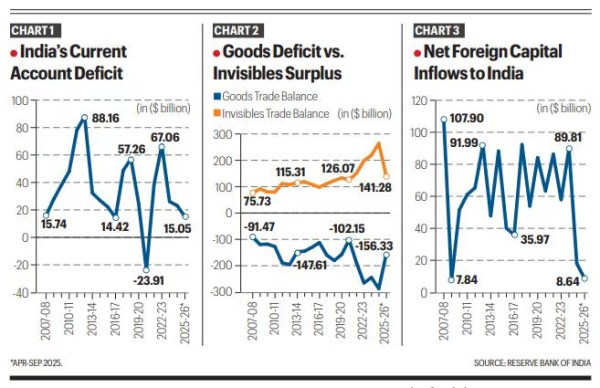
— India’s goods trade balance has always been negative, with the deficit more than doubling from $91.5 billion in 2007-08 to $195.7 billion in 2012-13. It narrowed to $112.4 billion in 2016-17 and $102.2 billion in 2020-21, only to shoot up and reach $286.9 billion in 2024-25.
— The widening goods trade deficit has, however, been significantly offset by the second so-called invisibles subcomponent. The “invisibles” trade has to do with the global flows of services, people, data and ideas, as opposed to the movement of tangible stuff (“visible”) across national borders through sea and by air.
— In the case of invisible transactions, India has consistently enjoyed surpluses, thanks to receipts from private remittances or transfers and exports of software, business, financial and miscellaneous services. These receipts have considerably exceeded the outflows from payment of interest, dividends and royalty to foreign lenders/investors, and also other sources such as Indians studying abroad.
— The rupee’s recent slide — it has in the past one year depreciated against the US dollar (from 84.73 to 89.92) as well as the euro (89.20 to 104.82), British pound (107.76 to 120), Japanese yen (0.5658 to 0.5815) and Chinese yuan (11.66 to 12.72) — has been more courtesy of the capital, not current, account of the BOP.
— Capital flows include foreign investment (both direct and portfolio), commercial borrowings, external assistance and non-resident Indian deposits.
Conclusion:
— The recent depreciation of the Indian rupee has been driven more by capital account pressures than by current account concerns. Large withdrawals of foreign portfolio investment and a marked slowdown in foreign direct investment have decreased the availability of foreign currency, notwithstanding high demand. This dollar demand-supply imbalance has exerted prolonged pressure on the rupee, causing it to depreciate even when the current account deficit has remained manageable.
(Source: Why the rupee has a capital account problem)
Points to Ponder
What is the current account deficit?
Read about Balance of Payment
Related Previous Year Questions
Craze for gold in Indians has led to a surge in import of gold in recent years and put pressure on balance of payments and external value of rupee. In view of this, examine the merits of Gold Monetization Scheme. (2015)
Justify the need for FDI for the development of the Indian economy. Why there is gap between MoUs signed and actual FDIs? Suggest remedial steps to be taken for increasing actual FDIs in India. (2016)
QUESTION 2: Public awareness campaigns on antibiotic misuse often fail because they oversimplify complex behavioural and structural issues. Discuss the limitations of conventional awareness campaigns in combating antimicrobial resistance (AMR) in India.
Note: This is not a model UPSC answer. It only provides you with thought process which you may incorporate into the answers.
Introduction:
— Antimicrobial resistance (AMR) is often described as one of the defining health threats of our time. AMR is a condition in which a pathogen acquires the ability to survive and cause infection even in the presence of an antimicrobial drug. AMR is the result of evolution of microbes in a situation where there is a misuse or overuse of antibiotics.
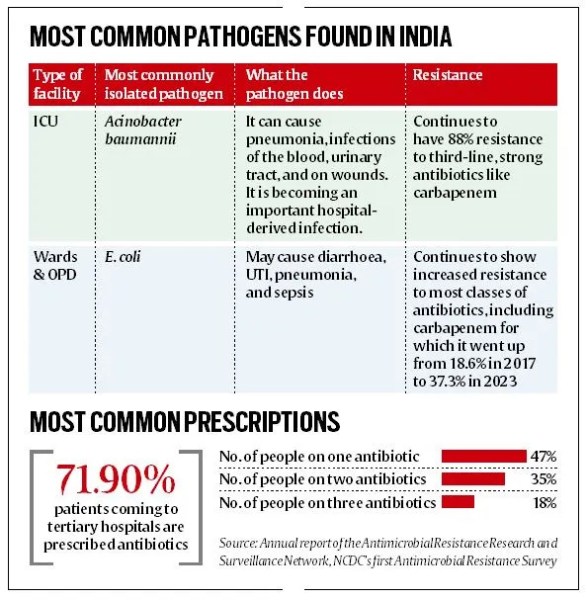
— Excessive use of antimicrobial drugs can lead to the creation of resistant or extremely resistant superbugs, which can circulate in hospitals, through drinking water, or sewers. Infections caused by these pathogens will not respond to commonly prescribed antibiotics.
Body:
You may incorporate some of the following points in your answer:
— The Union Health Minister launched the second version of the National Action Plan on Antimicrobial Resistance (2025-29) on November 18. The first version (NAP 1.0) was launched in 2017 following the Global Action Plan in May 2015. Both in the global and national action plans, the first strategic area focuses on improving awareness and understanding of AMR through effective communication, education and training. The World AMR Awareness Week (WAAW) is celebrated annually from November 18 to 24.
— Awareness is critical, but the way we pursue it today leaves large gaps. Undermining the complexity of the issue, linguistic barriers, poor targeting, and the neglect of key system actors risk turning AMR communication into a box-ticking ritual rather than a tool for real change, especially in low-resource health systems where resistant infections pose the greatest threat.
— AMR is not a condition that can be “awareness-raising” about; rather, it is the result of a complex interplay of bacteria, markets, and behaviours. When campaigns reduce that intricacy to one-line slogans, they lose accuracy and effectiveness. This is seen in how little WAAW rhetoric has changed over time, despite its central role in global and national action plans.
— In actuality, AMR is numerous epidemics rather than merely a “silent pandemic”: Neonatal sepsis, drug-resistant typhoid, carbapenem-resistant hospital infections, resistant pathogens in poultry, aquaculture, and the environment (as well as any social, economic, and behavioural predictors of these outcomes) are all separate, regionally driven, and socially patterned issues.
— If campaigns want individuals to modify their behaviour by getting accurate diagnoses, avoiding needless antibiotics, safely disposing of unused drugs, improving hygiene, or consulting veterinarians responsibly, they must clearly express each behaviour and explain why and how it is important. Vague appeals to “fight AMR” merely exacerbate the disconnect between the notion and daily realities.
— Campaigns also fail because they treat the people as a homogeneous mass. Antibiotic use varies significantly by area, occupation, caste, gender, and access to healthcare. A pig farmer in Uganda, a mother in rural India, and a Vietnamese chemist live in very different antibiotic realities.
Conclusion:
— Campaigns rely on moral exhortations such as “don’t misuse antibiotics” as if misuse was the only or primary driver. AMR emerges from the intersections of human medicine, livestock and poultry production, aquaculture, wastewater and environmental contamination, pharmaceutical manufacturing, and global trade. Over-the-counter sales, weak regulation, poor sanitation, and antibiotic-laden animal feed all play decisive and significant roles.
— Treating AMR as a single monolithic threat obscures the reality that each sub-epidemic requires its own public understanding, behavioural framing, and policy response.
(Source: Why the ‘don’t misuse antibiotics’ campaign doesn’t work, What is anti-microbial resistance (AMR) and why is it a grave threat?)
Points to Ponder
Read more about AMR
Read about National Action Plan on Antimicrobial Resistance (2025-29)
Related Previous Year Questions
Can overuse and free availability of antibiotics without Doctor’s prescription, be contributors to the emergence of drug-resistant diseases in India? What are the available mechanisms for monitoring and control? Critically discuss the various issues involved. (2014)
What do you understand by Fixed Dose Drug Combinations (FDCs)? Discuss their merits and demerits. (2013)
UPSC Essentials: Mains answer practice — GS 3 (Week 132)
UPSC Essentials: Mains answer practice — GS 3 (Week 131)
UPSC Essentials: Mains answer practice — GS 2 (Week 132)
UPSC Essentials: Mains answer practice — GS 2 (Week 131)
UPSC Essentials: Mains answer practice — GS 1 (Week 131)
UPSC Essentials: Mains answer practice — GS 1 (Week 132)
Subscribe to our UPSC newsletter and stay updated with the news cues from the past week.
Stay updated with the latest UPSC articles by joining our Telegram channel – IndianExpress UPSC Hub, and follow us on Instagram and X.


