9 min read
© IE Online Media Services Pvt Ltd
Latest Comment
Post Comment
Read Comments



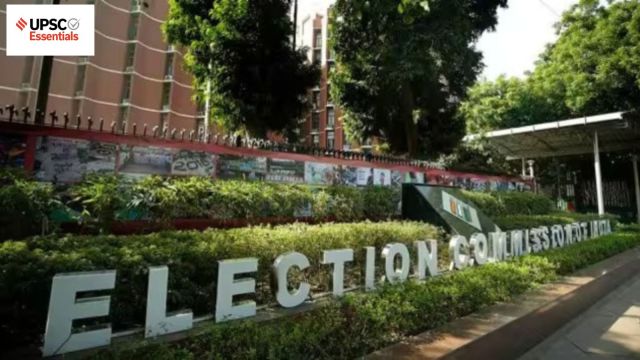 Check your progress and revise your topics through this quiz on Polity and Governance. Find a question on the mapping by Election Commission in today's quiz. (Express photo by Praveen Khanna)
UPSC Essentials brings to you its initiative of daily subject-wise quizzes. These quizzes are designed to help you revise some of the most important topics from the static part of the syllabus. Attempt today’s subject quiz on Polity and Governance to check your progress.
🚨 Click Here to read the UPSC Essentials magazine for November 2025. Share your views and suggestions in the comment box or at manas.srivastava@indianexpress.com🚨
With reference to the National Legal Services Authority (NALSA), consider the following statements:
1. It has been constituted under the Legal Services Authorities Act, 1987.
2. It aims to provide free Legal Services to the weaker sections of the society and to organize Lok Adalats for amicable settlement of disputes.
3. The Chief Justice of India is the Executive Chairman of NALSA.
How many of the statements given above are correct?
(a) Only one
(b) Only two
(c) All three
(d) None
Explanation
— The National Legal Services Authority (NALSA) has been constituted under the Legal Services Authorities Act, 1987 to provide free Legal Services to the weaker sections of the society and to organize Lok Adalats for amicable settlement of disputes. Hence, statements 1 and 2 are correct.
— The Chief Justice of India serves as the Patron-in-Chief, not the Executive Chairman. The Executive Chairman is a sitting or retired Supreme Court judge selected by the Chief Justice of India. Currently, NALSA’s Executive Chairman is Hon’ble Mr. Justice Vikram Nath, a Supreme Court of India Judge. Hence, statement 3 is not correct.
— Every state has established a State Legal Services Authority to carry out the NALSA’s rules and orders, as well as to provide free legal services to the public and conduct Lok Adalats throughout the state. The State Legal Services Authority is led by the Hon’ble Chief Justice of the relevant High Court, who also serves as its Patron-in-Chief. The Seniormost Judge of the High Court is nominated as Executive Chairman of the SLSA.
— In every District, District Legal Services Authority has been constituted to implement Legal Services Programmes in the District. The District Legal Services Authority is situated in the District Courts Complex in every District and chaired by the District Judge of the respective District. A Judicial Officer of Civil Judge Cadre is appointed as Secretary on a full time basis.
Therefore, option (b) is the correct answer.
(Source: nalsa.gov.in)
With reference to the mapping by Election Commission, consider the following pairs:
1. Self mapping: Electors in the 2025 roll whose names can also be found in the 2002 roll.
2. Un-mapped: Electors whose names do not appear in the 2002 roll but who have other blood relations in the list — father, mother, grandparents, etc.
Which of the pairs given above is/are correctly marked?
(a) 1 only
(b) 2 only
(c) Both 1 and 2
(d) Neither 1 nor 2
Explanation
— ECI uses the term ‘mapping’ to indicate the relationship of an elector in the 2025 electoral roll with the 2002 roll prepared after the last SIR. There are three categories of relationships.
— Self mapping: Electors in the 2025 roll whose names can also be found in the 2002 roll will be considered to have done self mapping.
— Progeny mapping: Electors whose names do not appear in the 2002 roll but who have other blood relations in the list — father, mother, grandparents, etc. — will be considered for progeny mapping.
— No mapping or un-mapped: Electors are neither in the 2002 electoral roll nor have any relatives in that roll will be labelled by the ECI as un-mapped. They will compulsorily be called for a hearing where they will have to furnish documents to prove that they are a legitimate voter.
Therefore, option (a) is the correct answer.
With reference to the Indian Constitution, consider the following statements:
1. The Constitution describes itself as a federation not as a unitary state.
2. It follows a quasi-federal design of governance.
3. India has an unwritten and flexible Constitution.
4. The Indian Constitution has the division of power between the Union and state through Union, State and Concurrent Lists.
How many of the statements given above are correct?
(a) Only one
(b) Only two
(c) Only three
(d) All four
Explanation
— The Constituent Assembly was deliberating upon the framing of Constitution way before state reorganisation took place. The primary concern of the members of the Constituent Assembly was to have provisions to maintain and sustain the country’s unity while retaining federal structure.
— The Constitution neither describes itself as a federation nor as a unitary state. Article 1 declares: “India that is Bharat shall be a Union of States”. Thus, it encompasses the features of both federal and unitary. It follows a quasi-federal design of governance and division of power with strong centre and state units. Hence, statement 1 is not correct and statement 2 is correct.
— Article 3 empowers Parliament to change by law the territories, areas and boundaries of the states without the states’ consent. India has a written and rigid Constitution, dual polity, bicameralism and division of power between the Union and state through Union, State and Concurrent Lists. The Union List contains 97 subjects, the State List contains 61 subjects. Hence, statement 3 is not correct and statement 4 is correct.
— During emergencies, Parliament has the power to legislate on the subjects contained in the State List. Parliament has the power to make any law necessary for meeting any obligation resulting from an international treaty.
Therefore, option (b) is the correct answer.
Consider the following statements:
1. Articles 15 and 16 give the state power to create special measures for SC/ST communities.
2. Recently, the Supreme Court allowed a minor girl to obtain a Scheduled Caste (SC) certificate based on her mother’s identity, despite her father not being from an SC community.
Which of the statements given above is/are correct?
(a) 1 only
(b) 2 only
(c) Both 1 and 2
(d) Neither 1 nor 2
Explanation
— The Supreme Court allowed a minor girl from Puducherry to obtain a Scheduled Caste (SC) certificate based on her mother’s Adi Dravida identity, despite her father not being from an SC community. A Bench of Chief Justice of India (CJI) Surya Kant and Justice Joymalya Bagchi declined to interfere with the Madras High Court order, saying it would not hold up a child’s education while the larger issue remains open. Hence, statement 2 is correct.
— Articles 15 and 16 give the state power to create special measures for SC/ST communities. But who counts as SC or ST is not fluid. It is fixed through Presidential Orders issued under Articles 341 and 342, and these lists are specific to each state. In practice, governments have long operated on one rule of thumb: the child takes the father’s caste. It appears in old circulars and is rooted in customary Hindu law. Hence, statement 1 is correct.
— Articles 39 and 46, which speak of protecting marginalised groups, have been used to emphasise that benefits exist to address structural barriers, not to recognise caste as a hereditary asset.
Therefore, option (c) is the correct answer.
Consider the following statements:
1. The Constitution does not recognise the Right to Food – access to adequate food and nutrition for every citizen.
2. Article 47 of the Constitution of India places a duty on the state to raise the level of nutrition and public health.
Which of the statements given above is/are correct?
(a) 1 only
(b) 2 only
(c) Both 1 and 2
(d) Neither 1 nor 2
Explanation
— As part of the Right to Life under Article 21, the Constitution recognises the Right to Food – access to adequate food and nutrition for every citizen. Article 47 of the Directive Principles of State Policy also places a duty on the state to raise the level of nutrition and public health. Hence, statement 1 is not correct and statement 2 is correct.
— The Integrated Child Development Services (ICDS) Scheme, launched in 1975, was the first holistic initiative aimed at improving child nutrition, maternal health, and early childhood development. This was followed by the National Nutrition Policy (NNP) in 1993 and the National Nutrition Mission (NNM) in 2018.
Therefore, option (b) is the correct answer.
Read more: Why PM POSHAN is more than just a nutritional intervention
Daily Subject-wise quiz — History, Culture, and Social Issues (Week 135)
Daily subject-wise quiz — Polity and Governance (Week 140)
Daily subject-wise quiz — Science and Technology (Week 140)
Daily subject-wise quiz — Economy (Week 140)
Daily subject-wise quiz — Environment and Geography (Week 140)
Daily subject-wise quiz – International Relations (Week 140)
Subscribe to our UPSC newsletter and stay updated with the news cues from the past week.
Stay updated with the latest UPSC articles by joining our Telegram channel – IndianExpress UPSC Hub, and follow us on Instagram and X.

Read UPSC Magazine