4 min read
© IE Online Media Services Pvt Ltd



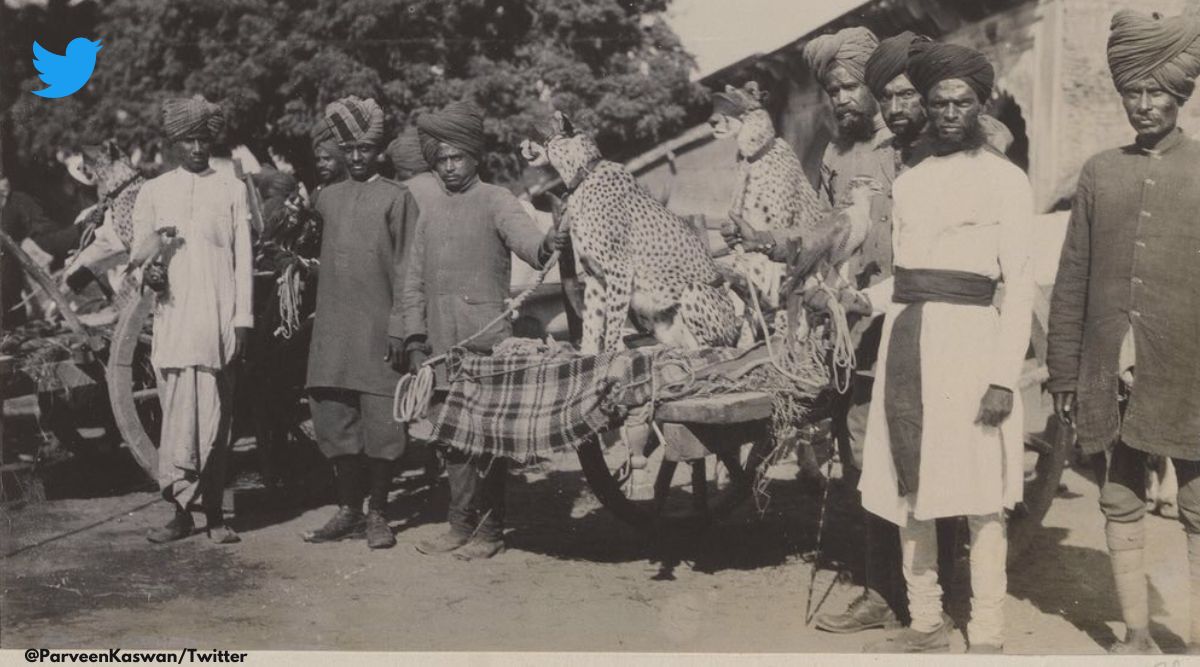 The relocation of eight cheetah’s from Namibia to India is the first time in the world that a large carnivore will be relocated from one continent to another.
Seventy years after it was officially declared extinct, cheetahs are being reintroduced in India as part of the government’s Rs 90-crore Project Cheetah endeavour.
As Prime Minister Narendra Modi released eight African cheetahs (five females and three males) from Namibia into quarantine enclosures in Madhya Pradesh’s Kuno National Park on Saturday, a Twitter thread explaining what led to the extinction of cheetahs in India is going viral.
When #Cheetah are coming back to #India. A look at how the last of the lots were hunted, maimed and domesticated for hunting parties. Video made in 1939. 1/n pic.twitter.com/obUbuZoNv5
— Parveen Kaswan, IFS (@ParveenKaswan) September 16, 2022
Not only cheetah but most of the charismatic animals were hunted in those days by kings and britishers. Until the Wildlife Protection Act 1972 was passed it was very late. Cheetah were already extinct from India. Footage is archive of Wilderness Films India Ltd. 3/3 pic.twitter.com/tlX46F4EXo
— Parveen Kaswan, IFS (@ParveenKaswan) September 16, 2022
A Cheetah in #India, which was used for hunting. From the archives of Prince of Wales Tour of India in 1875-76. A species never go extinct instantly. It takes time and special efforts. Efforts in negative sense. pic.twitter.com/9aM6z1t2pH
— Parveen Kaswan, IFS (@ParveenKaswan) September 17, 2022
And then the last lot of cheetah. 3 cheetah hunted by King of Koriya (Chhattisgarh) in 1947. By 1952 government of India declared then extinct. The first step of species extinction in local population extinction. Many are facing now in India. Hope we will pay attention to them. pic.twitter.com/DSRxs17uBW
— Parveen Kaswan, IFS (@ParveenKaswan) September 17, 2022
Most of Indian wildlife was destroyed by British officers for their hunting pleasure, and Indian rulers abetted them too for their own show-off. Arrival of guns with Britishers expedited extinction of many Indian wild animals like cheetahs once found in abundance. 😑😔
— Аnkit🇮🇳 (@icarus_ak) September 16, 2022
Personally I think gifting animals to each other on birthdays isn’t a great idea at all. It involves removing the animal from its familiar habitat and pushing it into unknown territory and captivity. Why is the question I ask.
— @onwingsoffire (@TalesofIndia1) September 17, 2022
Thank you for sharing Sir. We are paying the price now for the atrocities conducted in the past by upper strata of society on human and animal lives. Hope we still learn to live and respect all living being.
— Pankaj Raj Pipariya (@PankajPipariya) September 17, 2022
So naive and innocent animals these! Made my eyes tear up looking at what they went through. Sad really sad.
— Vishwas Acharya (विश्वास आचार्यः, ವಿಶ್ವಾಸ ಆಚಾರ್ಯ ) (@VishwasAcharyaN) September 16, 2022
राजा महाराजा ने अपने अय्याशी के लिए एक सुंदर जीव को भारत से लुप्त कर दिया
— Ravi Shankar Singh (@ravishankar67) September 17, 2022
This is so heart breaking. I hope the Cheetas are treated well this time.
— Giggly 😬 (@always_giggly) September 17, 2022
While sharing archival footage that shows how cheetahs were domesticated in India, Parveen Kaswan, an Indian Forest Services officer, wrote, “Historical record suggests cheetah were in least conflict with humans. Rather they were domesticated and used by hunting parties widely. Even some used to call them ‘hunting leopards’. 2/n”
In further tweets, he explained how cheetahs, once widespread in India, were pushed to extinction by recreational hunting.
Paswan also shared an 1879 painting that shows cheetahs and lynxes being chained like pets on charpais (cots) in the middle of human settlements in Alwar, Rajasthan. Commenting on this thread, a Twitter user wrote, “Most of Indian wildlife was destroyed by British officers for their hunting pleasure, and Indian rulers abetted them too for their own show-off. Arrival of guns with Britishers expedited extinction of many Indian wild animals like cheetahs once found in abundance. 😑😔”.
Another person wrote, “Thank you for sharing Sir. We are paying the price now for the atrocities conducted in the past by upper strata of society on human and animal lives. Hope we still learn to live and respect all living being.”