5 min read
© IE Online Media Services Pvt Ltd



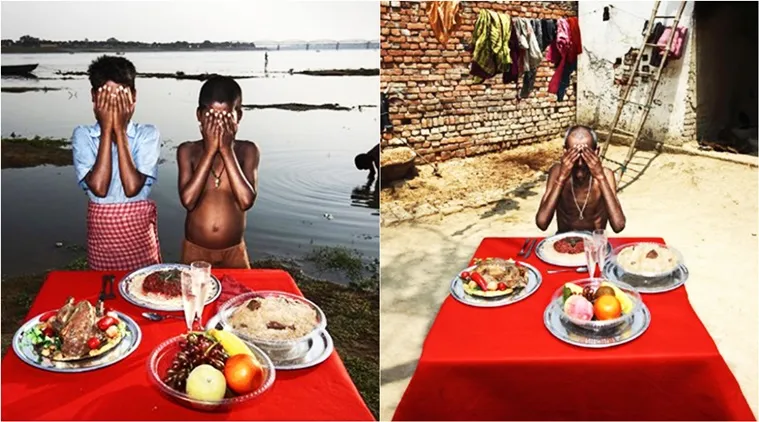 The Italian photographer took the pictures in states like Uttar Pradesh and Madhya Pradesh, which he claimed are “two of the poorest states in India.”(Source: World Press Photo/Instagram)
An award-winning Italian freelance photographer’s depiction of poverty and hunger in India triggered sharp reactions on the Internet. Alessio Mamo shared his photo series on World Press Photo’s Instagram handle. The series shows visibly malnourished people with their faces covered by hands in front of, what Mamo explained, was a table that he brought “and some fake food”. He then “told people to dream about some food that they would like to find on their table.” He shared his work on Instagram over a week’s time, during the course of which this particular series of pictures generated a massive outrage. Mamo took the pictures in Uttar Pradesh and Madhya Pradesh, and claimed that these “two states are the poorest in India.”
These are his pictures that are stirring up the Internet.
Here are some of the comments they garnered.
 (Source: World Press Photo/Instagram)
 (Source: World Press Photo/Instagram)
 (Source: World Press Photo/Instagram)
Mamo’s work received severe backlash even from renowned photographers and editors across the world. Many called his work exploitative and insensitive, along with terming it “poverty porn”.
Wow, this is tasteless and crass. From photographer @alessiomamo: “I brought with me a table and some fake food, and I told people to dream about some food that they would like to find on their table.” https://t.co/kXHa5Tv9rv pic.twitter.com/eeZXUlNMak
— Melissa Lyttle (@melissalyttle) July 22, 2018
1/This was a very badly-thought concept, one that follows the many “here’s all the food a kid eats in a week” concept we see all the time. But this one turned exploitative. It rightly should be criticized ! The work should never have been produced.
— olivierclaurent (@olivierclaurent) July 23, 2018
@WorldPressPhoto before you hand off you IG feed to former award winners – take a look at their work and screen for exploitation and cruelty.
“I brought with me a table and some fake food, and I told people to dream about some food that they would like to find on their table.” pic.twitter.com/eOfUZY82LJ
— Kainaz Amaria (@kainazamaria) July 22, 2018
This photographer brought his own fake food to put in front of these starving children in India. He asked them to dream about what kind of food they wanted to put on the table. This is an example of #journalism with no moral compass. @WorldPressPhoto why are you supporting this? pic.twitter.com/4hmDzSJO45
— Lauren Wolfe (@Wolfe321) July 23, 2018
How *not* to photograph people who have less money than you, on full display at @WorldPressPhoto’s Instagram today. World Press Photo is one of the world’s most well-known photo organizations, but economically disadvantaged humans are not props. #povertyporn #telltheirstories pic.twitter.com/MXtMVcabie
— Shannon Sims (@shannongsims) July 23, 2018
This is the text he shared along with his photos on the handle.
“These photographs are from Uttar Pradesh and Madhya Pradesh two of the poorest states of India. From the series “Dreaming Food”, a conceptual project about hunger issue in India.
⠀⠀⠀⠀⠀⠀⠀⠀⠀
My name is Alessio Mamo (@alessio_mamo) an Italian freelance photographer based in Catania, Sicily. In 2008 I began my career in photojournalism focusing on contemporary social, political and economic issues. I extensively cover issues related to refugee displacement and migration starting in Sicily, and extending most recently to the Middle East. I was awarded 2nd prize in the People Singles category of #WPPh2018 and this week I’m taking over World Press Photo’s Instagram account.
⠀⠀⠀⠀⠀⠀⠀⠀⠀
Despite economic growth, a majority of the Indian population still lives in extreme poverty and disease. Behind India’s new-found economic strength are 300 million poor people who live on less than $1 per day. Government figures may indicate a reduction in poverty. But the truth is, with increasing global food prices, poverty is spreading everywhere like a swarm of locusts. These pictures are taken in rural areas where conditions are worse than in the cities and where close to 70% of India’s population reside today. Statistics show that 2.1 million children under 5 years old die of malnutrition annually. The idea of this project was born after reading the statistics of how much food is thrown away in the West, especially during Christmas time. I brought with me a table and some fake food, and I told people to dream about some food that they would like to find on their table.”
He won the second prize at the World Press Photo of the Year Awards 2018 in the People category for his photo of an 11-year-old victim of a missile explosion in Iraq’s Kirkuk.
This week #WPPh2018 Photo Contest winner @alessio_mamo takes over our Instagram feed! Alessio was awarded 2nd prize in the People Singles category, for this picture of Manal. Check the feed for more: https://t.co/R1k6mFF5IC pic.twitter.com/F9LfxSEDVE
— World Press Photo (@WorldPressPhoto) July 16, 2018
Tell us what you think of his curation in the comments’ section below.