This is an archive article published on January 11, 2023
With 900 million paid subscribers, Apple’s services gamble appears to have paid off
With iPhone sales peaking in many matured markets and the company struggling with supply chain issues in China, the service segment has never been more important for Apple.
New Delhi | Updated: January 12, 2023 11:40 AM IST
5 min read
Whatsapp
twitter
Facebook
Reddit
The App Store remains the most important component in driving Apple's services business. (Image credit: App[le)
Listen to this article
With 900 million paid subscribers, Apple’s services gamble appears to have paid off
x
00:00
1x1.5x1.8x
Apple now has over 900 million subscribers for its popular services, including Apple Music and Apple TV+. The figure is astounding, but more than that, it gives a sense of how quickly Apple’s services business has grown. Amassing 900 million paid users across its services is a reflection that Apple isn’t just about hardware, an image Cupertino has been trying to break for a long time. With Apple gearing up to report for the first fiscal quarter of 2023 next month, the news of its services business reaching 900 million paid subscribers might help it focus on the long-term strategy of increasing service bundles and tightly integrating services with its hardware products.
More users subscribing to Apple services
Under CEO Tim Cook, Apple’s focus in recent years is shifting. With iPhone sales peaking in many mature markets and the company struggling with supply chain issues in China, the service segment has never been more important for Apple. Its service business, which includes marquee offerings Apple Music, iCloud+ and Apple Arcade, brought in $78 billion in fiscal 2022. In fact, Apple’s services arm is bringing more revenue per quarter than its other business segments – the Mac, iPad and the Wearables, Home and Accessories unit, with the exception of the iPhone.
In a press note on Wednesday, Apple highlighted how its services have grown quickly in a short time and are only getting better. The oldest of them, Apple Music (launched in 2015, after Apple bought and rebranded Beats), boasts 100 million songs. Although the music streaming service is reportedly trailing Spotify in paid subscribers count, Apple regularly adds new features that keep iPhone users hooked to the service. Another service that is gaining attention is Apple’s video streaming service, Apple TV+, which won an Academy Award for Best Picture for its movie “CODA.” Apple TV+ competes with Netflix and Disney+ in the cut-throat streaming market.
Apple now has 900 million paid subscriptions across services. (Image via Apple)
One Apple service that is underrated, but has a lot of potential to become big in the future, is Apple Arcade, a subscription-based gaming service. Because of its broad market appeal and lower entry point, Apple Arcade has become a hub for fun and casual games. Although the gaming service does not compete directly with Nintendo, Xbox and PlayStation, Apple Arcade has started to look like a breath of fresh air among other gaming services and platforms.
But the services business has its own challenges
The services business may be the second largest revenue contributor after the iPhone, but Apple’s fastest-growing unit faces multiple challenges. It’s entirely tied to the App Store. The largest component of the services business is the App Store, but its growth has started to slow down. Apple’s services segment grew by just 14 per cent last year, down from about 27 per cent growth in fiscal 2021. If the growth from the App Store starts to stall, it will impact Apple’s service business in the long run.
Apple, which operates the App Store – the gateway to millions of apps and games for iPhone and iPad users, faces lawsuits and antitrust charges globally due to its market power. The European Union, which has become the center of global regulatory crackdown against Big Tech, has accused Apple of stifling competition. The UK antitrust regulator, the CMA, recently started an investigation into Apple and Google over mobile practices.
The Apple iPhone 14 is seen in this photo. (Image credit: Anuj Bhatia/Indian Express)
Cupertino, however, continues to reject charges of monopolistic practices. Instead, it says the App Store continues to thrive, with developers benefiting the most from the mobile economy. The company noted that developers selling digital goods and services on the App Store have earned more than $320 billion since the launch of the platform, up from $260 billion last year. In 2021, Apple announced the expansion of its App Store pricing system to offer developers access to over 700 additional price points, a sign that the company is losing its tight grip on software distribution and payments on the App Store.
Story continues below this ad
For Apple, the services segment is a high-margin business free from the complexities of supply chain problems, which have hammered its growth in recent months. App Store, despite signs of slowing down, still attracts more than 650 million visitors across 175 regions each week.
But, like other companies, Apple is also vulnerable to an economic slowdown. A slowing economy, currency headwinds, and high inflation could slow subscriber growth, as fewer people have money to continue paying for the services. Apple’s reliance on the iPhone, which accounts for two-thirds of sales, could threaten the growth of its services business. Apple’s services are tied to the iPhone, iPad and Mac – and growth in those devices has begun to slow. Apple’s unwillingness to make these services grow beyond its devices and bring them on rival platforms is hurting the growth potential of its services business.
Anuj Bhatia is a seasoned personal technology writer at indianexpress.com with a career spanning over a decade. Active in the domain since 2011, he has established himself as a distinct voice in tech journalism, specializing in long-form narratives that bridge the gap between complex innovation and consumer lifestyle.
Experience & Career: Anuj has been a key contributor to The Indian Express since late 2016. Prior to his current tenure, he served as a Senior Tech Writer at My Mobile magazine and held a role as a reviewer and tech writer at Gizbot. His professional trajectory reflects a rigorous commitment to technology reporting, backed by a postgraduate degree from Banaras Hindu University.
Expertise & Focus Areas: Anuj’s reporting covers the spectrum of personal technology, characterized by a unique blend of modern analysis and historical context. His key focus areas include:
Core Technology: Comprehensive coverage of smartphones, personal computers, apps, and lifestyle tech.
Deep-Dive Narratives: Specializes in composing longer-form feature articles and explainers that explore the intersection of history, technology, and popular culture.
Global & Local Scope: Reports extensively on major international product launches from industry titans like Apple and Google, while simultaneously covering the ecosystem of indie and home-grown tech startups.
Niche Interests: A dedicated focus on vintage technology and retro gaming, offering readers a nostalgic yet analytical perspective on the evolution of tech.
Authoritativeness & Trust
Anuj is a trusted voice in the industry, recognized for his ability to de-jargonize trending topics and provide context to rapid technological advancements. His authority is reinforced by his on-ground presence at major international tech conferences and his nuanced approach to product reviews. By balancing coverage of the world's most valuable tech brands with emerging startups, he offers a holistic and objective view of the global technology landscape.
Find all stories by Anuj Bhatia here.
You can find Anuj on Linkedin. ... Read More


 5 min read


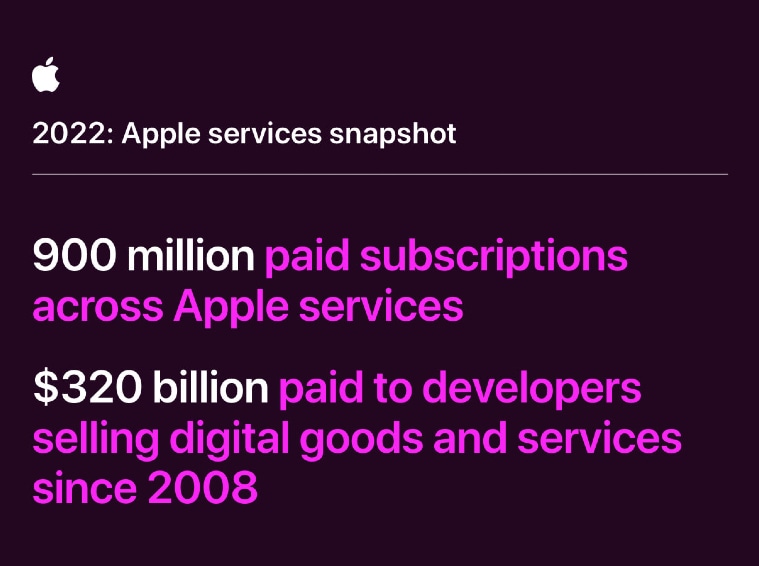 Apple now has 900 million paid subscriptions across services. (Image via Apple)
 The Apple iPhone 14 is seen in this photo. (Image credit: Anuj Bhatia/