3 min read
© IE Online Media Services Pvt Ltd



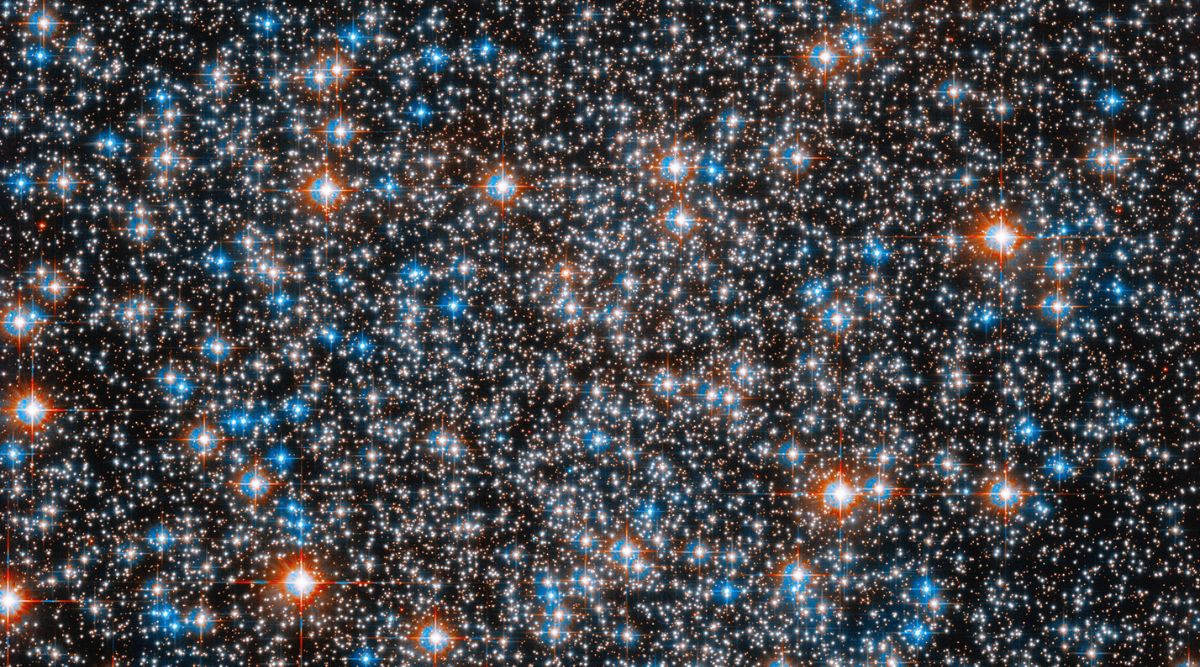 Messier 55 is an big, bright and extremely loose “globular cluster.” (Image credit: NASA)
Messier 55 is a big, bright and extremely loose “globular cluster.” It is known by many names. It is sometimes referred to as M 55 and is also known as NGC 6809. It is the “globular cluster” that you see in the above image taken by NASA’s James Webb Space Telescope.
Globular clusters are stable swarms of stars that hold tens of thousands or even millions of stars together, tightly bound. All the stars in globular clusters are trapped there due to their mutual gravitational attraction.
They are often much larger than open clusters, and their strong, mutual gravitational attraction gives them their regular spherical shape, which is where they get their name from.
According to the book Illustrated Guide to Astronomical Wonders, astronomer Abbe Nicholas Louis de la Caille discovered and catalogued Messier 55 on June 15, 1752. But even famous astronomer Charles Messier, after whom Messier objects like M 55 are named, had a difficult time locating it.
According to NASA, this is because despite Messier 55 being large and quite bright, it lacks a dense core and many of its stars are quite faint, making it hard to locate the cluster unless conditions are optimal.
Also, for observers in sitting in Northern locations of the planet, the globular cluster sits low in the sky. This means that it is obscured by a thicker layer of the atmosphere, along with water vapour and light pollution. This is the reason that Messier had a hard time viewing the cluster from his Paris observatory. When he finally catalogued it on July 24, 1778, he wrote that “its light is even and does not appear to contain any star.”
In this Webb image, the cluster may not look the “globular” part,” but that is because it is zoomed in on one particular portion of the cluster. The cluster as a whole actually appears spherical because of the aforementioned mutual attraction of the stars.
M 55 is about 20,000 light-years away from us in the direction of the constellation Sagitarrius, and it has a diameter of about 100 light-years. The globular cluster contains about 100,000 stars, among which, 55 are variable stars whose brightness changes.
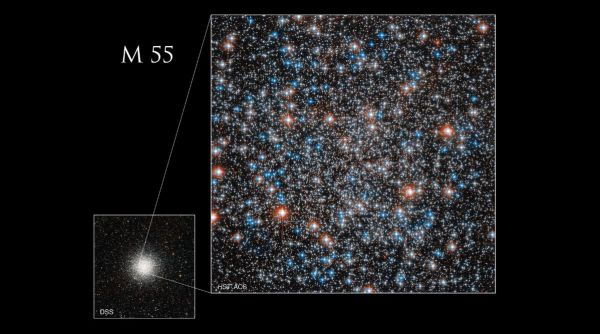 The image taken by the smaller ground-based Digital Sky Survey (inset) shows the section of the sky pictured in Webb’s image. (Image credit: NASA)
If you have skies with low pollution, you can view Messier 55 through binoculars, but it will only appear as a hazy round patch. Small telescopes can resolve some of the individual stars in M55 while telescopes with larger apertures will pick out even the low-magnitude stars easily.