2 min read
© IE Online Media Services Pvt Ltd



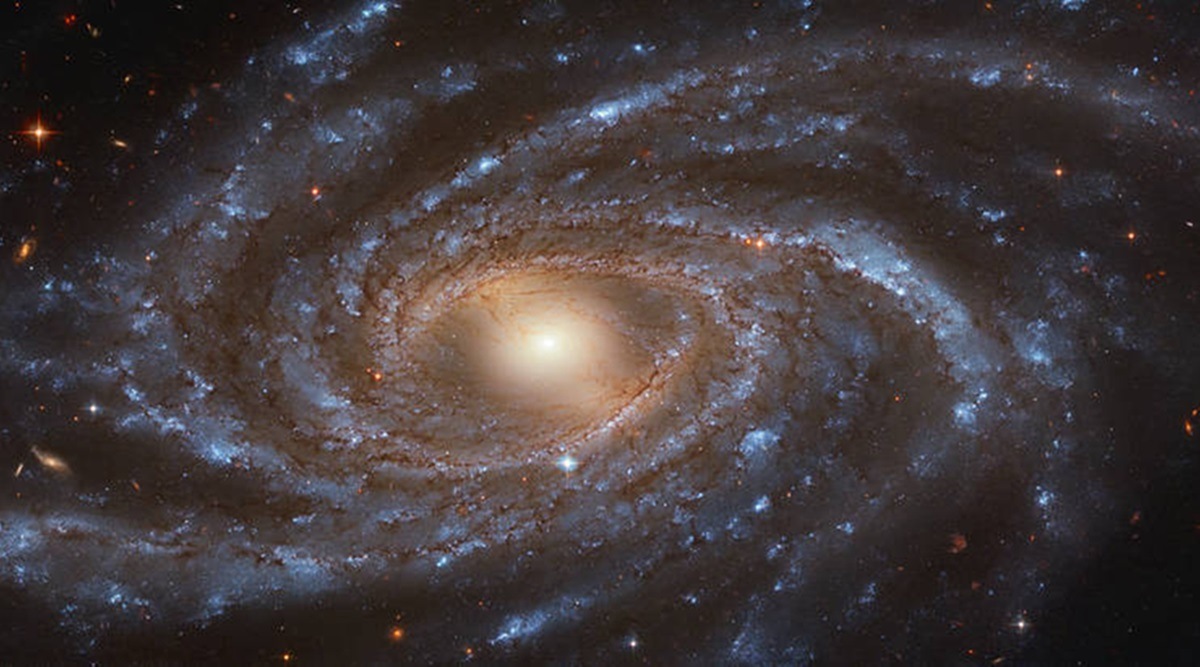 NGC 2336 galaxy captured by Hubble telescope (Image credit: ESA/Hubble & NASA)
National Aeronautics and Space Administration (NASA) on Monday shared the stunning image of a galaxy located approximately 100 million light-years away from us. The image shows the spiral arms of the galaxy glittering with young stars. There is a visible blue night in these stars. In the centre, it is dominated by older stars, hence the reddish colour.
The NGC 2336 which was discovered more than a century ago in 1876 by German astronomer Wilhelm Tempel can be seen in a high-resolution image. Located in the northern constellation of Camelopardalis (the Giraffe), the galaxy stretches across 2,00,000 light-years.
View this post on Instagram
In 1876, the Milky Way-like galaxy was discovered by Tempel using an 11-inch telescope. 111 years later, the massive galaxy experienced a Type-la supernova, the only observed supernova in the galaxy.
Comparing Hubble telescope to the old Tempel, it is nearly 10 times in size with the main mirror measuring 7.9 feet. The Hubble telescope was launched in April 1990. Since then, it has been able to capture mesmerising images of planets, meteorites, supernovas, galaxies and other celestial objects and events far away. The findings have also helped astronomers study and understand the history of the universe.
Recently, NASA successfully landed the Perseverance rover on Mars’ Jezero crater. Since its landing, the advanced rover has been sending images and videos captured by multiple cameras mounted on it. Recently, NASA confirmed that Perseverance performed its first test drive on the rough terrain of the Jezero crater. The drive lasted 33 minutes in which it covered a distance of six and a half metres.