Scientists may have figured out why Jupiter’s stripes change colour
One of the greatest mysteries of Jupiter was that the stripes that were visible on its surface often shifted and changed. Now, scientists believe they have figured out why.
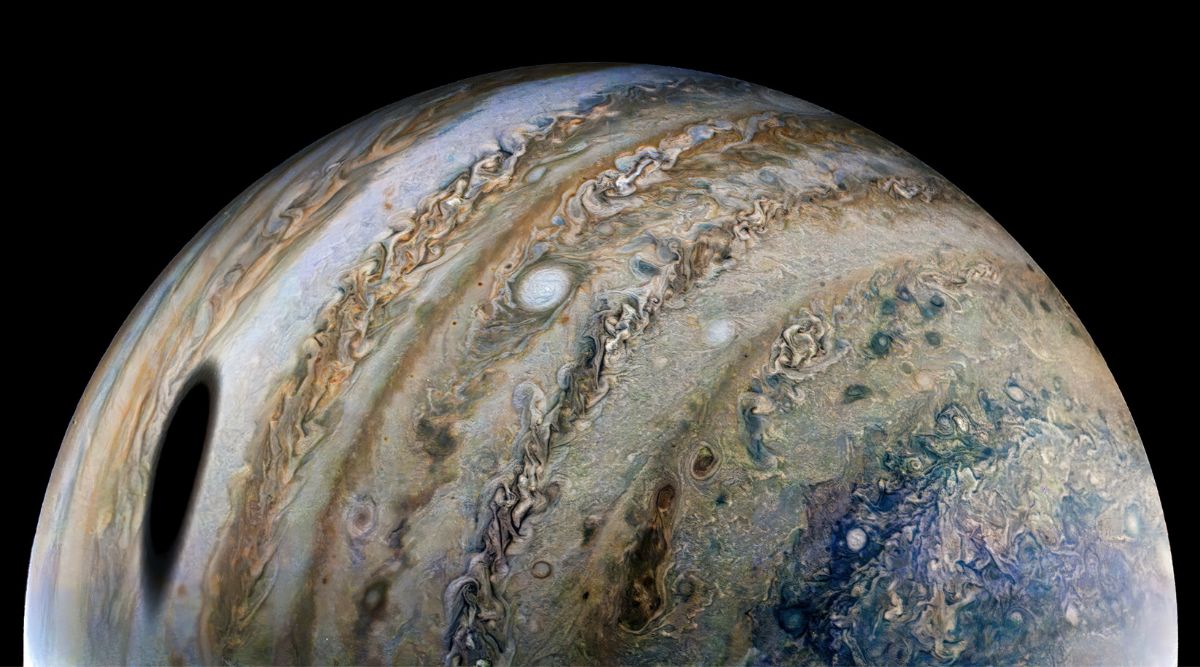
An image of Jupiter, with Ganymede's shadow on it, taken by NASA's Juno mission/ (Image credit: NASA)
Listen to this articleYour browser does not support the audio element.
Most images of Jupiter prominently feature many of the gas giant’s characteristic stripes. Apart from its giant red dot, one of the most fascinating features of the planet’s surface is that those stripes sometimes move and change, which scientists have not been able to explain until now.
But now, thanks to a new discovery which was made in part due to new information about Jupiter’s magnetic field, researchers think they have an explanation for why it happens, according to the University of Leeds.
“If you look at Jupiter through a telescope, you see the stripes, which go round the equator along the lines of latitude. There are dark and light belts that occur, and if you look a little bit more closely, you can see clouds zipping around carried by extraordinarily strong easterly and westerly winds. Near the equator, the wind blows eastward but as you change latitude a bit, either north or south, it goes westward. And then if you move a little bit further away it goes eastward again. This alternating pattern of eastward and westward winds is quite different from weather on Earth,” said Chris Jones, co-author of a study on the subject, in a press statement.
You’ve Read Your Free Stories For Now
Sign up and keep reading more stories that matter to you.
Every four of five years, things change on the planet, according to Jones. Sometimes, the colours of the belts can change, and scientists have sometimes observed global upheavals in the weather patterns. Why this happens has largely remained a mystery.
There is already evidence that points to this change in appearance being linked to infrared variations about 50 kilometres below Jupiter’s surface. But the new research by Jones and others shows that these variations could be caused by waves produced by the gas giant’s magnetic field, deep within the planet’s interior.
The researchers used data gathered by NASA’s Juno mission to the planet and they were able to monitor and calculate changes in its magnetic field. The researchers found that the planet’s magnetic field’s oscillations corresponded to the periods of infrared radiation from its gases.