2 min read
© IE Online Media Services Pvt Ltd



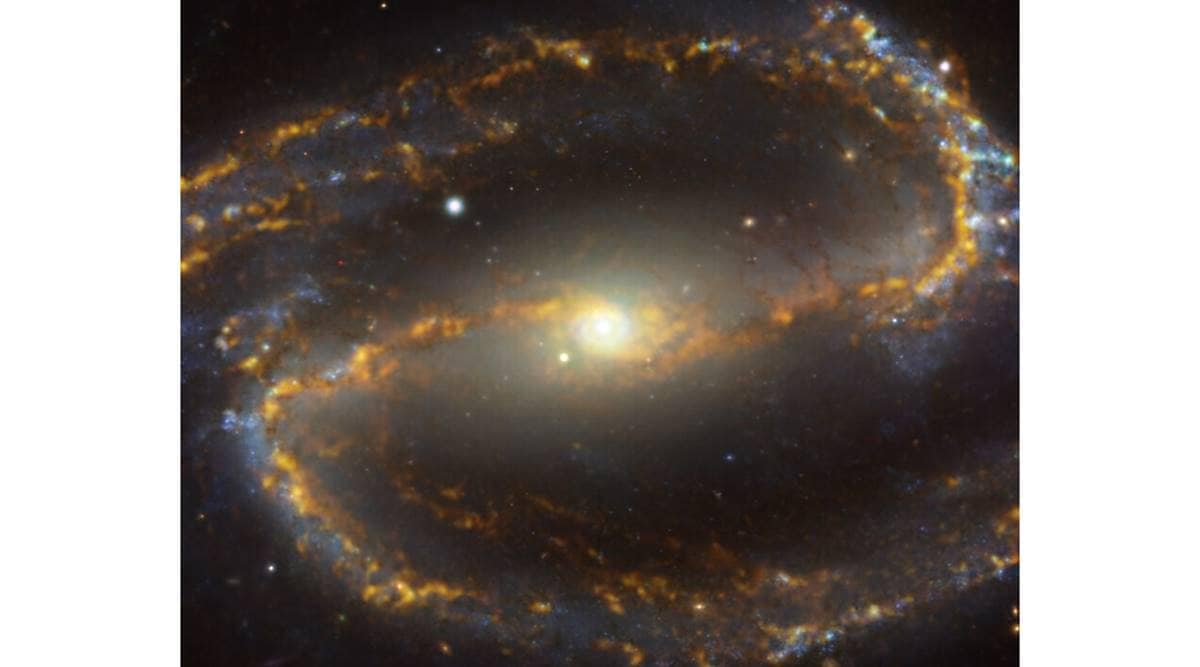 The NGC 1300 galaxy is located approximately 61 million light-years from Earth in the constellation Eridanus. (ESO/ALMA (ESO/NAOJ/NRAO)/PHANGS)
The European Southern Observatory’s picture of this week looks like a mouthwatering caramel nest. The image is of the NGC 1300 spiral galaxy, located about 61 million light-years from Earth. It was created using data collected by the Atacama Large Millimeter/submillimeter Array (ALMA) and the Very Large Telescope (VLT) located in Chile.
The image shows a bar of stars and gas along with a central ring which shows an intense star formation.
The caramel swirl in this Picture of the Week is the spiral galaxy NGC1300. In blue we see stars captured with our VLT, and in gold molecular gas imaged by @almaobs . What’s the connection between both?
Find out: https://t.co/sdvQzAVkaP
Credit: @ESO /ALMA (ESO/NAOJ/NRAO)/PHANGS pic.twitter.com/27aFVgiS4W
— ESO (@ESO) January 10, 2022
“The image is a combination of observations conducted at different colours — or wavelengths — of light. The golden caramel glow corresponds to clouds of molecular gas, the raw material out of which stars form,” said ESO in a release.
The images were taken as a part of the Physics at High Angular resolution in Nearby GalaxieS (PHANGS) project. The project aims to make high-resolution observations of nearby galaxies using several telescopes, including the ALMA, VLT, Hubble and the newly-launched James Webb Space Telescope.
The different telescopes will help observe the nearby galaxies at different wavelengths. “Different wavelengths can reveal a multitude of secrets about a galaxy and by comparing them astronomers are able to study what activates, boosts, or hinders the birth of new stars,” adds the release.