4 min read
© IE Online Media Services Pvt Ltd



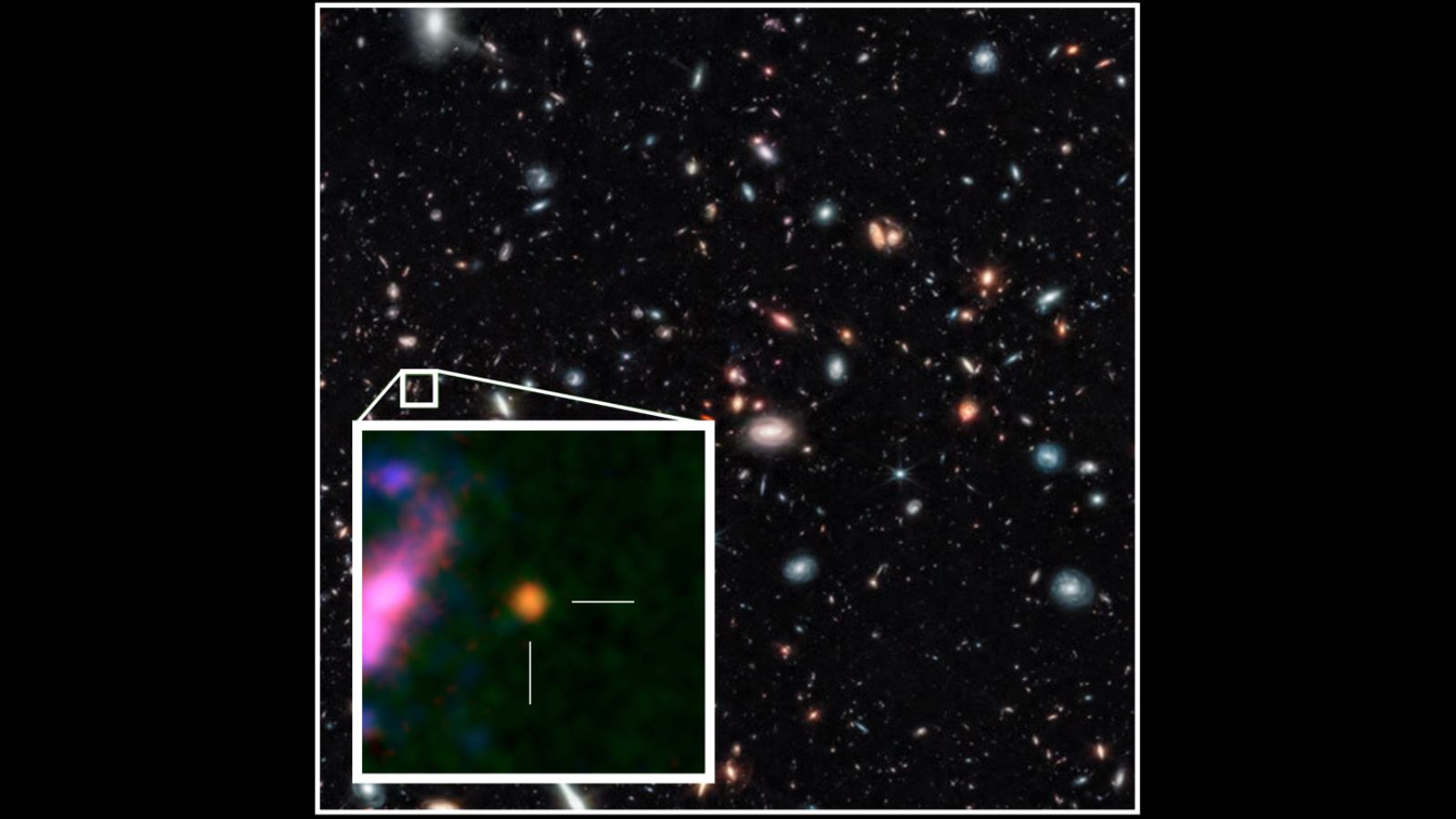 Nevertheless, Zavala pointed out that GHZ2 does not exhibit certain classic indicators of active galactic nucleus activity, implying that star formation might primarily fuel the galaxy, potentially via supermassive stars with masses significantly exceeding that of the sun, or through atypical star formation processes. (Image: Royal Astronomical Society)
Astronomers using the James Webb Space Telescope (JWST) may have discovered the most distant supermassive black hole ever. The massive object in the GHZ2 galaxy is located so far away that researchers see it as it was just 350 million years after the Big Bang.
The scientists used observations from JWST’s Near Infrared Spectrograph and Mid-Infrared Instrument in their study, which was published on the preprint server arXiv on November 4 but has not yet undergone peer review. These devices have a broad wavelength range and are capable of detecting ultraviolet and optical light that was initially released by a far-off galaxy but has been stretched into the infrared by the universe’s expansion.
“GHZ2 exists at a time when the universe was extremely young, leaving relatively little time for a supermassive black hole and its host galaxy to grow together,” the study’s lead author, Oscar Chavez Ortiz, a doctoral candidate in the Department of Astronomy at the University of Texas at Austin, wrote in an email to Live Science.
“In the local universe, black holes and galaxies clearly coevolve, but detecting such a system at this early epoch raises questions about how supermassive black holes gain mass so quickly.”
According to Ortiz, there are two basic theories as to how these supermassive black holes form so early: either they are “light seeds” that grow incredibly quickly, or they are “heavy seeds” that begin with tremendous masses, giving them an advantage.
Since its discovery in 2022, GHZ2 has garnered attention from astronomers using the JWST due to its unique spectrum featuring intense “emission lines.” These lines, indicative of energised atoms or ions, provide insights into the energetic processes underlying GHZ2.
Jorge Zavala, an assistant professor at the University of Massachusetts Amherst, noted that the high-ionisation lines observed require significant energy to form, which challenges the current understanding of gas ionisation derived from nearby star-forming regions. Such intense lines are characteristic of active galactic nuclei (AGN), which are powered by actively feeding black holes. A pivotal finding was the C IV λ1548 emission line from triply ionised carbon, suggesting an extreme radiation field beyond what can be achieved by stars alone. This implication points to GHZ2 potentially hosting an actively feeding black hole, prompting further investigation by the researchers.
Researchers faced the challenge of understanding the unique behaviour of GHZ2, an atypical galaxy, by developing detailed models to assess the contributions of both its stars and the active galactic nucleus to the galaxy’s emitted light. Extensive testing and refinement of these models were necessary to accurately depict the galaxy’s properties.
Their findings indicate that although the spectral lines in visible light could be attributed solely to star formation, the notably strong carbon line necessitated the existence of an active galactic nucleus, suggesting that a supermassive black hole plays a role in the galaxy’s luminosity. Nevertheless, Zavala pointed out that GHZ2 does not exhibit certain classic indicators of active galactic nucleus activity, implying that star formation might primarily fuel the galaxy, potentially via supermassive stars with masses significantly exceeding that of the sun, or through atypical star formation processes. Another hypothesis is that the galaxy’s light could arise from a mix of standard and exotic sources, including supermassive stars or an active galactic nucleus.
To further validate the presence of active galactic nucleus activity, the researchers intend to acquire additional observations from the JWST to obtain higher-resolution spectra of specific emission lines. Enhanced data sensitivity will also be sought from the Atacama Large Millimetre/Submillimeter Array, specifically targeting spectral lines in the far-infrared region.
If active galactic nucleus activity in GHZ2 is confirmed, it would represent the most distant supermassive black hole documented to date. Such a detection provides a rare opportunity to investigate competing models of black hole formation and growth, particularly the “light seed” and “heavy seed” theories, occurring a few hundred million years post-Big Bang.