3 min read
© IE Online Media Services Pvt Ltd



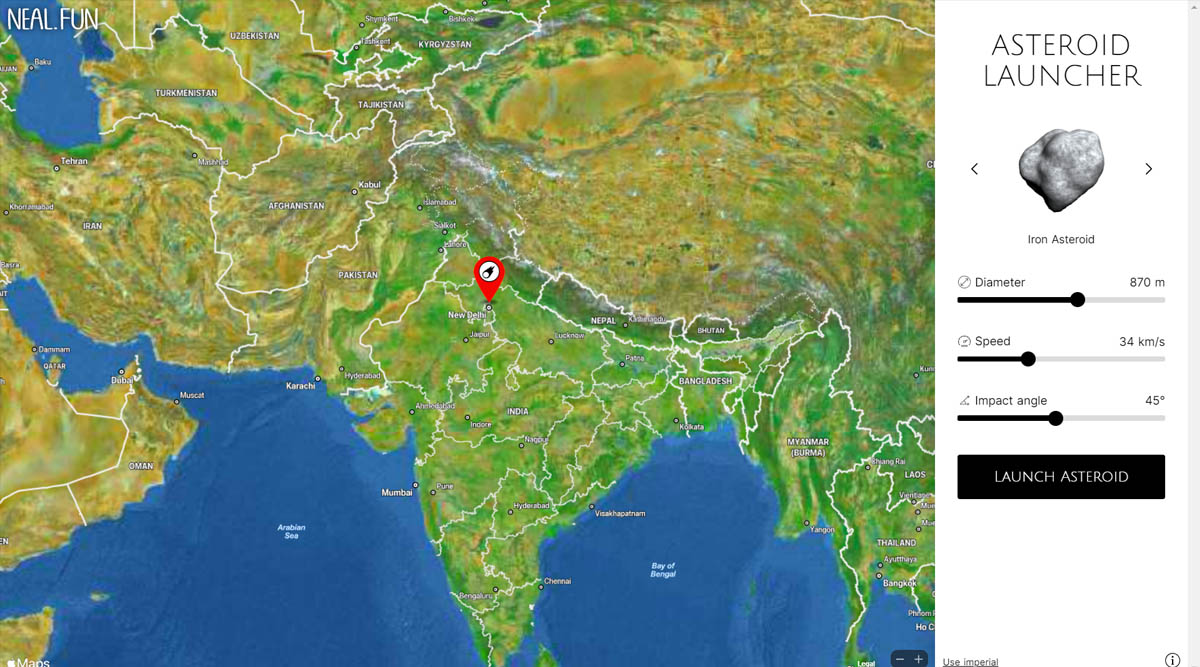 The Asteroid Launcher web app allows user to select the properties of the asteroid, including size and composition. (Image credit: Asteroid Launcher / screenshot)
 Have you ever wondered what would happen if your home city, state or region were to be hit by a massive asteroid? Well, a new web called Asteroid Launcher will help you understand exactly what will happen in a situation like that.
The new web app lets people see what will be the effects of an asteroid hitting any part of the Earth. It was created by programmer Neal Agarwal, who has created other online apps like “The Deep Sea,” an app that lets users visualise what sort of creatures can be encountered at different depths of the ocean and “Spend Bill Gates’ Money” that lets users visualise how much money billionaire Bill Gates has.
All you need to do to use the asteroid launcher is to visit the site neal.fun/asteroid-launcher. Once you load the web app, you will be greeted by a world map and a side panel where you can select the asteroid’s properties.
After you select the location where the asteroid will crash, you can choose the properties of the asteroid, including size, composition, speed and impact angle. After that, you need to hit the “Launch Asteroid” button. After you do this, the app will measure the consequences of the asteroid strike.
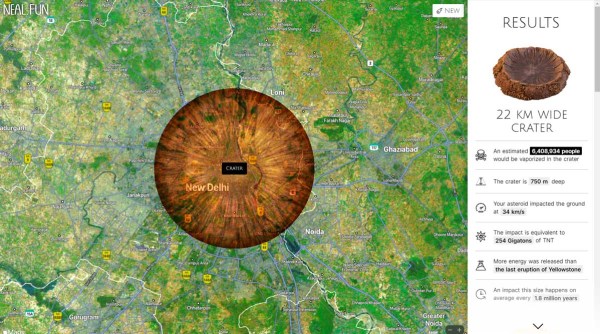 Once you select your target location and asteroid properties, the app will tell you about the potential consequences of an asteroid strike. (Image credit: Asteroid Launcer / Screenshot)
For example, if you simulate an 870-metre-wide asteroid striking New Delhi at a speed of 34 kilometres per second at an angle of 45 degrees, it will result in an impact that releases the equivalent of 254 gigatons of TNT, creating a 22-kilometre wide crater.
Playing with the app might have you worried about the chances of an asteroid striking the Earth and what the consequences will be, you don’t need to worry about that for another hundred years as scientists have ruled out the possibility of asteroids posing a threat to the Earth for the next hundred years.
And if and when that happens, there is a chance that we will already have a mitigation strategy in place. In September 2022, NASA successfully crashed the DART spacecraft into the asteroid Dimorphos, in the first demonstration of a planetary defence technique against an asteroid.