


Tags:


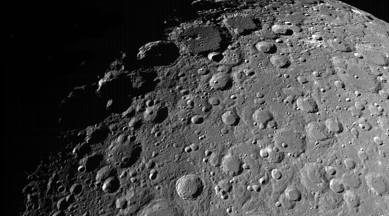
The moon might be having crashed fragments and remnants of Venusian rocks on its surface. A new study conducted by Yale University researchers Samuel Cabot and Gregory Laughlin suggests that asteroids and comets hitting the surface of Venus might have dislodged as many as 10 billion pieces of rocks towards the Earth’s orbit.
Further, the research claims that these rocks might have moved towards the intersection point of the orbits of the Earth and the Moon. Eventually, some of them might have got attracted towards the surface of the moon due to its gravity while on the Earth, these rocks might have been buried deep inside its surface due to rigorous geological activities or have been disappeared due to changing atmospheric conditions.


Both the scientists in their paper which will be published in Planetary Science Journal have cited that asteroids hitting Venus moves at a greater speed as compared to those moving towards Earth. It is followed by ejection of large amount of rocks from the Venusian surface towards the vicinity of Earth and Moon. The researchers have also said that these rocks land on Moon as Venusian Meteorites.
Moreover, Professor Laughlin hopes that these ancient fragments of Venusian meteorites will be having crucial insight and information pertaining to history of Venus, planetary sciences and that of asteroids and comets. There are chemical tests that can decipher the origin of rocks on the Moon as distinct ratio of elements and isotopes throws light upon the origin of every planet in Solar System.


