Premium
This is an archive article published on November 4, 2023

How to combat misinformation and disinformation during elections

We take a look at how misinformation and fake news spread during the run-up to an election and how it can undermine the electoral process

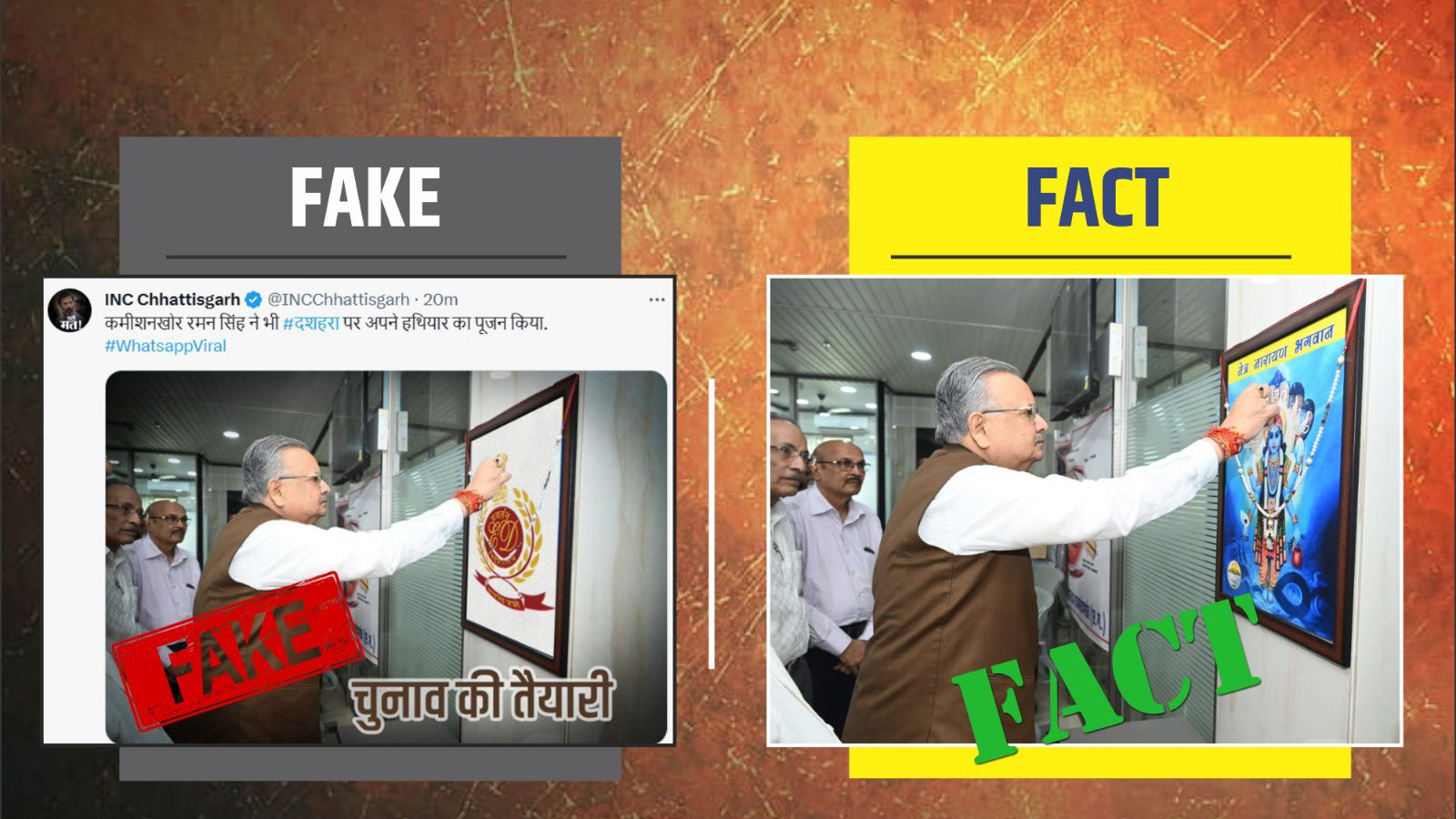
Fact vs Fiction election editionIn a social media post, Raman Singh, the ex-CM of Chhattisgarh, was seen applying tilak to a photo frame with the Enforcement Directorate (ED) logo on it. (Twitter/@drramansingh)
Listen to this article
How to combat misinformation and disinformation during elections
x
00:00
1x 1.5x 1.8x

Over 161 million people in five states — Madhya Pradesh, Chhattisgarh, Rajasthan, Telangana and Mizoram — will vote in assembly elections this month. Ahead of any election, the spread of misinformation and fake news is a challenge that needs to be tackled on priority.

Take for example a recent video of Madhya Pradesh Chief Minister Shivraj Singh Chouhan where he can be heard saying that people are upset with the BJP and that their party will face defeat this time.

On checking it was found that the video was edited, and is from a review meeting related to Prime Minister Narendra Modi’s visit to Bhopal in June. The original video has been overlaid with a fake audio.

In another social media post, Raman Singh, the former chief minister of Chhattisgarh, was seen applying tilak to a photo frame with the Enforcement Directorate (ED) logo on it. The picture was photoshopped. The real image, shared by the former CM, shows him applying tilak to a picture of God Narayan.

The above examples show how misinformation and fake news spread during the run-up to an election and how it can undermine the electoral process. A study, Industrialized disinformation 2020 global inventory of organised social media manipulation, conducted by University of Oxford in 81 countries, including India, says that 90 per cent countries have misinformation campaigns that involve pro-government and pro-party propaganda, 94 per cent of countries have misinformation campaigns that attack the opposition and mount smear campaigns, 73 per cent have misinformation campaigns that suppress participation through trolling or harassment and 49 per cent have misinformation campaigns that drive division and polarise citizens.

In 2022, social media platform X, formerly Twitter, reported that it had taken down over 11 million tweets for violating its policies on misinformation. In its 2022 Community Standards Enforcement Report, Facebook stated that it removed over 23 million pieces of content for violating its policies on misinformation.

While there are many ways to verify information, in today’s column, we will explain how the ‘Google Fact Check Explorer’ works.

Google provides a tool that allows you to search for ‘fact-check articles’ on specific topics or claims. Fact Check Explorer lets users find a fact check which has been investigated by independent organisations from around the world, in various languages on various viral social media posts.

So how does Google Fact Check Explorer work?

Enter ‘Google Fact Check Explorer’ in the Google search or use the above link.

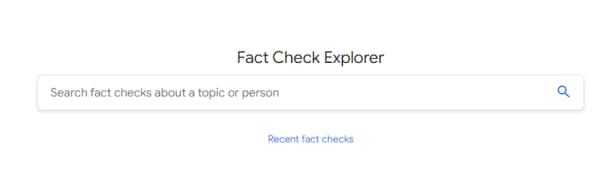
A dialogue box will appear:

Story continues below this ad
The dialogue box The Fact Checker dialogue box
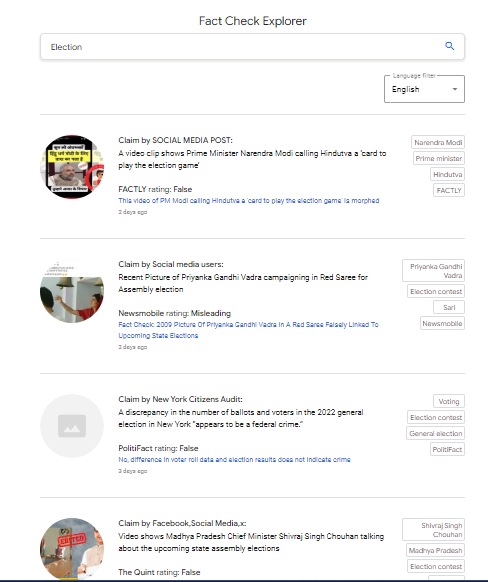
Enter a keyword related to the social media post you want to search, you will also get a language preference when you search for the relevant term.

How the Fact Check explorer works How the Fact Check explorer works

Through this tool, you can figure out whether the posts you have received on various social media platforms are true or not. Google will soon roll out a ‘search by image’ feature too. Always remember, if you are unsure about whether or not a piece of information is accurate, it is best to err on the side of caution and not share it or verify and then share it.

Ankita Deshkar is a Deputy Copy Editor and a dedicated fact-checker at The Indian Express. Based in Maharashtra, she specializes in bridging the gap between technical complexity and public understanding. With a deep focus on Cyber Law, Information Technology, and Public Safety, she leads "The Safe Side" series, where she deconstructs emerging digital threats and financial scams. Ankita is also a certified trainer for the Google News Initiative (GNI) India Training Network, specializing in online verification and the fight against misinformation. She is also an AI trainer with ADiRA (AI for Digital Readiness and Advancement) Professional Background & Expertise Role: Fact-checker & Deputy Copy Editor, The Indian Express Experience: Started working in 2016 Ankita brings a unique multidisciplinary background to her journalism, combining engineering logic with mass communication expertise. Her work often intersects regional governance, wildlife conservation, and digital rights, making her a leading voice on issues affecting Central India, particularly the Vidarbha region. Key focus areas include: Fact-Checking & Verification: As a GNI-certified trainer, she conducts workshops on debunking deepfakes, verifying viral claims, and using OSINT (Open Source Intelligence) tools. Cyber Law & IT: With postgraduate specialization in Cyber Law, she decodes the legalities of data privacy, digital fraud, and the evolving landscape of intellectual property rights. Public Safety & Health: Through her "The Safe Side" column, she provides actionable intelligence on avoiding "juice jacking," "e-SIM scams," and digital extortion. Regional Reporting: She provides on-ground coverage of high-stakes issues in Maharashtra, from Maoist surrenders in Gadchiroli to critical healthcare updates and wildlife-human conflict in Nagpur. Education & Credentials Ankita is currently pursuing her PhD in Mass Communication and Journalism, focusing on the non-verbal communication through Indian classical dance forms. Her academic foundation includes: MA in Mass Communication (RTM Nagpur University) Bachelors in Electrical Engineering (RTM Nagpur University) Post Graduate Diploma (PGTD) in Cyber Law and Information Technology Specialization in Intellectual Property Rights Recent Notable Coverage Ankita’s reportage is recognized for its investigative depth and emphasis on accountability: Cyber Security: "Lost money to a scam? Act within the 'golden hour' or risk losing it all" — A deep dive into the critical window for freezing fraudulent transactions. Public Health: "From deep coma to recovery: First fully recovered Coldrif patient discharged" — Investigating the aftermath of pharmaceutical toxins and the healthcare response. Governance & Conflict: "Gadchiroli now looks like any normal city: SP Neelotpal" — An analysis of the socio-political shift in Maoist-affected regions. Signature Beat Ankita is best known for her ability to translate "technical jargon into human stories." Whether she is explaining how AI tools like MahaCrimeOS assist the police or exposing the dire conditions of wildlife transit centres, her writing serves as a bridge between specialized knowledge and everyday safety. Contact & Follow X (Twitter): @ankita_deshkar Email: ankita.deshkar@indianexpress.com   ... Read More


Latest Comment
Post Comment
Read Comments
Advertisement
Loading Taboola...
Advertisement