16 min read
© IE Online Media Services Pvt Ltd



 Indian stock markets rebounded sharply in early morning trade on Wednesday. the markets witnessed heavy drubbing in the previous session amid buying in blue-chip bank stocks and a firm trend in Asian peers. (Reuters Photo)
In April 2025, Maharashtra Scooters traded at a 60% discount to the value of the Bajaj group stocks it holds. EID Parry’s stake in Coromandel International is worth over Rs 31,000 crore, but the entire company trades at just half that. Even Tata Investment Corp, with stakes in some of India’s best-run businesses, regularly trades at a discount to its portfolio value.
This isn’t an exception. It’s a pattern.
Across India’s listed markets, holding companies routinely trade at 40–70% discount to the value of what they own.
Why?
Because holding companies aren’t exciting, they don’t manufacture cars or launch new apps. They simply hold stakes, often in world-class businesses, but get punished for it by the market.
In this article, we dive into this paradox: Why do holding companies stay cheap even when their assets soar? When does the discount shrink—or vanish? And can retail investors turn this disconnect into long-term gain?
It is a quiet corner of the market, but sometimes, the best opportunities are the ones no one’s shouting about.
Let’s start with the basics. A holding company doesn’t make or sell anything directly. It simply owns shares of other companies—usually ones it helped create or spin off.
Think of it like a family office for a business group. It sits on valuable stakes in companies like Bajaj Auto, Coromandel International, or Bajaj Finance, and earns dividends, but doesn’t operate factories or launch consumer products itself.
Here’s where it gets interesting.
If you add up the value of everything a holding company owns—its Net Asset Value (NAV)—you would expect the stock to trade close to that number. But it almost never does. In fact, it often trades at a 40% to 70% discount.
So if a holding company owns Rs 1,000 worth of stocks, the market might only value it at Rs 300–600.
A few reasons:
● No control, no premium: Holding companies often own minority stakes in the businesses they hold. They can’t control strategy or cash flows, so the market discounts their ownership.
● Low liquidity, low interest: Many of these stocks don’t trade much. There is little news, low analyst coverage, and almost no institutional hype. That keeps retail and fund investors away.
● Tax and complexity drag: If the company were to sell its holdings, it would owe capital gains taxes. Many have complex ownership structures that make it difficult to understand who owns what.
● Poor capital allocation: Some holding companies simply sit on cash (a chunk of which is the dividends received from their holdings) or continue to reinvest within the group without generating meaningful returns. If management is not transparent or investor-friendly, markets assign a larger discount.
In short, holding companies are cheap because they are invisible, illiquid, and misunderstood.
But here’s the catch: value doesn’t disappear just because the market is ignoring it. And that’s where savvy retail investors can step in.
Just because a stock trades below its intrinsic value doesn’t automatically make it a buy. This is especially true for holding companies, where a discount is often the default, not an anomaly. For investors, the real question is not “Is it cheap?” but “Will the discount close—and why?”
Here’s how to approach that decision with logic:
1. Focus on transparent, listed holdings
The more listed and liquid the holdings are, the easier it is to calculate the Net Asset Value (NAV) of the holding company. Take Bajaj Holdings as an example. Its NAV is primarily driven by its ~36% stakes in Bajaj Auto and Bajaj Finserv, both listed, both widely tracked. This clarity allows investors to benchmark the holding company’s valuation and monitor its discount in real time.
In contrast, companies like Godrej Industries or Bombay Burmah have a mix of listed, unlisted, and legacy businesses, making it harder to assign fair value to the overall portfolio.
Key takeaway: Prefer holding companies where 80–90% of the NAV is derived from listed, high-disclosure assets.
2. The discount should be wide—and unwarranted
Not all discounts are worth chasing. A 10–20% discount might simply reflect transaction costs, governance concerns, or tax friction—factors that persist and are often fair. But when the discount stretches to 50–70%, and there is no structural deterioration in the underlying businesses, it may signal a market mispricing.
Take EID Parry as a case in point. It holds a 56% stake in Coromandel International, a Rs 56,000 crore company. That holding alone is worth over Rs 31,000 crore. Yet, Parry’s entire market cap trades between Rs 15,000–Rs 16,000 crore. That implies a 50%+ discount—even before valuing EID’s own sugar, ethanol, and distillery businesses, which clearly have intrinsic value.
This suggests a level of market indifference that doesn’t align with asset reality.
However, deep discounts aren’t always attractive. They can be a symptom of structurally broken businesses, such as those with capital-starved subsidiaries, weak promoters, or no path to monetization. In such cases, the market is not being irrational—it is applying a risk-adjusted lens.
Another important consideration: many holding companies tend to trade within historical discount bands. For instance, a holding company might usually trade at a 45–50% discount, but due to temporary disinterest or market volatility, the gap may widen to 65–70%. If the underlying fundamentals haven’t changed, that might represent an unusually attractive entry point—a tactical opportunity within a strategic thesis.
Note: I have covered a detailed breakdown of EID Parry separately. For investors who want to dive deeper into the structure, math, and triggers, a full note is available [here] with expanded valuation logic and historical analysis.
Key takeaway: The discount should be both large and unjustified. The real opportunity lies where high-quality assets are temporarily ignored, and where the gap between NAV and price drifts beyond historical norms without a fundamental reason.
3. Look for triggers, not just valuation
Holding company discounts don’t close on spreadsheets alone—they need events that force revaluation. These include:
● Spin-offs or demergers that directly list the subsidiary
● Group restructurings, especially when new holding structures are created or dismantled
● Buybacks, dividend announcements, or stake sales that reveal or release underlying value
● Regulatory interventions, such as SEBI’s special call-auctions in October 2024, which temporarily enabled price discovery in illiquid holding firms
For example, Bajaj Holdings and Investment Ltd (BHIL) saw its discount narrow materially between 2015 and 2021 due to surging investor interest in Bajaj Finance. As the operating business attracted attention and re-ratings, investors began looking at BHIL as a backdoor entry at a discount.
Key takeaway: Without a catalyst, the NAV discount can persist indefinitely. Seek companies where a concrete corporate event or market interest in the subsidiaries can realistically narrow the gap.
4. Assess cash flow, not just book value
A company may sit on valuable holdings but never pay out dividends or monetize them. In that case, the NAV is largely theoretical. If there is no distribution mechanism, such as consistent dividends or buybacks, investors may never benefit from the underlying value.
On the other hand, companies like Tata Investment Corporation pay regular dividends and hold highly liquid, blue-chip stocks. Even if the discount persists, investors earn a return while waiting.
Key takeaway: Prefer holding companies that generate regular, visible cash flows from their holdings and share those proceeds with investors.
5. Match investment horizon to discount realization timeline
Discounts in holding companies often close slowly, if at all. Price discovery is inefficient, especially in low-float stocks. An investor might need to hold the stock for 5–7 years to see value unlocking via structural changes, group-level events, or increased market awareness.
However, being “patient” is not the same as being passive. If the business environment changes, the quality of the underlying assets deteriorates, or the governance outlook worsens, it is important to re-evaluate the position.
Key takeaway: Treat holding companies as multi-year bets. Revisit your thesis periodically, and be willing to exit if the underlying logic no longer holds.
The setup: BHIL holds more than 35% each in Bajaj Auto and Bajaj Finserv, two of India’s most admired companies.
As of early 2025, the combined market value of these holdings is over Rs 2 lakh crore. Add to that some cash and other investments, and BHIL’s Net Asset Value (NAV) crosses Rs 2.2 lakh crore.
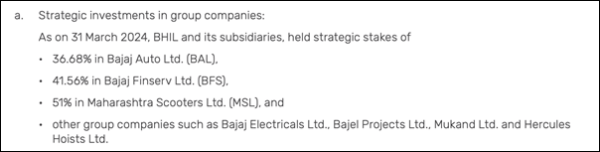 Figure 1: BHIL Holdings Information. Source: BHIL AR FY24
The discount: Back in FY20, BHIL’s market cap was just Rs 22,000 crore while its NAV was over Rs 50,000 crore, a 60% discount. Even Maharashtra Scooters, another Bajaj group holdco, traded at ~24% of its NAV at the time—a 76% discount.
| List of companies | Approx Mcap (in INR crore) | ||||
| 2015 | 2017 | 2020 | 2023 | 2025 | |
| Bajaj Finserv | 22,000 | 68,000 | 76,000 | 213,000 | 326,000 |
| Bajaj Auto | 54,000 | 80,000 | 56,000 | 124,000 | 225,000 |
| Maha Scooters | 1,000 | 2,200 | 2,600 | 4,900 | 13,000 |
| Total | 77,000 | 150,000 | 135,000 | 340,000 | 564,000 |
| Share in Bajaj Finserv | 9,100 | 28,000 | 31,000 | 88,000 | 135,000 |
| Share in Bajaj Auto | 20,000 | 29,000 | 21,000 | 45,000 | 82,000 |
| Share in Maha Scooters | 500 | 1,1100 | 1,300 | 2,500 | 6,600 |
| Bajaj Holdings | 15,000 | 24,000 | 22,000 | 71,000 | 135,000 |
| Discount | 49% | 58% | 59% | 48% | 40% |
What changed: Between FY21 and FY24, Bajaj Finance became a retail investor favourite, delivering massive returns and re-rating upwards. As more investors sought indirect exposure at lower prices, BHIL’s stock gained visibility. The market slowly began to close the discount. As of April 2025, BHIL trades at a P/B of ~2.3x, roughly in line with its holdings’ growth, one of the rare times a holding company matched or outperformed NAV growth.
Investor takeaway: BHIL worked because the underlying businesses were strong, widely followed, and kept compounding. The discount narrowed only after market attention caught up. This is a textbook example of invest early in the holdco when the subsidiary is undervalued and emerging.
The setup: EID Parry, a Murugappa Group company, is primarily in sugar and distillery but owns over 56% of Coromandel International, a Rs 56,000 crore market cap company in fertilizers and agrochemicals.
The discount: As of April 2025, EID Parry’s total market cap is ~Rs15,500 crore. Its stake in Coromandel alone is worth ~Rs 31,000 crore. This implies a 50% discount, even if one assigns zero value to its own sugar and distillery business.
What hasn’t changed: Despite this deep discount, the gap has persisted for years. The market has not re-rated EID Parry, partly due to low float, its commodity exposure (sugar), and lack of aggressive capital allocation moves from the promoters.
What could change: Coromandel’s continued growth and any potential stake monetization or demerger announcement could act as triggers. But in the absence of that, this remains a classic “value without catalyst” story.
Investor takeaway: The discount is real, the math is clear but the timeline is uncertain. Unless a corporate event occurs, EID Parry might stay undervalued for years. This is a lesson in patience and in understanding whether the underlying businesses and management have the intent to unlock value.
The setup: TICL holds a diversified portfolio of Tata group stocks like TCS, Tata Motors, Tata Steel, and others. It is a clean, pure-play investment company with minimal debt and a history of dividend payouts.
The discount: Unlike most holdcos, TICL usually trades at close to its NAV, sometimes even at a small premium. This is due to its transparency, regular dividend policy, and the brand equity of the Tata group.
Investor takeaway: TICL shows that not all holdcos are cheap. When the structure is clean, dividends flow consistently, and promoter reputation is strong, the market assigns a fairer valuation. But this also means less upside from discount narrowing—TICL is more of a steady compounding vehicle than an arbitrage play.
The setup: Godrej Industries owns stakes in multiple group companies, including Godrej Consumer Products, Godrej Agrovet, and Godrej Properties. These are all listed, professionally run businesses with sizeable market caps.
The discount: Despite the asset quality, Godrej Industries has traded at a discount of 50% or more to its NAV for years. This is largely due to complex group structures, limited communication on capital allocation, and lack of investor engagement from the holding company itself.
Investor takeaway: This is a case of high-quality assets, but no clear unlocking strategy. Without concrete moves to separate or monetize holdings, the market continues to apply a heavy discount. This reflects that not even strong brands can escape a valuation gap if there is no visibility on value creation.
The setup: For years, Religare Enterprises was viewed as a cautionary tale – once a financial services conglomerate, later plagued by promoter controversies, regulatory overhangs, and a complex web of subsidiaries. Its most valuable asset, Care Health Insurance, continued to grow quietly, but Religare’s stock traded far below its intrinsic value due to governance baggage and market distrust.
The discount: At one point, Religare’s market cap had fallen to around Rs 500 crore, while Care Health, based on peers like Star Health, could have commanded a valuation well north of Rs 3,000–4,000 crore. Effectively, investors were getting a high-growth health insurance platform for free.
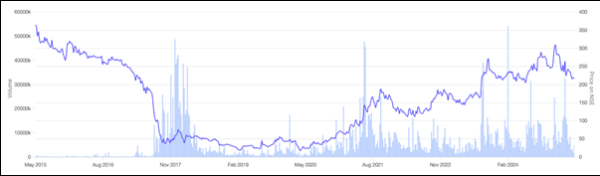 Figure 2: Share Price of Religare Enterprises Ltd. Source: Screener.in
What changed: The transformation began with a new board and institutional oversight, which focused on simplifying operations and cleaning up the balance sheet. But the real inflection came in September 2023, when the Burman family (of Dabur group) announced plans to acquire a controlling stake in Religare through an open offer. This was a pivotal moment: the market suddenly saw strategic capital, promoter credibility, and potential for long-term value unlocking via an IPO or demerger of Care Health.
What followed was a dramatic re-rating and not just because the intrinsic value changed, but because the narrative changed. Religare was no longer just a legacy holdco; it became a potential platform for financial services revival, with Care Health as its crown jewel.
Investor takeaway: Religare illustrates how a deeply discounted holding company can rerate rapidly when three forces align: credible governance change, visible monetization path (like an IPO), and strategic promoter interest. The discount doesn’t just close because assets are valuable, it closes when capital and control signal that value will be realized.
Note: A deeper breakdown of Religare’s valuation dynamics, Care Health’s premium trajectory is available [here].
| Criteria | What to Look For | Why It Matters |
| NAV vs Market Cap | Discount of 40–70% between NAV and market cap | Indicates potential undervaluation—but only if quality and governance hold up |
| Underlying Assets | Listed, high-quality, dividend-paying businesses with growth potential | Strong assets make the NAV meaningful and reduce the risk of value traps |
| Capital Allocation | Clear dividend policy, low debt, no history of cash leakage | Ensures value flows back to shareholders rather than staying trapped |
| Catalysts | Demergers, stake sales, IPOs, promoter restructuring, SEBI actions | Triggers are essential for the discount to narrow or vanish |
| Governance Quality | Transparent disclosures, limited cross-holdings, promoter alignment | Poor governance often justifies the discount, and keeps it in place |
| Liquidity and Float | Reasonable trading volumes and public shareholding | Allows realistic entry/exit without excessive impact on price |
| Holding Horizon | Minimum 3–5 years, unless a near-term corporate trigger is visible | Discounts don’t close quarterly; they need time or structural shifts |
Holding companies are often ignored, misunderstood, or dismissed as static value traps. But beneath the discount lies a deeper question: Is this undervaluation structural or situational?
For investors who do the math, study the ownership, and wait for real-world catalysts, not just theoretical value, holding companies can quietly outperform with lower downside risk.
The challenge is not spotting a discount. It’s spotting a discount that has somewhere to go.
Note: This article relies on data from the annual report and industry reports. We have used our assumptions for forecasting.
Parth Parikh has over a decade of experience in finance and research and currently heads the growth and content vertical at Finsire. He holds an FRM Charter along with an MBA in Finance from Narsee Monjee Institute of Management Studies.
Disclosure: The writer and his dependents do not hold the stocks discussed in this article.
The website managers, its employee(s), and contributors/writers/authors of articles have or may have an outstanding buy or sell position or holding in the securities, options on securities or other related investments of issuers and/or companies discussed therein. The content of the articles and the interpretation of data are solely the personal views of the contributors/ writers/authors. Investors must make their own investment decisions based on their specific objectives, resources and only after consulting such independent advisors as may be necessary.