13 min read


© IE Online Media Services Pvt Ltd



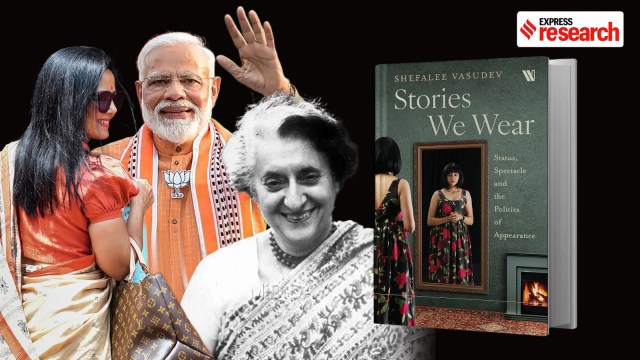 In her interview with Indianexpress.com, Vasudev speaks about the visual grammar of Indian politics. (Edited by Abhishek Mitra)
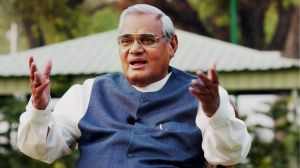
The second chapter of Shefalee Vasudev’s latest book, Stories We Wear, opens with a striking image: Prime Minister Narendra Modi at his swearing-in ceremony on June 9 last year, marking his third consecutive term in office. Vasudev, a fashion journalist and cultural commentator, turns her attention to the azure-blue bandi Modi wore that day. It was no “Nehru jacket”, she argues, despite what India’s costume historians might suggest. “It was unmistakably a ‘Modi jacket’—a category unto itself, much like the man who wears it,” she writes. The blue, too, demands attention: a shade that “wants to be seen”, unlike the measured hues associated with former prime minister Manmohan Singh or the muted grey-blues favoured by Atal Bihari Vajpayee.
In an interview over Zoom, Vasudev describes Modi as the “best-dressed person in Indian politics”. Yet politicians in India—including the prime minister—are quick to deny, or remain silent about, any conscious engagement with fashion or styling. What they wear, however, is never without meaning. Even this refusal to speak about appearance, Vasudev suggests, is itself a political gesture, calibrated for a vast and variegated electorate.
Stories We Wear moves beyond the wardrobes of politicians to examine how appearance functions as a language of identity, power, belonging and resistance. Vasudev traces the evolving symbolism of khadi, dissects the phenomenon of celebrity “airport looks”, and documents the quiet sartorial rebellions worn by women in small-town India.
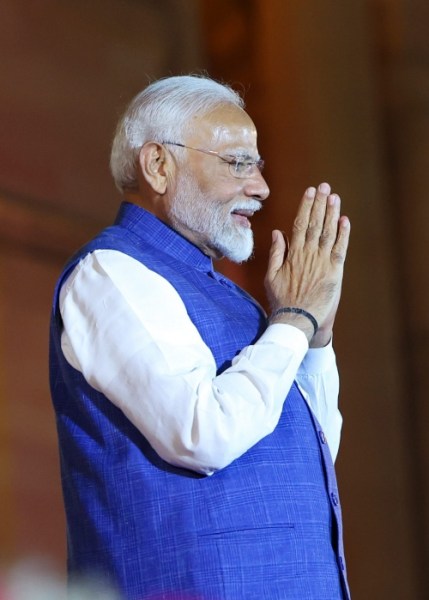 New Delhi: Prime Minister Narendra Modi after taking oath, at Rashtrapati Bhavan in New Delhi, Sunday, June 9, 2024. (PTI Photo)
In her interview with Indianexpress.com, Vasudev speaks about the visual grammar of Indian politics, why the saree continues to dominate the wardrobe of women politicians, how voters read displays of high fashion, and why Indian leaders prefer not to acknowledge the careful choices behind what they wear.
Excerpts from the interview:
Why have female politicians in India always worn a saree?
Shefalee Vasudev: The saree is seen as both serious, and as a power statement. Power in India through dressing among politicians has not been able to find any other echo. And for women who want to convey, and communicate power and seriousness and an India-specific identity, there is no garment that has been accepted by the politicians themselves, even though the electorate has changed dramatically. The electorate is no longer saree-obsessed for themselves. The electorate wears tattoos and trinkets and ghagras and sneakers when they go to vote, or when they go to listen to politicians speak. There is a sea change in how India looks, what India wears and how India aspires. The saree is not necessarily its fulcrum.
Take the example of the Indira Gandhi School of Sarees, because it had a handloom ideology, it was simultaneously offering a few codes, which were saying, “Hum swadeshi hain, hum saade hain, hum powerful hain, hum traditional hain (I stand for swadeshi, I am simple, powerful and traditional)”. So it offered that formula, which was useful.
Then came the many other types of sarees, Jayalalithaa scapes, which were, as I say in my book, a kind of armour, and they were also wielders of severe authority. Some might read her as a gang leader.
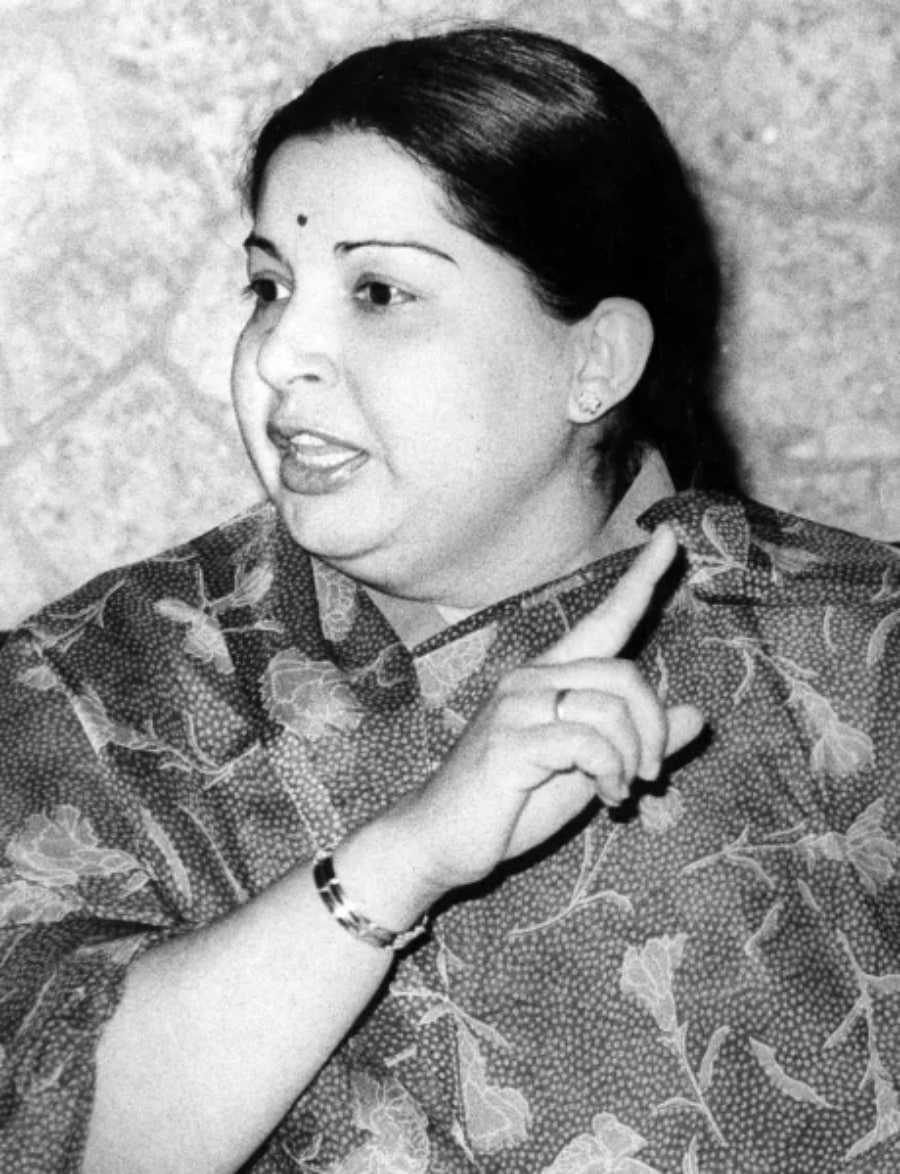 Jayalalithaa in her quintissential saree drape (Express archives)
Then there are Mamata Banerjee’s Mother Teresa sarees. The BJP women have worn ordinary sarees. Their ordinariness is the statement that they are making.
Now there are several saree schools inside Indian politics. There is distinction, but they are all sticking to the saree because they don’t trust their voters to accept dynamism. I read it as a poor trust or insufficient trust in the electorate to be able to accept modernity. So the electorate wants modernity and it has moved on. The politician is saying, I will promise you better bijli (electricity), paani (water), sadak (roads), railway station, airport, cafes and everything. But we will only wear the saree, or the male politicians will wear Indian specific dressing.
However, there are those who differ as well. Now Kumari Selja, to give you an example, always wears the salwar kameez. She has worn salwar kameez even in Parliament. She is a Congress leader and presumably, she did not want to fall into the trap of the handloom saree. However, when she was the Minister of Tourism, she went abroad and wore a saree.
Mayawati, on the other hand, eschewed and rejected the saree purely as a garment of the elite. She was a Dalit girl who wanted her own identity and the saree could not have been part of it. She even wore the dupatta as a loop around her neck and never wore it as a drape. So you see, there are many statements of small rebellions and personal rebellions within the large uniformity of the saree.
What makes you believe that the electorate is okay with more variation? In your research, have you come across people who would prefer a woman politician in any other attire other than the saree?
Shefalee Vasudev: I don’t think they will prefer it. The voter seems to be using a two-way currency of modernity. By modernity, I don’t mean westernisation. Not for a minute am I arguing for a pantsuit or a Hillary Clinton-style dressing. We have the example of Jacinda Ardern, the former New Zealand Prime Minister, who was able to dress in a contemporary style and setting without resorting to western wear that was pants and shirt-coated.
Most people in different parts of India will castigate, cancel or call out a politician who is being flashy or stylish. They will call them out for being too fashionable, conceited or vain, or criticise them for not knowing enough about India and its development issues. Yet, the same electorate wants these things for themselves. They want Rolex watches, shinier houses, imported shoes. They want to experiment and go for international holidays. But when Rahul Gandhi is holidaying internationally, they do not like it.
There are regional differences in the electorate’s perception too. Himanshu Mishra from the Amar Ujala newspaper had told me that in Uttar Pradesh, when a politician walks surrounded by a group of strongmen, the electorate thinks that if he is able to take care of himself, he can very well take care of us. The same image is not at all appreciated or accepted in Punjab. The Badals, for instance, would ruffle their pagdis (turbans) and don a dishevelled look before meeting the electorate to come across as ‘sons of the soil’.
In this electorate, the saree seems to pass all the tests you throw at it, including those of fashion, style, textile, handloom and more.
In a recent book, Michelle Obama wrote about how she chose her attire for international or diplomatic events. In the Indian context, the female politician is seen sticking to the saree even for international affairs. Why is that the case?
Shefalee Vasudev: Saree is international. It is an attire of identity. Michelle Obama never took off her identity. She may have veered from a Prabal Gurung to a Naeem Khan, to J Crew by saying, “I’m going to Vietnam and an American Vietnamese designer is going to make my dress.” But she did not start wearing feathers, or lungis or ethnic costumes from Arabia. She was an American woman who was inviting the work of various origin designers who either live and work in America or who have some interaction with America.
Even the interaction was a diplomatic interaction. So when she came to India and she wore Naeem Khan or Bibhu Mohapatra, it was to say, you are Indian designers, but I’ll still wear your gown. Meaning she was engaging with the artisanal identity of different people, but she never once laid aside her American persona, personality and identity in dressing. And that’s what Indian politicians are doing. The saree is where they find themselves being able to reflect multiple languages of communication, of belonging, of identity, of style, of power, and so on and so forth. I find that quite consistent, in fact.
What I am intrigued by rather, is why a Priyanka Gandhi Vadra would wear Western clothes to some private gatherings in Delhi, but they will never make this mistake when they are facing people, or in the Parliament or giving interviews. Look at Omar Abdullah, he has had a fairly contemporary life in terms of his choices, both political and personal. However, he wears a Kashmiri topi when he comes to meet the Prime Minister. Look at Chirag Paswan, he is quite good looking and tall. But what is he wearing in the Parliament? Kalawas (sacred thread) on his wrist, teeka on his forehead. So that is the only way they connect, unfortunately, with the electorate or with the people by saying, ‘Hum aapki tarah hai (We are like you)’.
You said that when the American first lady comes to India and wears a local designer’s gown, she is communicating something to India. Do we have similar examples of politicians from India who, even if they are in Indian attire, make an effort to communicate with the country they are in?
Shefalee Vasudev: I have no examples, and I wish there were. I wish they would pluck a bag, an accessory, something to do with hair, maybe a blouse, which has some local connect to the country they are visiting. There are New Zealand textiles, African prints and more. Indian politicians could have worked towards a fine reflection of saying, ‘I’m coming to your country and let me take a piece of you and mix it with a piece of me.’ That’s what diplomacy is. But I can’t think of any such instance.
The only person I can think of is Indira Gandhi who would wear long coats not made in India, on top of her sarees, during her travels abroad.
How do you read Indira Gandhi’s sarees? Was she communicating something through them?
Shefalee Vasudev: For all the things that she said about khadi and swadeshi, it was elitism and elegance that she wore. Handloom and khadi are elitist. There are very few people who can afford them. So she was the most elitist politician in terms of dressing, because she carved a distance from the common.
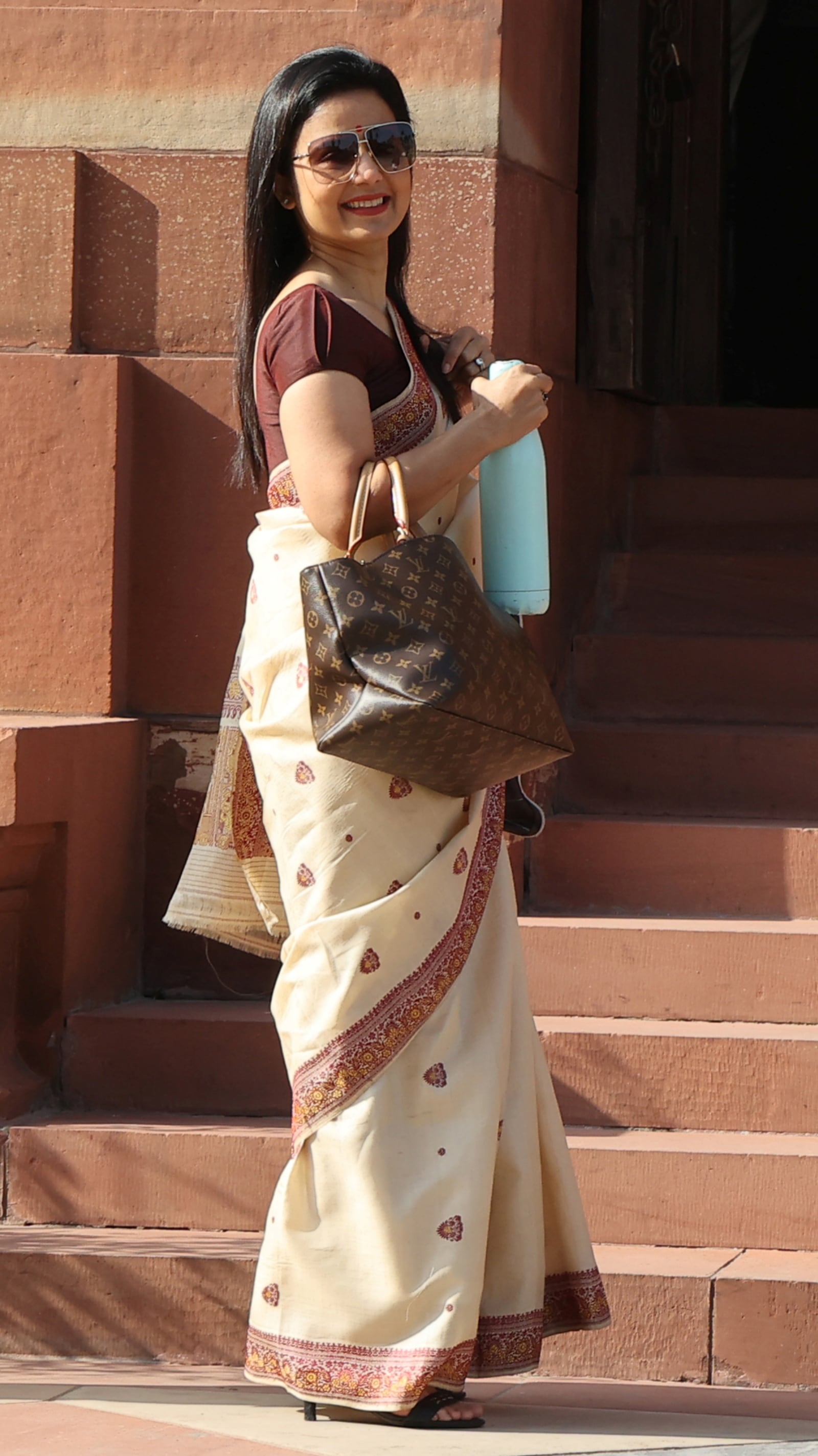 “Mohua Moitra is the real rebel,” says Shefalee Vasudev
Lisa Trivedi’s book, Clothing Gandhi’s Nation, argues that the making of the national body through khadi was itself a distinction that was being driven. Mahatma Gandhi was using khadi in a different way. He was using it as a tool and a message. But those who were wearing it, including some of these ladies in Parliament, they were wearing it as a distinction.
Today, the khadi saree and the handloom saree are among the most distinct sarees of the day. Rs 3,000 per metre is the most expensive khadi fabric. So, Indira Gandhi was basically saying, “Main Hindustani hu, main swadeshi hu, par main hatke hu (I am an Indian, and believe in swadeshi, but I am also different from the rest)”.
What do you have to say about the way Trinamool Congress leader Mahua Moitra drapes her saree?
Shefalee Vasudev: I don’t think she drapes the saree differently, but she is unabashed in her choices. She is clearly a person who establishes her choices. She says it through her clothes and her bags. She does not care that her Louis Vuitton will give the wrong impression to people.
She is the real rebel. I would call her a rebel even if she was male. When she was called to court during her case, she came carrying three Louis Vuitton bags because she had been called out for shoving one Louis Vuitton under her desk inside the Parliament. That was like saying, ‘This is who I am, and I’m not going to change how I dress because you think it assembles my politics as a politician’.
Even when she wears the saree, she wears it in a way that is not prim and proper, and is not weighed down by modesty.
Clearly, there are conscious choices in the way politicians drape themselves. But do politicians in India ever accept, acknowledge or speak about their sartorial choices?
Shefalee Vasudev: No, I have constantly asked them, and I have constantly been refused interviews when it comes to style. I think it is because the idea of dressing up is seen as vanity and frivolous. The Prime Minister, who is the best-dressed person in Indian politics, is at the forefront of setting his agenda through his clothes, turbans, and his hundred headgears. The moment you talk about it, it’s seen as frivolous. So there is a denial.
That denial is a very part of communication. So they are telling you that they will not talk about it because perhaps we are all conditioned to see leaders as having a certain kind of gravitas. It is beneath the gravitas of governance to accept that you dress up. I really wish that a person of PM Modi’s textile ability could talk about it because then the story would be consistent, but he doesn’t and nor does any leader.
Would you also say that there is a difference between, say, the Global South and the way the West communicates about fashion?
Shefalee Vasudev: Absolutely. A majority of the first women of the United Nations have been on the covers of Vogue, where every stylist, every look has been broken down. Here, you do not have a single instance. Once, Mahua Moitra was on Harper’s Bazaar cover, and even then certain details were kind of masked.