5 min read
© IE Online Media Services Pvt Ltd



 After the withdrawal of the Non-cooperation Movement in 1922, Bhagat Singh’s ideology of revolutionary struggle received an impetus from the disillusioned youth across the country.
The moment in history when bombs were thrown on the central assembly by Bhagat Singh and B K Dutt in 1929, the Indian national movement took a sharp turn from the hitherto monopoly of passive resistance in the struggle for freedom. No longer was ‘Bande Mataram’ the sole cry for freedom. The slogan of ‘Inquilab Zindabad’ made its entry, not just into the national movement, but into the very consciousness of the nation’s people, and stayed on till the present day, awakening generation after generation of youth to carry forward the legacy of Bhagat Singh.
Largely inspired by the Marxist-socialist ideology, Bhagat Singh’s idea of the freedom struggle was beyond the mere objective of freeing India. He was interested in examining the very roots of imperialism that led to the process of enslaving other nations. After the withdrawal of the Non-cooperation Movement in 1922, Bhagat Singh’s ideology of revolutionary struggle received an impetus from the disillusioned youth across the country. Strongly opposing the Gandhian form of the independence movement, the thoughts and methods of Bhagat Singh have continued to have a large impact upon the youth.
Watch what else is making news
Over the years Bhagat Singh has become an icon for the youth. No narrative on freedom or protest against societal injustices takes place without reference to the legend of Bhagat Singh.
AAP youth wing
In 2014, the Aam Aadmi Party announced the launch of their youth wing on the 107th birth anniversary of Bhagat Singh. According to the party, the youth wing would set their ideologies upon the thoughts of Bhagat Singh. “The Youth Wing has chosen the birth anniversary of revolutionary Bhagat Singh for its launch, since youth politics seems to have lost its direction and requires a new vision. There is no better example than the legendary freedom fighter who chose to sacrifice his life for the nation, merely at the age of 23 years,” said the official website of the party.
The youth wing’s objective has been to provide a platform to the youth to voice their opinion and also spread awareness about various societal evils among the youth.
Protest in JNU
Earlier this year, the Jawaharlal Nehru University erupted into a long phase of protest. Specifically, the issue raised by the students was the opposition to the judicial killing of Afzal Guru and Maqbool Bhat. However, as part of the protest the concern of freedom from repressive governmental policies were raised aggressively. The image of Bhagat Singh was raised in more than one occasion as students chanted the slogan of ‘inquilab zindabad’.
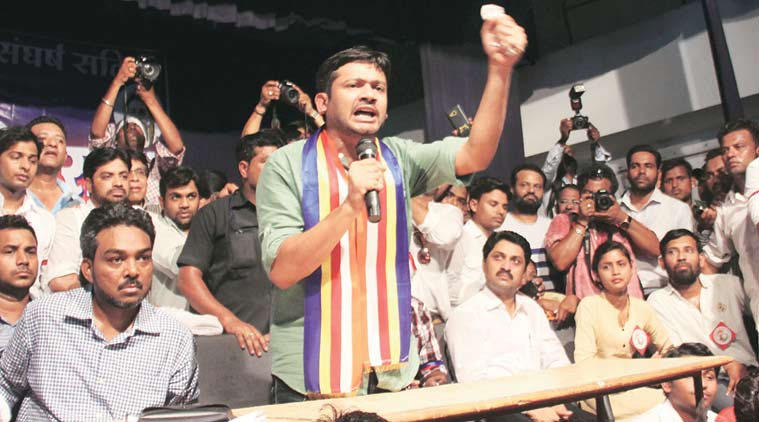 After coming out of jail, student union president, Kanhaiya Kumar said that there was nothing wrong in being sent to jail considering the fact that an icon like Bhagat Singh was also in jail.
The invocation of Bhagat Singh to define their protest was particularly strong when after coming out of jail, student union president, Kanhaiya Kumar said that there was nothing wrong in being sent to jail considering the fact that an icon like Bhagat Singh was also in jail.
Bollywood and Bhagat Singh
The legend of Bhagat Singh is particularly popular among filmmakers in the Hindi film industry. Over the years several films have been made depicting the life of Bhagat Singh. Shaheed-e-azaam (2002), Shaheed (1965), The legend of Bhagat Singh (2002), Inqilab (2008) and 23rd March 1931: Shaheed (2008) are some of the films that have paid tribute to the revolutionary leader.
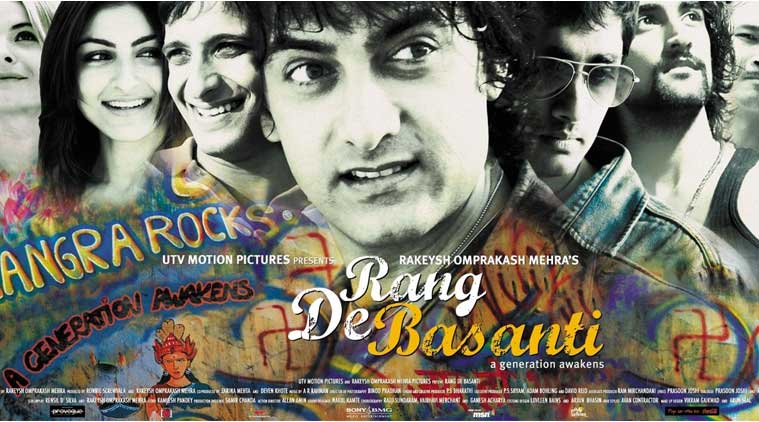 The direct impact of the film Rang de basanti was visible in the nationwide protest against the acquittal of the accused in the Jessica Lal murder case.
Rakeysh Omprakash Mehra’s Rang de basanti can also be added to this list of films invoking the revolutionary spirit of Bhagat Singh. It went on to achieve huge success both in India and abroad and had a huge impact upon the youth of the country. Soon after its release there was a tremendous increase in public discussions about governmental inefficiencies. The direct impact of the film was visible in the nationwide protest against the acquittal of the accused in the Jessica Lal murder case.