This is an archive article published on November 27, 2024
TDP does U-turn on EVMs, from ‘not tamper proof’ to ‘proven can’t be manipulated’, calls it ‘evolution’
Following the rout of his party, which was then not a part of the NDA, in the 2019 Andhra Assembly polls, Chandrababu Naidu had claimed EVMs are not “tamper proof” and also accused the EC of “faltering”
Written by Nikhila Henry
New Delhi | Updated: November 27, 2024 05:56 PM IST
3 min read
Whatsapp
twitter
Facebook
Reddit
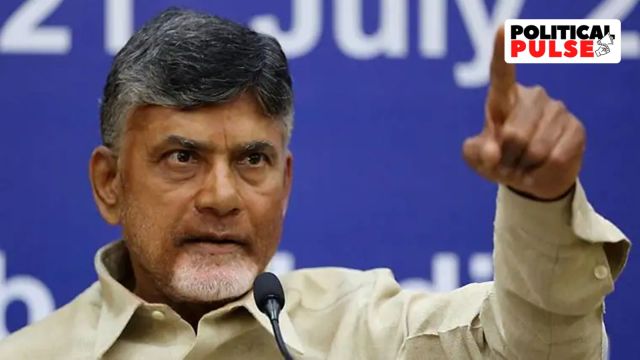
Telugu Desam Party (TDP) supremo N Chandrababu Naidu is more than 6,000 times wealthier than West Bengal CM and Trinamool Congress chief Mamata Banerjee. (File Photo)
As the debate over the veracity of Electronic Voting Machines (EVMs) rages on following the Mahayuti’s emphatic victory in Maharashtra, the Telugu Desam Party (TDP), which after its 2019 rout in Andhra Pradesh had claimed that EVMs are “not tamper proof”, has taken a U-turn on the issue and now claims “it has been proven without doubt that the machines are tamper proof”.
“The Election Commission (EC) has successfully proved that the EVMs cannot be tampered with and our party is in support of voting through EVMs,” TDP national spokesperson Jyothsna Tirunagari told The Indian Express, a day after the Supreme Court rejected a plea that sought a shift back to voting through ballot papers.
Five years ago, after the YSR Congress Party (YSRCP) reduced his party to 23 seats in the 175-member Andhra Pradesh Assembly, TDP chief N Chandrababu Naidu had voiced concerns over the functioning of EVMs on social media. “EVMs pose a big risk in a democracy as they are susceptible to manipulation. No developed or technology-driven country would use EVMs for voting,” he had said in a post on X (then Twitter).
Naidu had also accused the EC of faltering during the 2019 polls. “It was an infringement of citizens’ voting rights in the recent Andhra Pradesh polls due to a colossal failure of the election machinery,” he had said.
Another TDP leader, requesting anonymity, said several Opposition parties, including the Congress, had raised doubts over EVMs in 2019. “The TDP was in alliance with the Congress then. We lost the polls and were sure that the YSRCP had indulged in malpractices to win the elections and hence questioned the EVMs,” the leader said and argued that the party’s stand on the issue had “not changed but only evolved with time”.
The TDP, which was then not a part of the NDA, was also one among the 21 Opposition parties which had approached the apex court in March 2019 with a demand that 50% Voter Verified Paper Audit Trail (VVPAT) slips be counted with the votes recorded in the EVMs.
The Opposition parties – the Congress, Aam Aadmi Party (AAP), NCP (then undivided), Samajwadi Party (SP) and Left parties – along with the TDP, in their plea had urged the top court to ensure EVMs are tamper proof and claimed the only way to ensure it was by manually counting VVPAT slips. The Supreme Court dismissed the petition in May 2019.
Story continues below this ad
On the other hand, a TDP insider drew parallels with his party’s stance and BJP veteran L K Advani, who had questioned EVMs following the Congress victory in the 2009 Lok Sabha elections. “While he (Advani) had earlier questioned EVMs, the BJP now supports their use. Similarly, the TDP raised the issue in the past and now supports it,” the source said.
The senior TDP leadership remained unavailable for comment while Andhra IT Minister, Nara Loksh declined to comment on the issue.
Nikhila Henry is an Assistant Editor at The Indian Express, based in Hyderabad. With a career spanning 17 years, she has established herself as an authoritative voice on South Indian affairs, specialising in the complex intersections of politics, education, and social justice.
Experience & Career: Nikhila commenced her journalism career in 2007 as an education correspondent for The Times of India in Hyderabad,where she gained recognition for her coverage of student politics. Her professional trajectory includes a four-year tenure at The Hindu, where she focused on minority affairs and social welfare. In 2019, she took on a leadership role as the South Bureau Chief for The Quint, where she directed regional coverage across all five South Indian states. Her expansive career also includes a tenure at the BBC in New Delhi and contributions to prestigious international outlets such as The Sunday Times (London) and HuffPost India.
Expertise & Focus Areas
Nikhila’s reportage is marked by a deep-seated understanding of grassroots movements and institutional policy. Her core focus areas include:
Regional Politics: Comprehensive analysis of the socio-political dynamics across South India.
Education & Student Movements: Chronicling the evolution of Indian academics and the rise of youth activism.
Minority Affairs: Rigorous reporting on the welfare, rights, and challenges facing marginalized communities.
National Beat: Elevating regional stories to national prominence through investigative and on-ground reporting.
Authoritativeness & Trust
A respected figure in Indian media, Nikhila is not only a seasoned reporter but also an accomplished author and editor. She authored the critically acclaimed book The Ferment: Youth Unrest in India and edited Caste is Not a Rumour, a collection of writings by Rohith Vemula. Her dual background in daily news reporting and long-form authorship allows her to provide readers with a nuanced, historically-informed perspective on contemporary Indian society.
Find all stories by Nikhila Henry here. ... Read More


 3 min read