6 min read
© The Indian Express Pvt Ltd



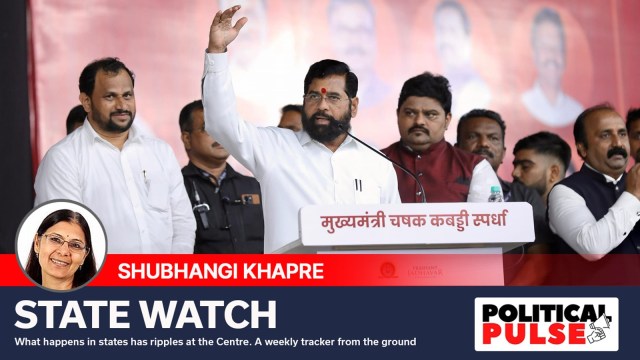 The Eknath Shinde government reckons that if the unrest among farmers is left unaddressed, it could prove detrimental to the state administration. (File Photo)
The Centre’s decision to ban onion exports has put the Maharashtra coalition government led by Eknath Shinde in a Catch-22 situation, as it cannot oppose the decision by the Union government led by Prime Minister Narendra Modi in public.
At the same time the Shinde government reckons that if the unrest among farmers is left unaddressed, it could prove detrimental to the state administration, especially when it is facing protests both inside and outside the Assembly in Nagpur, where the Winter Session is currently in progress.
Aware of the ramifications of the issue, Deputy CM Devendra Fadnavis held a meeting with Union Minister for Commerce and Trade, Food Consumer Affairs and Public Distribution Piyush Goyal. He presented a memorandum highlighting the concerns of farmers and sought the Centre’s intervention to address the same.
On December 11, barely three days after the onion export ban was announced, NCP president Sharad Pawar steered a farmers’ protest rally at Chandwad in Nashik district. The former Union minister has also decided to take up the issue with the Modi government at the Centre during the ongoing Winter Session of Parliament.
According to Pawar, “The ban on onion exports is injustice against farmers. It would cause a huge setback to them,” adding that “I am going to raise it with the Centre.”
While the Modi government imposed a ban on onion exports till March 2024 in the run-up to the Lok Sabha polls slated for April-May 2024, there seemed to be no shortage of onions in the domestic market. An order by the Directorate General of Foreign Trade last week said, “The export policy on onions is amended from free to prohibited till March 31, 2024.”
At Lasalgaon in Nashik district, which has the largest wholesale onion market in the country, farmers blocked the Mumbai-Agra national highway in anger. All related trading activities in Nashik came to a halt and onion auctions were stopped as a mark of protest. In Nagpur, the Opposition raised the issue of farmers by protesting outside the Vidhan Bhawan.
Vanchit Bahujan Aghadi president Prakash Ambedkar charged: “Each and every decision taken by the Centre is election-oriented. It wants to check onion prices to appease consumers who outnumber farmers in terms of vote bank. Such short-sightedness and narrowness is not going to help in the long run.”
Instead, he argued, “The government could have consulted stakeholders and farmer groups to find a middle path.”
In less than six months, the Centre has twice upset Maharashtra’s onion cultivators. In August 2023, the Union government imposed a 40% duty on onion export, leading to massive protests across the state. All
Agricultural Produce Market Committees (APMCs) closed operations for weeks in solidarity. In Nashik, the district onion auction was stopped for 40 days.
Four months later, the Union government imposed the ban on onion exports. Promptly, the onion auction was stopped in Nashik district. This time though, the state cooperation and marketing department issued a strict directive to APMCs against stopping onion auctions. The order stated, “If onion auctions and work in APMCs is stalled, the department will cancel their licenses.” As a result, these bodies resumed operations after a week’s protest.
Along with the threat of strict action, CM Shinde and his deputies Devendra Fadnavis and Ajit Pawar have also reassured farmers of safeguarding their interests. Fadnavis said, “All unsold onion stock will be procured by the government. It would ensure farmers are not subjected to any financial loss on account of the ban on onion exports.”
“Onion export is permitted when there is surplus stock. Currently, there is a 25-30% shortage. In such a situation, the Centre had to take the decision to avoid shortage and check a steep hike in retail prices. It will tackle farmers’ concerns by raising procurement of onions,” he explained.
With pressure mounting from onion growing states, the Centre has raised the buffer stock target to seven lakh tonnes for 2023-24. Last year, it was three lakh tonnes.
Currently, onions are being sold at Rs 1,000 to Rs 1,500 per quintal. However, depending on quality, in some places it is being sold at Rs 2,500 to Rs 3,000 per quintal too. In the domestic market, the price per kg had risen to Rs 90-120. But after the export ban, prices came down to Rs 60-70 per kg.
Farmers and traders argue the decision to curb exports will adversely impact the sector, as the surplus stock is likely to cause a crash in prices and financial losses for them, so they demand a complete rollback of the order. Lasalgaon APMC chairperson Balasaheb Kshirsagar said, “The blanket ban on onion export is detrimental to farmers and traders. The government should reconsider its decision.”
State Congress president Nana Patole said, “The BJP-led Central and state governments are anti-farmer, who are in dire financial stress due to crop loss caused by recurring unseasonal rains and hailstorms.”
Farmers believe the government should support them by bringing policies that would promise higher remuneration. But frequent policy changes and higher duty on onion export goes against their interests. It leads to a price crash and benefits middlemen.
Swabhimani Shetkari Sanghatana president Raju Shetti said, “Why do farmers always pay the price? Whether it is onion or sugarcane, soya beans or cotton, farmers are passing through a difficult phase. There is uncertainty due to climate challenges. Whatever they harvest is not enough to recover input expenditure. On top of that, the Centre has banned exports. How will farmers cope with these frequent policy changes?” he asked.