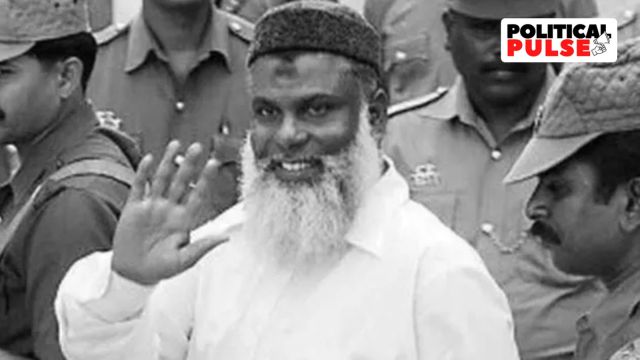
S A Basha, the founder of the banned fundamentalist outfit Al-Umma and the architect of the deadly 1998 Coimbatore serial bombings that killed 58 people, was laid to rest on Tuesday evening, bringing to an end one of the darkest chapters in Tamil Nadu’s political history.
The 84-year-old had been ailing for some time, with his death raising barely a whimper, but for heavy deployment by the cautious Coimbatore police.

The target of the Coimbatore bombings, carried out on February 14, 1998, was senior BJP leader L K Advani, who was in the city for an election rally. While more than 50 people were killed, over 231 were injured. The case, transferred to the CB-CID’s Special Investigation Division, led to the arrest of 166 people. Basha was convicted for conspiring to acquire 650 kg of gelatine and other explosives to manufacture improvised bombs.
Serving a life term, an infirm Basha had secured parole a few months ago and was with his family when he died.
The Coimbatore blasts had come in the wake of growing tensions in the city starting in the early 1980s. As per the Justice P R Gokulakrishnan Commission of Inquiry into the incident, which submitted its report in 2000, the blasts were meant as revenge for the killing of 18 Muslims in police firing and communal riots in November-December 1997 in Coimbatore following the murder of a traffic constable by Al-Umma cadres.
The commission also held the Coimbatore police responsible for lapses that allowed Al-Umma to orchestrate the bombings.
By then, the city had been a cauldron of Hindu-Muslim tensions for some time, with speeches by controversial Hindu right-wing leaders such as Tirukovilur Sundaram provoking a counter-reaction. A series of tit-for-tat attacks had left killings on both sides, including two that occurred within 45 minutes of each other in 1990.
Story continues below this ad
The demolition of the Babri Masjid in 1992 further put Coimbatore on edge.
The tipping point was the November 1997 murder of traffic constable Selvaraj by Al-Umma cadres. In its report, the Justice Gokulakrishnan Commission talked of radical outfits such as the Hindu Makkal Katchi going on a rampage following the murder, with policemen joining at some places. While the Army and CRPF were eventually called in, by then 18 Muslims had been killed.
The next month, bombs exploded in three trains originating from Chennai, killing nine passengers and injuring 70 others. A note found at the spot bore the name ‘Islamic Defence Force of Kerala’, and attributed the attack to the Babri Masjid demolition. Then, in January 1998, a bomb went off in Chennai, with a group called the Jihad Committee blamed for it.
On the day of the Coimbatore attacks, 19 bombs went off within the space of 20 minutes, between 3.50 p.m. and 4.10 p.m, including one at the site of Advani’s scheduled rally, as well as BJP offices. The bombs were planted in cars, two-wheelers, pushcarts, tea cans, and suicide belts.
Story continues below this ad
A CB-CID probe later said that three Al-Umma operatives had also been deployed as suicide bombers to target Advani, but had failed to make it past the security cordon.
Among the 166 arrested were Basha and Al-Umma’s second-in-command, Mohammed Ansari. Basha was convicted of procuring explosives and IED materials from Mysuru.
In 2007, a Special Court convicted 158 people, sentencing 43, including Basha and Ansari, to life imprisonment. Seventeen convicts appealed to the Supreme Court, but not Basha, reportedly as he did not want to hamper his chances of parole.
The scars of the Coimbatore blasts took years to heal, especially the city’s businesses. The DMK government that had come to power under M Karunanidhi, in a landslide victory in 1996, ousting Jayalalithaa’s AIADMK, faced accusations of inefficiency, police complacency, and failure to act on intelligence warnings. The AIADMK was then a BJP ally, but broke its partnership in 1999.
Story continues below this ad
Traditionally opposed to the BJP, the DMK now entered into an alliance with the NDA, with Karunanidhi insisting that this was “conditional on safeguarding of minority interests”. However, as the NDA under A B Vajpayee formed the government at the Centre, this friendship helped the DMK tide over the anger of the Coimbatore blasts.
Senior Supreme Court lawyer Prabhu Balasubramanian, who knew Basha, claimed he died remorseful for his role in the attacks. “Once he said things had spiralled beyond his control before he could stop it… In the final years of his life, I asked him why he never filed an appeal against his sentence. He said, ‘I just wanted to be with my family, even if only for a few days every year’… He would say it was for his grandchildren.”
Meanwhile, Coimbatore remains central to the BJP’s Tamil Nadu plans, and in the Lok Sabha elections earlier this year, this was one of the nine constituencies where the BJP finished second, ahead of the AIADMK.


 5 min read