2 min read
© IE Online Media Services Pvt Ltd



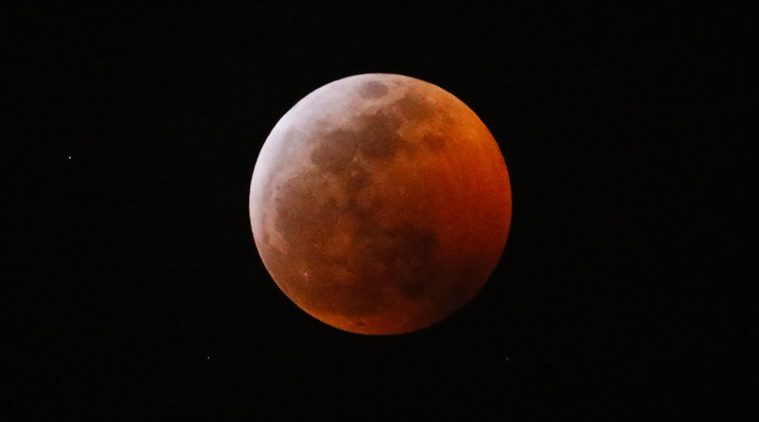 Lunar Eclipse 2019 (Source: AP)
This year’s total lunar eclipse, called the Super Blood Wolf Moon has begun. While the eclipse won’t be visible from India, parents can take the opportunity to explain to their kids what the phenomenon is all about, to develop their interest in astronomy. We answer five questions on Super Blood Wolf Moon:
When the Moon comes closest to the Earth, it is called “supermoon”, according to space.com. Again, the first full Moon of the year (in January) is named after howling wolves or “Wolf Moon”. The two occurrences together led some to name the phenomenon this year Super Blood Wolf Moon.
A total lunar eclipse takes place when the Earth comes in between the Sun and the Moon, such that they are aligned to form a line. Sometimes, a total lunar eclipse is called Blood Moon, as it looks red in colour. The light of the Sun filters through the atmosphere of the Earth, and gets scattered and absorbed. Only red and orange light get through, giving the Moon its characteristic red colour during the total phase of the eclipse, explains astronomer Rishabh Jain.
The century’s longest total lunar eclipse took place last year on July 27-28, 2018, and lasted approximately one hour and 43 minutes.
As per timeanddate.com, a total lunar eclipse can be seen every 2.5 years from a given location.
According to NASA, the next total lunar eclipse is likely to take place in May 2021.