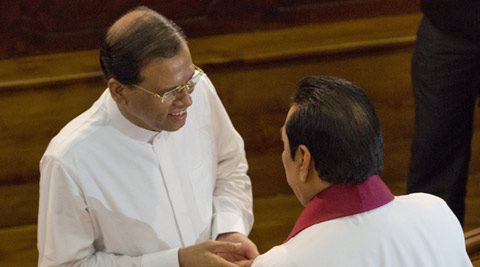

The appointment of a Tamil parliamentarian as the leader of the Opposition in the Sri Lankan parliament, the first time in nearly four decades, is being hailed as a big step towards ethnic reconciliation in the country. In fact, the elevation of R. Sampanthan, leader of the Tamil National Alliance and its main constituent, the Ilankai Tamil Arasu Kadchi, to this important parliamentary position is not so much a reach-out to Tamils — though it could certainly have that consequence — as it is a result of the pre- and post-election dynamic between the two largest parties in Sri Lanka.
The United National Party and its front won 106 seats in the 225-strong parliament, below the halfway mark; the Sri Lanka Freedom Party and its front, the United People’s Freedom Alliance (UPFA), won 95 seats; the TNA won 16 seats. In the normal course, the UPFA should have got the post. But without splitting officially, the UPFA is divided between President Maithripala Sirisena and his rival, Mahinda Rajapaksa. During the campaign, Sirisena made it clear that if Rajapaksa won enough seats and staked a claim to the prime ministership, he would not appoint him. After the UNF victory, the Sirisena group of about 40 MPs joined Prime Minister Ranil Wickremesinghe’s “government of national unity”. Some have been given key cabinet positions. Though the remaining UPFA parliamentarians — the Rajapaksa group — demanded recognition as the Opposition, the speaker decided that it was impossible as the party is now in the ruling front, thus denying Rajapaksa a role that would have kept him central in Sri Lankan politics.


