
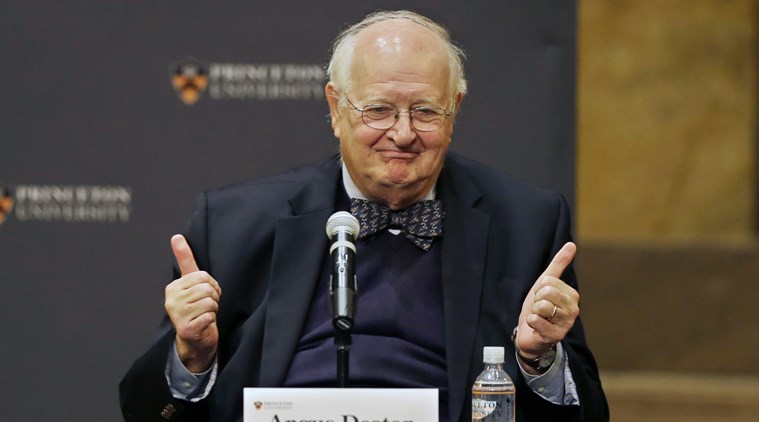
The Royal Swedish Academy of Sciences hailed this year’s Economics Nobel prize winner Angus Deaton’s research for the breadth of its impact. “By emphasising the links between individual consumption decisions and outcomes for the whole economy, his work has helped transform modern microeconomics, macroeconomics and development economics,” it said. The central message emanating from Deaton’s work, including his eloquently titled book The Great Escape, is that inequalities are often a consequence of economic growth. The great escape from poverty and ill-health does not happen without many being left behind. However, that “in no way makes the escape less desirable or less admirable”. It is a message India must ponder as it wrestles with the imperatives of boosting economic growth and removing persistent inequalities. Over the past few years, with the deceleration in domestic economic growth in India, the role of the state and the expansion of the rights-based approach have been cast into question. Deaton’s Nobel puts that debate in sharper focus.
India has been one of Deaton’s laboratories. His work has greatly influenced how India maps its disadvantaged population. For instance, he pointed out how in the 55th Round of the NSS (1999-2000) there were measurement flaws — such as inconsistencies in the recall of consumption expenditure — while collecting data. Incorrectly collected data led to overestimates of consumption and underestimates of poverty, and vice-versa, in the country. Similarly, his work on price indices and measuring poverty was central to the poverty line drawn by the Suresh Tendulkar Committee.


