
Opinion Quota blackmail
Haryana government failed to react firmly in face of a violent agitation stoked by perceptions of dwindling opportunities.
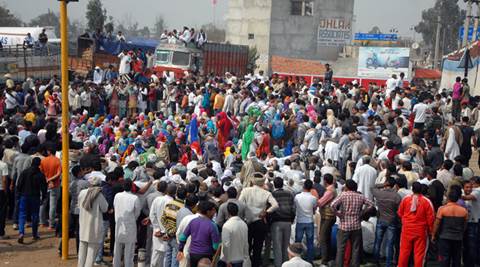 Rohtak, India, February 20: Jaats blocked Jhajjar-Rohtak road at Saapla, in Rohtak, India, on Saturday, February 20, 2016. Photo by Manoj Kumar

 Rohtak, India, February 20: Jaats blocked Jhajjar-Rohtak road at Saapla, in Rohtak, India, on Saturday, February 20, 2016. (Express Photo by Manoj Kumar)
The merits of the Jats’ claim for OBC status in Haryana can be debated. But the violence wreaked by the agitators since last week needed to be firmly dealt with. At least 16 people have died in the state and many more have been injured as mobs occupied the streets and resorted to violence. By all accounts, the Haryana government appears to have succumbed to the blackmail of the agitators in promising to immediately legislate in favour of the Jats’ demand, even as the Union home minister has announced a panel to examine the community’s demand for quotas in Central government jobs. Both the state and Central governments, having been caught unawares by the unrest and lacking the leadership to negotiate with the community, now appear to be on a path of appeasement. The government should follow the norms laid out to verify if a community deserves inclusion in the OBC list. Shortcuts that bypass procedure for populism are likely to face legal hurdles and would eventually further alienate the community. The previous Bhupinder Hooda government, without due diligence, created a special backward classes category for the Jats among other castes, only for the Supreme Court to strike down the provision.
Having said that, the reasons behind dominant rural castes like the Jats in Haryana — or the Patels in Gujarat and the Kapus in Andhra Pradesh — clamouring for quotas in government jobs deserve to be reflected upon. Structural changes in the economy have impacted the financial well-being of these politically influential peasant castes. The general crisis in agriculture resulting in unstable and falling incomes has forced them to look beyond farming and search for stable jobs in the private and public sectors. But job-creation has not kept pace with the numbers seeking non-farm employment. Many job-seekers also lack the skills to compete in the employment market due to the uneven quality of education in rural areas. With the private sector-driven professional education becoming expensive, there is intense competition for the few opportunities in government institutions. The cry for quotas is the outcome of the mismatch between supply and demand in education and employment, in itself a creation of the movement towards a non-agrarian economy.

The violence has exposed the inexperience of the Manohar Lal Khattar government. Focused on implementing pet Hindutva demands like the cow slaughter ban, the BJP government failed to sense the dissatisfaction among the Jats, who felt ignored in government formation. It now needs to focus on governance.
 Share
Share


