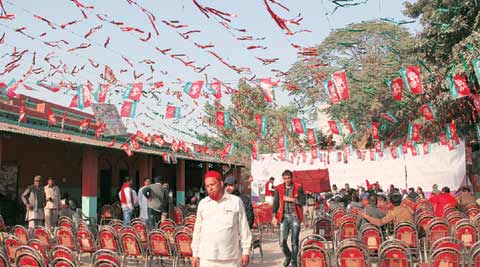

As the BJP campaign for a bypoll in Muzaffarnagar takes an inflammatory turn, there are several reasons why the party’s leadership in Delhi cannot afford to look the other way. Muzaffarnagar is not elsewhere. Ever since communal violence broke out in this part of western Uttar Pradesh in September 2013, it unsettled a happy complacency that the phenomenon of the large-scale riot would not revisit India today, and Muzaffarnagar acquired a new resonance in the national imagination. Then, the brutal Lok Sabha campaign the BJP ran in Muzaffarnagar in 2014 provided ballast to the arguments of those who pointed out that the Modi project was essentially two-faced, that it stoked minority insecurities on the ground even while it made promises of “sabka saath sabka vikas”. As it heads towards its two-year anniversary, the Modi-led government must heed the dangers of the party’s abrasive rhetoric in Muzaffarnagar yet again overtaking the official agenda insistently proclaimed in Delhi.
In Muzaffarnagar, local MP and Union minister Sanjeev Balyan by his side, state BJP executive committee member Umesh Malik is reportedly invoking the “embers that spread” from the 2013 violence and “made Narendra Modi the prime minister”. It is not incidental that both Balyan and Malik were detained by the state government before the riots. Malik is unabashedly boasting about organising the mahapanchayat that preceded and, by all accounts, led to full-scale riots in the region. In Muzaffarnagar, the air is once again thick with apocalyptic talk of “bullets” and the “honour” of “bahu-beti”. For the Modi-led government, at this juncture, these echoes from UP do not just underline the difficulties of the balancing act between pandering to the base and changing the subject. They directly threaten to undermine its efforts to project an image, at home and abroad, of a nation vying for the spotlight on the global stage as it remakes itself through campaigns like Swachh Bharat, Make in India and Start-up India.


