
Opinion Missing in opposition
The government is taking large steps. There is incoherence across the aisle.
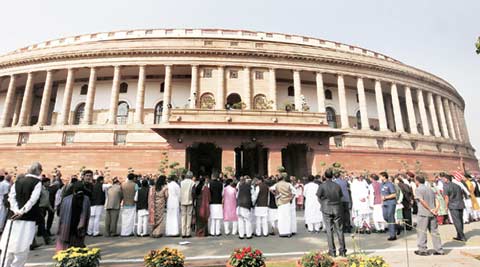


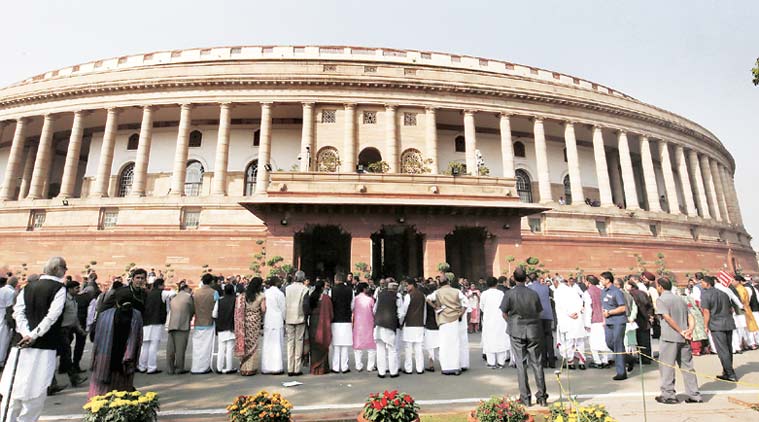 Opposition MPs protesting outside Parliament over the demonetisation issue. Over 200 MPs from 14 parties took part in the protest. (Express Photo by Anil Sharma/Representational)
The Opposition looked divided again on Tuesday, as some parties held a press conference to relaunch their attack on Prime Minister Narendra Modi and his government’s policy of demonetisation. Trinamool Congress chief Mamata Banerjee demanded the PM’s resignation if the cash crunch did not ease after the expiry of his 50-day deadline, but other leaders seemed reticent on the matter. Congress vice president Rahul Gandhi repeated his charges of corruption against the PM based on the purported Sahara and Birla group papers, but the rest didn’t chime in.
Watch what else is making news

The Left was among the Opposition parties missing on stage, with the CPM later complaining that it was neither informed nor consulted about the joint campaign. The JD(U) had, in any case, broken ranks with the Opposition on the issue of demonetisation, extending the policy its support. As the government’s ambitious and controversial experiment enters its next stage, then, and the nation a new year, the Opposition’s talk of a common minimum agenda sounds like a difficult proposition.
In a sense, this is as it should be. After all, in a diverse and layered democracy, why must the Opposition speak, or be expected to speak, in one voice, always? That Nitish Kumar and Naveen Patnaik have extended their support to the government’s demonetisation policy, for instance, while other prominent leaders criticise it roundly only underlines different ideas, interests and compulsions of players operating in and addressing different arenas of a complex polity. Having said that, however, it is also true that over the last few weeks and months, a contrast has been highlighted again and again — while the government has been seizing the initiative, and the headlines, moving from one consequential policy and project to another, with demonetisation following close on the heels of the surgical strikes across the Line of Control, the Opposition has seemed overtaken and reactive.
It also lacks a centrepiece that could hold even a loosely defined joint strategy together. As the main Opposition party despite its dwindled numbers in the Lok Sabha, the Congress, which remains convulsed with its own incoherence and uncertainties, has seemed unprepared for the role. And so far, no other party, be it Nitish Kumar’s JD(U) earlier or Mamata Banerjee’s Trinamool Congress now, has fully stepped up either.
What this means is that at a time when a robust Opposition is needed in a healthy and argumentative democracy — when the government is taking important decisions that deserve to be fully discussed and vigorously debated, even if not necessarily opposed — the Opposition has seemed unfocused. Whether or not it can find a centre of gravity and get its act together is a question for the new year.
 Share
Share


