
Opinion With ‘Tanu Weds Manu Returns’, Bollywood learns to live in small towns
Bollywood is learning to live in small-town India, not just visiting for local colour.
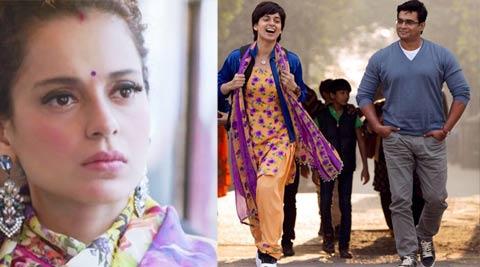


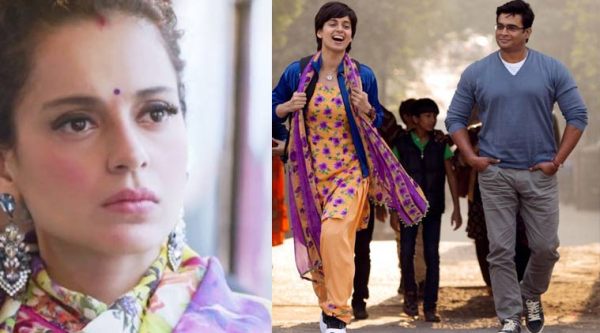 Thankfully, the film is not yet-another reimagining of the small town. These are people and milieus usually seen in documentaries, not in films starring A-list heroines.
The definition of small town keeps changing, because the goalposts keep shifting. Small towns keep getting bigger, and systematic overuse has leached them, for the purposes of Bollywood, of freshness and flavour. It’s time for the rise of a new genre — the subaltern film, glimpses of which were visible in Tanu Weds Manu Returns. It replaces Bollywood’s artificially lit-up small towns with locations and characters not confined to, or defined by, their “small-town quirks”. It gives us Tanu, a girl with multiple exaggerations; it also gives us the gloriously provincial Datto, a first for Bollywood.
The heavily Haryanvi Datto’s idea of a hot date is to pedal around the slimy lake outside Delhi zoo, not a spot your average multiplexer would set foot in. She races off to the bus “adda” to go to Chandigarh. A bus? Not even a deluxe one? Kangana Ranaut is startlingly svelte, but Datto’s tracks and tees look as if they were picked up from Delhi’s street stalls. These are people and milieus usually seen in documentaries, not in films starring A-list heroines.

[related-post]
Thankfully, the film is not yet-another reimagining of the small town. It is not glossing it up. In 2005, Kanpur was centre-staged in Bunty Aur Babli, whose likeable lead characters were bent on escaping the ennui of their surroundings. We enjoyed the movie, while noting Abhishek Bachchan wasn’t really a Hindi speaker and Rani Mukerji’s perky attire was more costume than clothes. We adopted “Kajrare” as the hit disco ditty and came happily home.
Ten years later, we are back in Kanpur, but the town we see is not dotted with designer grunge. Ranaut’s Tanu lives in an area crammed with shops and traffic. When Tanu re-enters it, after a fruitless stint in London, she returns to its “mohalla”-ness, its streets a natural habitat for its residents, used for bathing, bantering, flirting, dreaming, not just for locomotion. The chatter you hear makes it lived in. The Hindi spoken sounds as if it is the characters’ primary language, not a translated, grafted “vernacular” afterthought. The colloquialisms and the casual use of invective took me back to the conversations that peppered my childhood: my long-stay corner of UP was overrun by the “khadi boli” of the Braj and had a different “leheja”, but the salty turn of phrase is the same everywhere. The film captures it delightfully, even if it underlines it a tad for us to laugh at. Director Anand L. Rai and writer Himanshu Sharma are careful to keep it as authentic as they can, staying away from studio-created prettified landscapes and pretty people, where even the grit feels air-brushed.
There have always been “chote sheher” in Hindi cinema. The contrast between the “bade shehar ka babu” and the “gaon ki gori” was stark: when the babu returned to the “chamak dhamak”, he forgot the pristine values of the village and the girl he left behind. Till he found her again. Or not. Those were simpler times, and we were content watching these two Indias. The advent of small-moffusil-town India — the in-between space — pushed rural India into the background, and the action shifted to the conflict between big town and small town.
But it was hard to present the dreary realities of the small town without sexing it up. Bollywood needed small towns for colour, but the insistence on lushness and plushness have usually deprived representations of accuracy and depth, and turned locals into fancy-dressed curios. Rai managed to keep it real in the first half of his previous film, Raanjhana, his Benares mostly devoid of touristy kitsch, but Sonam Kapoor just wasn’t unpolished enough.
He does much better in Tanu Weds Manu Returns. Ranaut is a true outlier, who sounds as if she started using English much after Hindi. Her awkwardness in diction (Datto is lovely precisely because she nails the body language of a girl who’s come to big city Delhi on a “sports quota”, even if her accent slips occasionally) helps us believe in her outsider status. The filmmakers smartly keep her comfortable in her skin; she is not suddenly all Dior-and-Chanel to keep the urbanistas happy. She is capable of being one of us, whether we come from high-class, high-end India, middle-class, middle-of-the-road Bharat. In a triumphant stroke in this film, she is the true small-town girl who blares loudly, keeping her voice free of artifice.
It is the voice of subaltern India.
shubhra.gupta@expressindia.com
 Share
Share


