
Opinion View from the right: Pakistan terror
Peshawar school massacre has now shaken the whole country.



Pakistan terror
The editorial in the Organiser says the Peshawar school attack has shown once again that Pakistan faces the Frankenstein of its own “terror promotion policy”. It argues that the attack has “proved beyond doubt that the state of Pakistan will not and cannot afford to disband its policy of breeding terrorism… The real issue is whether it has put a question mark on ‘Idea of Pakistan’ as a nation…”

Countering the popular belief that Pakistan conceived its proxy war as reaction to the 1971 war that led to the creation of Bangladesh, the editorial says, “The reality in fact is that it was not Zia-ul-Haq but Jinnah who made statement after statement about [the] unfinished project called ‘Pakistan’. People, who entered Jammu and Kashmir on October 23, 1947, were the seeds of terrorism Pakistan sowed — Pakistan was being created on the ground of negating [the] ‘Indian’ identity and conceiving [an] ‘Islamic’ identity.”
This idea, it says, has compelled Pakistan to promote anti-Indianism and terrorism. Pointing out that recent developments have put Pakistan’s very existence under threat, it claims, “There is a pressure from within to disband [the] policy of terrorism at the same time hardliners nurtured by the Pakistan state are pushing for more Islamic laws. If Pakistan continues to succumb to the pressure of Islamists, it will continue to bleed…”
Cruelty & creed
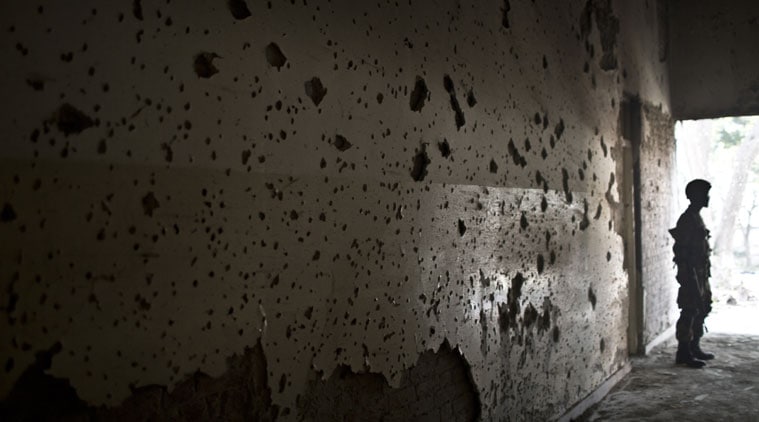
The Peshawar school massacre has again exposed the “umbilical chord between Islam and barbarism,” says the editorial in Panchjanya, adding that this “assault was the result of such a tribal mindset”. But the Peshawar attack was such a slap on Pakistan’s face that it has made the state see certain realities. Only the killing of Sunnis had shocked Pakistani society and government so far. Peshawar has now shaken the whole country.
Panchjanya says that just as the masterminds of the 2008 Mumbai attacks are connected to Pakistan, the masterminds of Peshawar are linked to Afghanistan. Just as Hafiz Saeed planned the attack against India sitting in Pakistan, the Taliban’s Umar Naray strategised on the Peshawar attack in Afghanistan. The editorial wonders about the attitude of fundamentalist Muslims to such incidents. Salman Rushdie had been targeted by fundamentalists for the representation of the Quran in the Satanic Verses. But what would be their attitude to the masterminds of these attacks?
Defence FDI
An article in the Organiser lauds the government for attracting FDI in defence production. But it pitches for improving indigenous R&D for domestic production. Although Indian scientists have achieved remarkable results, our R&D is far below potential. “The answer to the question of performance gaps in R&D is crisp and clear. Professionalise the R&D bodies in the country,” it says. The article also suggests salaries and remuneration as per global standards for R&D personnel, the removal of the “rotten bureaucratic culture in DRDO and other government organisations that do not adequately reward performance, but reward sycophancy”, and the extension of greater autonomy to the DRDO. “With dependence on imports for 60 per cent of our defence equipment requirements, indigenisation of defence production is a must if India is to develop into an economic and political superpower. For this, self-reliance, whether in marshalling capital resources or in technology or in actual manufacturing, holds the key,” says the article.
It cautions the government that foreign investors in India’s defence production would not like to lose their existing global customers to India’s new defence manufacturer-cum-exporter entities. “This consideration may make the foreign companies… bring outdated and outmoded technologies… which we need to beware of. India has already suffered heavily in the past on account of procurement of such equipment,” it warns, citing the example of the MiG fighters imported from Russia.
Compiled by Liz Mathew
 Share
Share


