
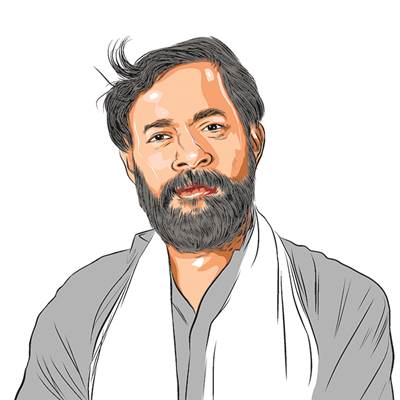

The passing away of Sachchidanand Sinha (August 30, 1928-November 19, 2025) was for me the closure of the 20th century. It marked the end of an era where someone without a college degree could be an intellectual giant, where a political thinker could help us make sense of the entire range of human experience, where thinking was not a profession but a vocation, where ideology was not a cuss word. A small and dwindling circle of socialists marked his departure as the end of the socialist ideological tradition. For me, it was the end of the age of ideology as I knew it.
It is a mark of our times that the death of such a preeminent thinker was not noticed by the world of ideas. At least not by its official custodians in academia and the media. The front page of the Patna edition of the Hindi daily Prabhat Khabar and a small tribute in this paper were among the few exceptions. To be fair, most journalists and academics may not have heard of him, when not conflating him with two of his better known namesakes.


Part of it was due to the very unusual trajectory of his life. Born in a family of freedom fighters in Bihar, he had his first brush with politics during the Quit India movement and then joined the socialist movement. That meant an abrupt end to his studies after the first year of his BSc. The Socialist Party asked him to work among mine workers in today’s Jharkhand, then railway and port workers in Mumbai (he worked as an unskilled khalasi in the railways when his own nana was a minister in the Bihar cabinet) and for B R Ambedkar’s election in 1952. This is where his political education happened, through the party library and evening study camps. He learnt a bit of French and German as well. Rammanohar Lohia noticed one of his early articles and invited him to join the editorial team of his magazine Mankind.
Sachchida ji was and remained a political worker, away from any position in the party, choosing ideas as the principal vehicle for his politics. After spending nearly two decades in a barsati in Delhi, he shifted back to his modest dwelling in the village of Manika in Muzaffarpur district, where he spent the last four decades of his life. He shunned positions, awards, fellowships. Except for a tiny group of socialist activists and Hindi writers, he was and remained an outsider to the intellectual world. Since the socialists, unlike the communists, had very little clout in academia, his work remained largely unnoticed. It did not matter to him, but it should matter to the world of ideas that struggles for relevance in New India.
More than his biographical disconnect, it was Sachchida ji’s intellectual disconnect — his steadfast refusal to follow the rituals and protocols of the world of ideas — that accounts for amnesia about him. He refused to be bound by the expertise-driven academic division of labour. He ventured into any field, studied and researched it deeply, where his curiosity and political priority took him. His output was not limited to footnoted articles and books. He wrote pamphlets, political booklets and handouts for training political workers, as also songs for children. His writings were informed by a sense of purpose and a need to communicate. He wrote simple, accessible prose, shorn of fancy buzzwords and catchphrases. His principal audience were political activists or thinking citizens, which allowed him to bridge the worlds of political thinking and action.
He set his own intellectual agenda, unconcerned with the dominant global debates. Very often, his work anticipated global debates. His thesis on “internal colonialism” foreshadowed the “dependency” school. He defended coalitions as a form of political power before the experiments of the 1990s. He focused on caste and reservation before it became academically respectable to do so. And he foregrounded the limits to development and the ecological destruction caused by it before it became global talk. At the same time, he did not feel the need to respond to many of the dominant intellectual conversations of the last few decades. Sachchida ji was a model of the kind of political thinkers India so desperately needs.
“Saada jeevan, uchha vichar (simple living, high thinking)” was one of the phrases we learnt in school. It was my fortune that I met Sachchida ji, Kishen (Pattanayak) ji and Ashok (Seksaria) ji who lived this motto. Sachchida ji lived the life of a sadhu, indifferent to material comfort, political power, popularity or recognition. He was not just self-effacing, he had a way of self-erasure.
Yet he would not erase an iota of truth, however uncomfortable it might be. He would not compromise on political commitment or intellectual integrity. Those who wish to address the vacuum of political thinking in contemporary India could begin by reading him.
The writer is member, Swaraj India, and national convenor, Bharat Jodo Abhiyaan. Views are personal


