It’s official! Ahmedabad will host the 100th Commonwealth Games in 2030. All eyes will now be on India, as it showcases its mettle in staging a multisport event, exorcising the ghosts of Delhi-CWG2010, and signalling its readiness for the Olympics. As a responsible custodian of mega-events in the climate age, ensuring carbon neutrality, embedding circular economy principles into its planning, and aligning with SDGs are non-negotiables. But how prepared is India?
The impacts of climate change are evident across sectors worldwide, producing oppressive heat and sudden cold spells, sport in particular is feeling the vulnerability. This directly influences an individual’s health, performance, and the very ability to participate. Heatwaves heighten the risk of dehydration, cramps, and even fatal heatstrokes, particularly in endurance-heavy disciplines like cycling and marathon running. Poor air quality impairs lung function, aggravates respiratory illnesses, and triggers eye and skin irritation.

These pressures carry tangible consequences: Event cancellations, truncated local leagues, and relocation of competitions. Long-term exposure to extreme weather may also reduce children’s interest in outdoor play. Where possible, many may shift to indoor sports or digital fitness/leisure activities, patterns associated with rising lifestyle-related diseases. Heterogeneity analysis indicates this trend is more pronounced in urban centres. Infrastructure damage from storms, flooding, and coastal winds further compounds the challenge, especially for sports venues located near shorelines.
Playing outdoors in natural light used to be routine, but it’s being replaced by climate-controlled environments. While technology has enabled this shift, it also raises venue costs through cooling, lighting, and capital-intensive construction. Weather-related injuries like slippery surfaces, uneven fields, and sudden rainstorms are all on the rise. To ensure athlete safety, several countries follow the Wet Bulb Global Temperature (WBGT) based heat protocols. In the US, exceeding temperature thresholds triggers shortened practice sessions or mandatory breaks. The Australian Open implemented its “Extreme Heat Policy” in 2023 when conditions reached level 5, compelling officials to halt play. Such measures illustrate how climate realities are redefining playing conditions worldwide.
At the broader level, climate change is reshaping sports calendars, ecosystems, and economies. The UN’s Sports for Climate Action initiative, launched at COP24 in 2018, seeks to align the sports sector with a 1.5°C climate-safe future through reduced emissions, mindful travel, and collaborative partnerships. and leverages sport’s cultural influence to strengthen the narrative of climate change.
The IOC has embedded sustainability in its Olympic Agenda 2020+5, yet, mega-events like the Olympics and FIFA World Cup remain major emitters. Typically, the Summer Olympics generates 3–3.5 million tonnes of CO₂. Even Paris 2024, marketed as the “greenest Games yet”, produced 1.6–2.1 million tonnes, similar to the spectator-free Tokyo2020. Major emission drivers continue to be construction, travel by athletes, officials, and spectators, and energy use. While leagues such as UEFA, the EPL, SPL, and NFL have lower per-event emissions, their year-round schedules create a significant cumulative footprint.
Training methods are also being recalibrated. Additionally, inequitable access to cooling technologies, sports science, and climate-controlled training centres threatens to widen the performance gap between affluent and resource-constrained nations.
Competitions are evolving accordingly. Leagues are experimenting with seasonal shifts, nighttime fixtures (also suited to global broadcasting windows), and relocating events to more ‘climate-reliable’ regions. Sponsors and broadcasters now factor climate risk into contracts, increasing insurance requirements to safeguard business continuity. Many traditional winter-sport venues now rely heavily on artificial snow, affecting skiing, snowboarding, and outdoor ice sports that cannot simply move indoors.
The scene is no different in India. Even as the government articulates its ambition to become a sporting powerhouse, it must navigate the same climate vulnerabilities affecting nations worldwide. India’s major sporting events: the National Games, Khelo Games and IPL are energy-intensive and generate substantial waste. Compounding this, severe air pollution has recently forced school closures across NCR-Delhi, and has led to health advisories discouraging outdoor activity in the Nov-Dec period.
Despite growing global momentum on climate-conscious sports frameworks, India’s policy landscape remains fragmented. The newly approved Khelo Bharat Niti 2025, revisited after 24 years, surprisingly omits any reference to environmental sustainability or emission reduction for major sporting events. This is a significant gap. For a nation aspiring to host the 2036 Olympics, sustainability will be a pivotal factor. Meanwhile, countries like Indonesia and Qatar have already signalled climate-smart ambitions in their Olympic bids. Earlier this year, the MYAS, along with the Uttarakhand government, introduced the “Green Games” concept at the 38th National Games. Private leagues can amplify ‘green protocols,’ setting benchmarks for venues, travel, and waste management, reinforcing India’s 2070 net-zero commitment.
Integrating climate and sports policies is no longer optional; it is strategic, economic, and essential. Athlete safety, fan experience, financial viability, and India’s long-term sporting ambitions all depend on it. By embedding sustainability at the core of sports governance, India can lay the foundation to emerge as a torchbearer of a truly sustainable sporting nation.
Malathi Renati is Head of Policy School, Takshashila Institution and Gaurav Gullaiya is a sports policy consultant

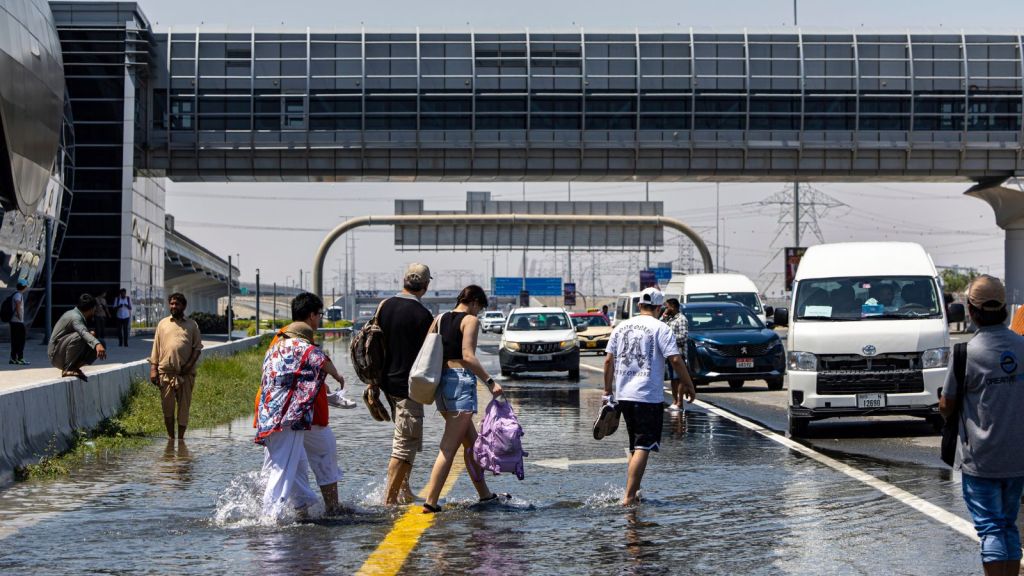 People walk through floodwater caused by heavy rain while waiting for transportation on Sheikh Zayed Road highway in Dubai, United Arab Emirates, April 18, 2024. A report says climate change played a role in the floods. (AP Photo/Christopher Pike, File)


 Share


