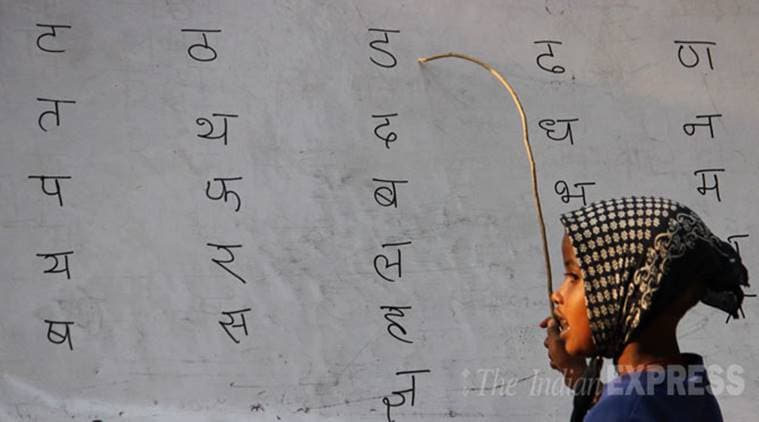

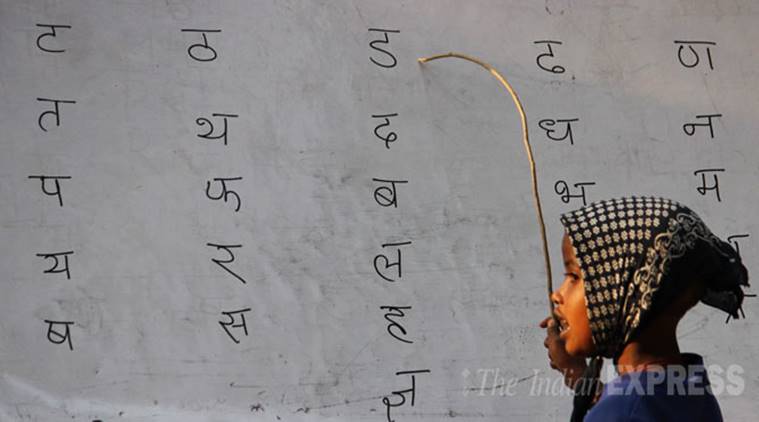
The Hindi agenda shows in the official actions and political preferences of the establishment. By choosing to implement the committee’s recommendations, the government has announced its bias. Of course, the issue is not only about the implementation of the recommendations of the parliamentary committee. The claim that Hindi is the national language is already pervasive in large parts of north India. Among academic circles there, Hindi is formally adopted not so much because audiences are (mostly) Hindi-speaking, but because of an implicit insistence on speaking the official (read national) language unmindful of the composition of the audience. It almost promotes the idea that citizenship is coterminous with Hindi.


The compromise on the language question deferred a single national language and instead devised the “three-language” formula. This was given a go-by in most of north India, by not learning or teaching any modern Indian language except Hindi. Elsewhere too, nowhere did we seriously attempt to encourage the learning of “other Indian” languages; some states adopted only two languages, states like Maharashtra adopted Hindi as the only other Indian language besides the region’s own.
In the absence of multilingual skills, the issue of a link language is often converted into the all too familiar anti-English
discourse. The irrelevance of that discourse is evidenced by the chasm between the elite insistence on villainising English and the popular tendency to opt for English language skills. Anti-English criticisms are often employed in the pro-Hindi arguments as a ploy. Lest this be misunderstood, it should be stated that this writer has written enough in his own language (Marathi) to outweigh his English writing. Therefore, the objection is not to enriching Indian languages, it is about enforcing a false debate in the name of either nationalism or an anti-English crusade, both evoking linguistic chauvinism. People adopt Hindi for pragmatic considerations. They also turn to English from similar concerns.
So, three things were already happening even before the current attempts to enforce Hindi: One, Hindi was perceived as the national language in many parts of the country. Two, the north often refused to learn other Indian languages. Three, Indian languages ordinarily got a raw deal everywhere.
In this backdrop, the semi-official insistence on Hindi can only further accentuate these same distortions and create new complications. First, it would weaken the authentic movements for the enrichment of all Indian languages. Two, it would create an unnecessary wedge between Hindi-speaking populations and non-Hindi speaking ones. Three, the curse of official Hindi would gain in strength. It is one thing to be able to understand a smattering of Hindi mostly introduced by street practices or Hindi films. It is entirely another thing to fathom either official, sarkari Hindi or chaste academic Hindi. The burden of acquiring the skills of this formal Hindi will create additional pressures on citizens and put some sections of a Hindi-speaking population to an undue advantage.
For the last half-century, India managed to bypass the tricky debate on language. During this time, the opposition to spoken Hindi considerably diminished, thus allowing Hindi to become the language of ordinary transactions among citizens. Besides Hindi cinema, this was achieved by the political economy of north India that forced migration on large numbers of the poor. Ironically, poverty effected an intermingling of language communities. But the Hindi enthusiasts and self-appointed architects of a homogenised national identity have taken it upon themselves to undo what natural intermingling achieved. They want every Indian to learn formal Hindi and use it for official transactions.
This produces both a burden and a tension. The burden is that for a large majority in the country, two different language skills are required for two separate terrains of transactions. For official transactions, they would be required to learn Hindi, while for livelihood opportunities and global transactions, they need to acquire English language skills. While this burden may cause tensions arising from unequal competition, the insistence on Hindi can create additional tensions over identity. If that happens, we would have only ourselves to blame because by bringing in Hindi chauvinism, we would be forgetting the clumsy compromise of the Sixties that stood us in good stead. Both Hindi enthusiasts and those concerned with Indian languages would do well to leave Hindi out of the national language debate and instead focus on genuine multilingualism as routine language practice.
It is easy to blame the establishment for inducing linguistic chauvinism, but the confluence of Hindi enthusiasts and language chauvinists who link Hindi to nationalism is making the present moment all the more worrisome. Is it not that hegemony is built by appropriating prevailing sensibilities?
The writer taught political science at Savitribai Phule Pune University and is chief editor of ‘Studies in Indian Politics’


