Written by Manimugdha S Sharma
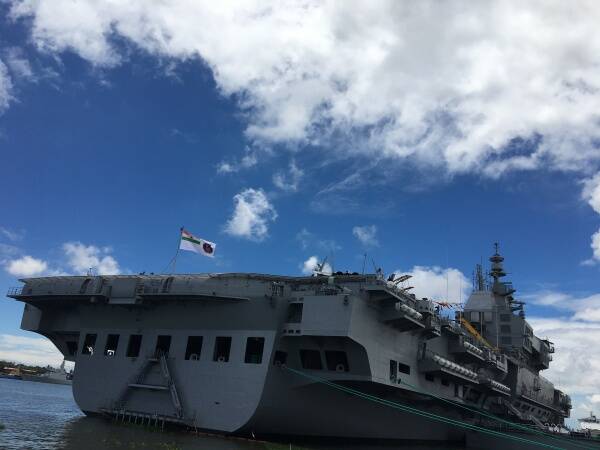
Prime Minister Narendra Modi on September 2 unveiled the new naval ensign and dedicated it to Maratha king Shivaji, calling him the “father of the navy”. An explanatory video was soon released that talked about the Indian Navy’s “civilisational heritage” and explained how the new ensign was inspired by the Maratha chhatrapati’s seal design.


Even though selectively deployed by Hindu nationalists to claim that they were written out of textbooks in favour of “Islamic” empires, the imperial Cholas still don’t have much rhetorical appeal in the Hindutva discourse, unlike the Marathas. That they did not have Muslim adversaries is one reason, but a largely medieval polity from the south of the country has a limited recall in the north where Hindu nationalist politics thrives. But any claim about the Cholas or the Marathas being the “father of the Indian Navy” hides historical reality.
The service history of the Indian Navy takes it back to the East India Company’s Marine, formed in the early decades of the 17th century — before the Marathas had their navy. Over the course of over three centuries, it became the Bombay Marine, Indian Navy, Her Majesty’s Indian Navy, Bombay Marine again, Her Majesty’s Indian Marine, Royal Indian Marine, Royal Indian Navy, and finally, back to Indian Navy when India became a republic in 1950.
This bit of history should have been familiar to all and sundry. Turns out, it is not. Instead, what is happening is an alternative past is being imagined in which there is an unbroken continuity from the Mauryas, Guptas, Cholas, and Marathas, all the way down to the modern Indian Navy. The limitations of such a construct become visible when “cultural and spiritual” connections are emphasised over physical ones.
The point that has been missed all along is that the maritime history of a country and the service history of a navy are two different things. India has a rich maritime history that goes back thousands of years. At various points in history, dominant polities operated navies, but these were usually brown-water navies that operated in littoral zone waters. There were some exceptions like the Cholas who were able to project their power across the waters, but exceptions were not the rule. Besides, historical navies operated in their context; modern strategic visions cannot be projected onto them.
Right-wing commentators, in keeping with the “India is vishwaguru” discourse, have been going on and on about Indians teaching Europeans how to navigate. But the fact remains that the coming of the European powers to India’s shores towards the end of the 15th century changed local attitudes towards naval warfare.
Powered by mercantilism and innovations in navigation and gunpowder technologies, European fleets presented an existential threat to Indian coastal powers. These powers tried to address this challenge with mixed results. For instance, the Muslim Kunjali Marakkars, fighting for the Zamorin of Calicut, challenged the Portuguese bid for control of the Malabar coast in the 16th century with some success. But eventually, their power was destroyed when the Zamorin ganged up with the Portuguese against them in 1600. This was a few decades before Shivaji was born.
Shivaji showed great military acumen in building a navy that by the time of his death in 1680 had expanded to 250 ships. But the strategic objectives of the Maratha navy in the chhatrapati’s lifetime seem to have been “to counter and, possibly, pre-empt the marauding Siddis (of Janjira) adept at projecting power on land from their sea bases”, write historians Anirudh Deshpande and Muphid Mujawar in their recent book on the Maratha navy, The Rise and Fall of a Brown Water Navy.
Even when they challenged European naval power, the Marathas could only do so in the littoral zone waters. Shivaji’s merchant vessels going towards West Asia, just like the Mughal vessels, had to pay for cartaz or special passes from the Portuguese who controlled the high seas.
The most brilliant phase of the Maratha navy came in the post-Shivaji era under the stewardship of sarkhel Kanhoji Angre, who successfully asserted Maratha sovereignty over the waters but whose own interests and that of the Maratha state didn’t always converge. But just like the Kunjali Marakkars, a similar fate befell the Angres when the Maratha Peshwa and the East India Company joined hands in 1756.
Despite all this exciting action along the western coast, the high seas forever remained under the control of the European fleets and the Marathas never had the means or vision to challenge them there. “The only exception was Mysore where a different naval vision seems to have arisen. Hyder Ali and Tipu Sultan understood the importance of naval power like none of their Indian contemporaries. Compared with Mysore, the Marathas under the Peshwas influenced a longer strip of the coast but never conceived the possible construction of a blue-water navy,” Deshpande and Mujawar argue.
Today’s Indian Navy rightfully honours both the Angres and the Kunjali Marakkars and many others from India’s maritime history. But whether it needs to rewrite its past through acts of omission and commission is an open question. In any case, the acknowledgement of the colonial genesis of the Indian Navy is not a sign of “mental slavery”.
The writer is pursuing a PhD in History at the University of British Columbia, Vancouver, Canada, and is the author of Allahu Akbar: Understanding the Great Mughal in Today’s India


