
By : Navroz K. Dubash and Ashwin Gambhir
As the date nears for US President Barack Obama’s visit, there may well be a high-profile joint statement on energy and climate policy. With the recent memory of a joint US-China statement on energy and climate, and an upcoming landmark climate change meeting in Paris at the end of 2015, there is growing speculation that, as part of a wider package, India will unveil a goal of renewable energy growth in the range of 15-20 per cent (some guessing even as high as 33 per cent) of its electricity needs coming from zero-emission sources by 2030.


Renewable energy (RE) is very much part of this government’s domestic policy agenda. In recent months, the government has informally announced a target of 100 gigawatts (GW) of solar power by 2022 (up from about 20 GW), backed by preparation of a new RE law and RE-friendly amendments to the Electricity Act, an investor meet planned for February and serious discussion of a wind energy mission. Translating these initiatives to a foreign policy context provides a relatively straightforward way to reap a double dividend.
While climate change action provides the immediate context, the strongest arguments for aggressive RE promotion are domestic. RE brings the promise of greater energy security through less reliance on foreign imports and less exposure to global fuel price shocks, the potential for enhancing energy access for development, and scope for diminished local environmental pollution. RE has the potential to be the lynchpin of an energy future that enables growth, supports equity and promotes environmental sustainability.
So far, so good. What does it take, however, to translate potential foreign and domestic gains to reality? In order to make sure we do not overpromise and underdeliver, it is necessary to dive into the details of the RE sector and identify the conditions under which this will work. The results of two recent government studies help provide some context (see table).
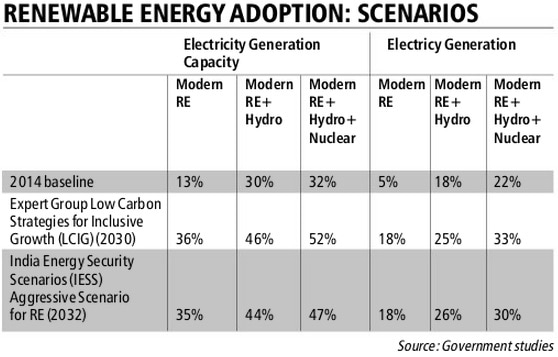
However, these studies by themselves may not provide a sufficiently robust basis for making this decision. The India Energy Security Scenarios (IESS) is explicitly a scenario tool to explore alternative scenarios and does not, as yet, incorporate costs. While the Low Carbon Strategies for Inclusive Growth (LCIG) does attempt to assess macroeconomic costs, the energy-related outcomes are derived entirely from assumptions about rates of technological change in particular technologies that result in certain growth rates in each sub-sector. For example, the LCIG projects future annual growth rates of 11 per cent for wind (versus 25 per cent over the last 12 years), 25 per cent for solar (although a 100 GW target would raise this even further) and 14 per cent for nuclear (compared to 4.6 per cent over the last 15 years). The robustness of these assumptions and the resultant projections is not clear. Any target-setting should ideally be based on a better justified and more widely debated set of assumptions.
Beyond quantitative scenarios, enhancing the share of RE in practice requires assessing and addressing a range of broader issues. For example, aggressive energy efficiency measures can be an essential complement to RE-based supply-side measures, since they decrease the total electricity used, thereby increasing the share of RE in the total electricity mix. Complementary electricity sector policies on grid reform and distribution sector reform, as well as policies around land and siting issues are necessary to enable RE investments. From a macroeconomic perspective, since RE is capital intensive, lower interest rates can accelerate RE investments. Internationally, and largely beyond India’s control, global demand for RE will affect the price trajectory of some technologies, as will the prices of competing fossil fuels. A credible RE goal needs robust projections and also a realistic analysis of the scope for broader electricity sector reforms and global economic trends.
RE holds considerable promise as the central element of a future Indian electricity sector that delivers growth, equity and environmental sustainability. To deliver, however, Indian RE policy needs to be embedded within a larger and analytically robust discussion of Indian energy policy and planning. This, in turn, can and should form the basis for a robust and defensible climate contribution. Any target-setting, particularly if hasty and opportunistically driven by Obama’s visit, needs to be quickly followed by concerted focus on these larger questions, with opportunity for broader debate and discussion.
Dubash is senior fellow, Centre for Policy Research, Delhi. Gambhir is senior research associate at Prayas Energy Group, Pune


