
Opinion P Chidambaram writes: The second killing of Mahatma Gandhi
What started with Jawaharlal Nehru has now reached Mahatma Gandhi. The BJP’s grave wrongs will not be forgiven by the people of India
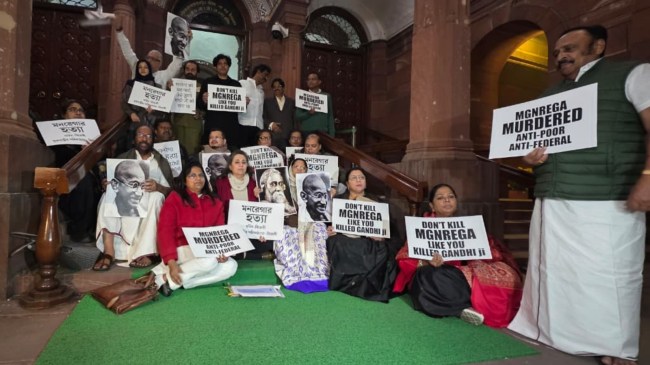 Opposition MPs protest at Parliament complex, Thursday night. (Express)


Mahatma Gandhi was assassinated on January 30, 1948. The RSS vehemently denied that its ideology and propaganda motivated the assassin. The RSS claimed that the ban imposed on the organisation by Sardar Vallabhbhai Patel was unjust. Let’s, for a moment, take the RSS at its word, and pose the following question to the RSS and its progeny, the BJP: Why did you erase the name of Mahatma Gandhi from the one — and only — socio-economic programme named after him?
The programme named after Mahatma Gandhi is the Mahatma Gandhi National Employment Guarantee Scheme (MGNREGS) supported by an Act of Parliament. The government has passed Bill No. 197 of 2025 in Parliament to repeal the Act and the Scheme. Section 37(1) of the Bill reads:

“Save as provided in section 10, on and from such date as the Central Government may by notification appoint in this behalf …the Mahatma Gandhi National Rural Employment Guarantee Act, 2005, with all rules, notifications, Schemes, orders and guidelines made thereunder shall stand repealed.”
The Bill goes further: it obliges, under section 8(1), every state government to make a Scheme for providing a guarantee of 125 days of wage employment in a financial year to every household in the rural areas; the Scheme shall conform to the minimum features specified in Schedule I of the Bill; and under Schedule I, the first minimum feature is:
“The Scheme notified under section 8 of the Act by all States shall be called the ‘Viksit Bharat—Guarantee for Rozgar and Ajeevika Mission (Gramin): VB—G RAM G Scheme’.” The name is not only a mouthful, it conveys no meaning to a non-Hindi speaking citizen and is an affront to such citizens.
Lifeline for poor
The 100-days-a-year wage employment guarantee scheme was the lifeline for 12 crore families to ensure that the household did not go to bed hungry and dejected. It was a boon for the poor, especially women and the elderly without regular employment. It put money in the hands of the women in the household giving them a degree of independence that their foremothers had not experienced. It created a safety net for the poor. The Bill snatches these benefits away, cruelly.
In the first Budget of the UPA government (2004-05), I had said: “In our scheme of things, the poor will have a first charge on … the entire Plan funds…Work has begun on the National Employment Guarantee Act. The object is to guarantee 100 days of employment in a year to one able-bodied person in every poor household…”
- The soul of the Act was ‘guaranteed livelihood security’ and its key features were:
- The Scheme was universal, demand-driven and available throughout the year.
- The wages were guaranteed by the central government.
- The Scheme was financed by the central government; the State’s share was 25 per cent of the material cost alone.
- If refused work, the person was entitled to an unemployment allowance.
- As the Scheme evolved, it acquired a welcome tilt towards women workers.
Negating spirit of MGNREGS
The Bill and the Scheme destroy every one of the above. The Scheme will be state-specific and the costs will be shared by the Centre and the state in the ratio of 60:40. The central government will make a ‘normative allocation’ of funds to each state, the expenditure in excess of the allocation will be borne by the state and the areas where the Scheme will be implemented will be notified by the central government, stealthily making it a supply-driven Scheme. The state shall ‘guarantee’ employment for 125 days — a chimera. No work shall be provided during notified peak agricultural seasons aggregating 60 days in a year. The unemployment allowance can be as low as 25 per cent of the notified wage and hedged with numerous conditions including the economic capacity of the state. The central government will be the arbiter on all aspects, making the Bill anti-federal. In effect, the Bill and the proposed Scheme turn the original concept of guaranteed livelihood security on its head. States — BJP ruled, especially — will plead economic incapacity, seek lower normative allocation and smaller areas of implementation, and gradually kill the Scheme.
Erasing from memory
On February 28, 2015, Mr Narendra Modi said in Parliament “My political sense tells me never to scrap MGNREGA. ….it is a living monument to your (UPA’s) failures.”
Over the years, MGNREGS suffered neglect. Though promised 100 days of employment, the average has hovered around 50 days per household. Out of 8.61 crore job card holders, only 40.75 lakh households completed 100 days of work in 2024-25 and only 6.74 households in 2025-26. The unemployment allowance, which is the responsibility of the state government, is rarely paid. The allocations are inadequate and the BE has fallen from Rs 1,11,170 crore in 2020-21 to Rs 86,000 crore in 2025-26. Total number of households that worked has declined from 7.55 crore in 2020-21 to 4.71 crore in 2024-25. Arrears of unpaid wages have mounted to Rs 14,300 crore.
Bill’s defects apart, the Bill is a deliberate attempt to erase Mahatma Gandhi from the nation’s memory — which is reprehensible. In the BJP’s reckoning, the history of independent India began on May 26, 2014. The past must be erased. What started with Jawaharlal Nehru has now reached Mahatma Gandhi. The BJP’s grave wrongs will not be forgiven by the people of India.

 Share
Share


