
Opinion P B Mehta writes: MNREGA was the ground beneath our feet. It’s slipping away
One of the principal arguments advanced against the MGNREGA is that it raises wages. This concern underlies the clamour to restrict the scheme to the agricultural off-season. But in the context of the extreme precarity at which the Indian poor operate, this concern is close to moot
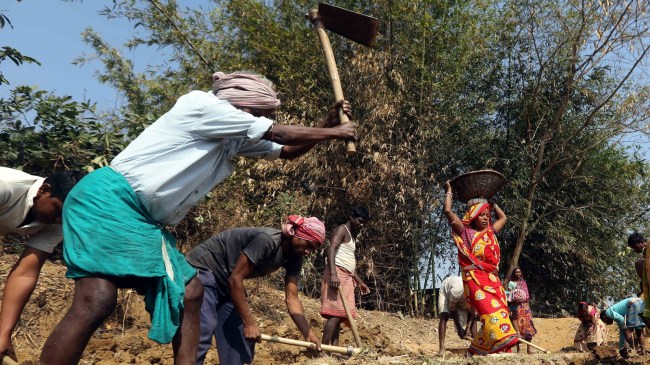 Viewed over the longer arc of the past two decades, the MGNREGA may come to be seen as more than a relative economic success.


If the Nobel Prize were awarded for genuine economic thinking combined with demonstrable positive policy impact, the architects of the Mahatma Gandhi National Rural Employment Guarantee Act (MGNREGA) would rank among the strongest candidates. It is difficult to imagine a public programme of comparable scale that was both so carefully designed and so consequential in its effects. Yet the way the MGNREGA is usually debated is strikingly impoverished. It is too often dismissed as a mere welfare handout, or defended only as a normatively attractive rights-based scheme. In fact, the MGNREGA represented a far deeper revolution in how poverty alleviation, labour markets and service delivery are conceptualised in India.
The MGNREGA is possibly the most intensively studied public policy in Indian history. There are hundreds of academic papers analysing its design, implementation, and effects. The overwhelming verdict, even among scholars who began as sceptics, is that the scheme has been a remarkable success. Among the most rigorous and influential contributions is Karthik Muralidharan, Paul Niehaus, and Sandip Sukhtankar’s paper, ‘The General Equilibrium Effects of (Improving) Public Employment Programs: Experimental Evidence from India’. Their findings went far beyond documenting the scheme’s direct benefits. They showed that the general equilibrium effects were substantial: Household earnings rose by about 14 per cent, poverty declined by roughly 26 per cent. The programme increased the bargaining power of labour. This led to higher wages and greater local demand, which in turn generated additional non-farm employment.

It is therefore astonishing that one of the principal arguments now advanced against the MGNREGA is precisely that it raises wages. This concern underlies the clamour to restrict the scheme to the agricultural off-season. Economists often worry when wage growth outpaces productivity growth. But in the context of the extreme precarity at which the Indian poor operate, this concern is close to moot. More importantly, the evidence showed that higher wages under the MGNREGA did not lead to reduced employment. That rising wages for the poorest workers could be treated as a defect rather than a virtue of the scheme is mind-boggling. Indeed, elevating the bargaining power of labour was not an unintended side effect; it was central to the economic logic of the MGNREGA. And it achieved this without adverse macroeconomic consequences.
Public memory is short. Despite its implementation weaknesses, the MGNREGA was the programme that effectively helped save India during the Covid shock. It provided a critical lifeline to millions of households and played a key role in sustaining rural demand. Even the Narendra Modi government, initially hostile to the scheme and later content to dilute it through administrative attrition, was compelled to rely on it during the crisis. The MGNREGA thus functioned not merely as a welfare measure, but as an instrument that generated a virtuous cycle of economic effects across the rural economy.
Equally important were the theoretical principles that informed the scheme’s design. Even setting aside any commitment to a rights-based welfare state, the MGNREGA grasped a fundamental truth about governance in India: Targeted programmes are exceptionally prone to failure and manipulation. Universality, near-universality, or self-targeting offers the best chance of success. The current government itself has grudgingly acknowledged this logic in expanding food security coverage. The MGNREGA cut through interminable debates by adopting a self-targeting design: Anyone willing to do the work could demand employment.
The social consequences of this design choice were transformative. Nationally, more than 57 per cent of the MGNREGA employment days generated in 2023 accrued to women; in states such as Tamil Nadu, the figure rises to nearly 80 per cent. Few public policies have so decisively altered gendered patterns of labour force participation at scale.
The demand-driven nature of the MGNREGA also made it unusually supple. It could respond to diverse local conditions and shifting economic circumstances across states. Its signalling value, that the state would act as an employer of last resort, was immense. In principle, the scheme could certainly be improved, for example, by better linking it to skill formation or more durable public asset creation, and by situating it within a changing welfare architecture. Yet many of its apparent shortcomings were deliberate design choices. The gains from simplicity far outweighed the benefits of burdening the programme with multiple, and often conflicting, objectives.
From this perspective, proposals to alter the scheme by allocating work to states on supposedly objective criteria determined by technocrats in NITI Aayog represent a regression in India’s administrative architecture. The changes proposed in the new VB-G RAM G Bill largely move in the wrong direction. On the surface, extending the employment guarantee to 125 days appears progressive. In practice, however, this is likely to be nullified by seasonal pauses, by converting a demand-driven entitlement into a budget-capped, supply-driven programme and by shifting a greater financial burden onto states.
The MGNREGA, for all its limitations, was also a significant instrument of decentralisation, empowering gram panchayats in meaningful ways. Although the new Bill formally involves panchayats in planning, the requirement that these plans align with centrally determined priorities will, in practice, hollow out their agency.
The UPA government largely got the policy design right but mishandled the politics of the MGNREGA. Congress lacked the organisational capacity to credibly claim ownership of the scheme’s successes, despite its administrative imperfections. In 2014, party leaders compounded this error by projecting the MGNREGA as a ceiling of achievement rather than a floor, allowing Narendra Modi to appropriate the language of aspiration. From the outset, he successfully framed the MGNREGA as emblematic of a politics of low ambition, an interpretation eagerly amplified by a media ecosystem indifferent to scholarly evidence and reflexively aligned with elite discomfort over higher wages. That this government also displays an instinctive aversion to anything bearing Gandhi’s name only reinforced this posture.
Yet, viewed over the longer arc of the past two decades, the MGNREGA may come to be seen as more than a relative economic success. It may well have been the bedrock safety net that underwrote political stability in a period of profound economic and social transformation. Quite literally, it provided the political and economic ground beneath our feet.
The writer is a contributing editor at The Indian Express

 Share
Share


