
Opinion No proof required: Sons, daughters, class
Prior to the advent of Modi’s “unscrupulous doctors” practising abortion of the girl foetus, Indian parents had enforced a son-preference society through neglect or infanticide of the girl child.
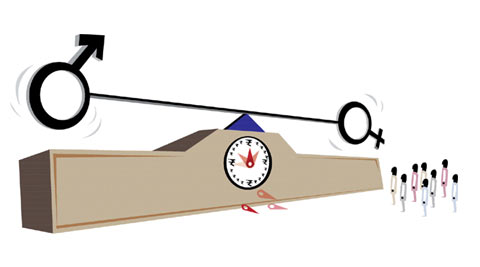



 Modi also pointed to the culpability of parents who treated daughters and sons unequally. Pradeep Yadav
In his Independence Day address a year ago, Prime Minister Narendra Modi highlighted the unpleasant reality that India was a kudi-maar (daughter killing) nation. He said: “Have we seen our sex ratio? Who is creating this imbalance in society? Not the almighty. I appeal to doctors not to kill the girl child.” This was a first for a PM — to openly discuss the shame of our traditional society, the fact that we wantonly kill girls, and have done so for centuries. Prior to the advent of Modi’s “unscrupulous doctors” practising abortion of the girl foetus, Indian parents had enforced a son-preference society through neglect or infanticide of the girl child.
Modi also pointed to the culpability of parents who treated daughters and sons unequally. He zeroed in on a key ingredient of gender inequality — discrimination in educational opportunities between sons and daughters — and coined the slogan “beti bachao, beti padhao”. Social scientists have for long pointed out that intra-household discrimination in food, education and healthcare translates into higher girl child mortality and lesser human capability development among girls. But what India began to do from the 1980s and more starkly from 2001 onwards was to eliminate daughters even before they could be born. Or even before they could be conceived (by using pre-conception sex selection methods). Gender-biased sex selection had become the fashionable way of planning the desired family, one that had few or no daughters.

Nature produces a stylised constant at birth — 105 boys born for every 100 girls born (this is equivalent to the Indian version of the neutral sex ratio — 950 girls born for every 1000 boys). Nature also produces a higher mortality rate for boys such that by the early teens, an equal number of boys and girls are present in society. That is as it should be in civilised societies. In India, the sex ratio at birth (SRB) averaged around 110 in the mid-1980s. In both the mid-1990s and mid-2000s (2004 to be precise), the sex-ratio peaked at around 113 boys for every 100 girls born. In 2000-02, the SRB was 112 boys to a 100 girls; it began improving in 2005-07 and the latest 2012 estimate produced by the Sample Registration System (SRS) is 110.
The story is one of transformation: Between 2005-12, the sex ratio improved by approximately the same amount it had lost in the previous 20 years. This means that the number of girls killed at birth has declined. According to a new report by the UNFPA, the missing number of girls has come down to 2,90,000 in 2012, much lower than the average of 4,50,000 for the previous 12 years. What happened?
According to our research, a major reason is the changing mix of the share of the middle class in the population. On a broad-brush basis, a society has four classes — absolute poor; not poor but not middle class, which we call the emerging middle class (EMC); middle class; and rich. The middle class is defined according to the poverty line in rich economies; in 2011, it was approximately equal to PPP $12 per person per day. This line separates the poor from the beginning of the middle class in developed societies.
The EMC comprises those who are poor by international standards (income below PPP $12 or Rs 221 per person per day, in 2014 prices), but not by domestic standards. The latter in India’s case is an income level corresponding to Rs 59 per day (PPP $3.2 a day), somewhat higher than the Tendulkar consumption poverty line of Rs 37 per day. So the range of incomes for which a person’s income is between the income poverty line (Rs 59 per day) and the international poverty/ middle class line (Rs 221 per day) is defined by us to be the EMC. The difference between the two middle classes is important. They differ in terms of income, of course, but also in terms of their attitudes and behaviour.
The EMC consists of people who have climbed out of poverty and whose goal is to become members of the middle class, a class that no longer has worries about slipping back below the poverty line. Class status affects the demand for both the number of children and its sex composition. But changing the latter involves significant expenditure. The poor, while they may want to affect the sex of their child, cannot afford to do so. The international middle class has education and values that do not favour sex selection. They emphasise child quality a lot more than child quantity, so they tend not to sex-select. Summarising, the poor are too poor to afford sex selection; the EMC has the desire and ability to execute sex selection; the stable middle class has the financial ability but no longer the desire to sex-select.
If this framework is broadly acceptable (and we find it to be empirically valid), a major explanation for trends in the proportion practising sex selection in India is the size of the EMC. Its size grew post the 1980s, coming to a peak in the early 21st century. In 1984, the poor accounted for 57 per cent of the population and the EMC for 40.5 per cent. In 2004, the proportions were 28.2 per cent poor, 59 per cent EMC and 12.8 per cent middle class. By 2012, the proportion of the EMC was at 59 per cent, after reaching a peak of 62 per cent in 2009, and the middle class had risen to 30.4 per cent. According to trends, the size of the EMC is expected to decline to less than 32 per cent by 2025. With this decline, the sex ratio at birth in 2025 is expected to be the lowest ever, and close to the neutral 105 level.
In 2011, we had first offered this optimistic scenario based on SRS data till 2008 and NSS data for 2009-10. The latter showed that India had achieved a turnaround and that, primarily because of the growth of the middle class, the SRS sex ratio would show this turnaround when data became available. Our results were met with considerable scepticism by editors and experts alike — hence, a week later, we presented a second paper detailing the basis of our results. (‘The girl child’s future’, The Indian Express, November 5, 2011 and ‘More girls being born not less’, The Indian Express, November 12, 2011).
We are somewhat surprised (but pleasantly so!) that our forecast turned out to be accurate, and this emboldens us to make our prediction that after a decade, daughter discrimination will officially end in most parts of the country (except Haryana and to a lesser extent, Punjab). But who knows, maybe the demonstration effect will end the scourge sooner than predicted by our model.
Bhalla is contributing editor, ‘The Indian Express’, and senior India analyst, The Observatory Group, a New York-based policy advisory group. Kaur is professor of sociology in the department of humanities, IIT Delhi
 Share
Share


