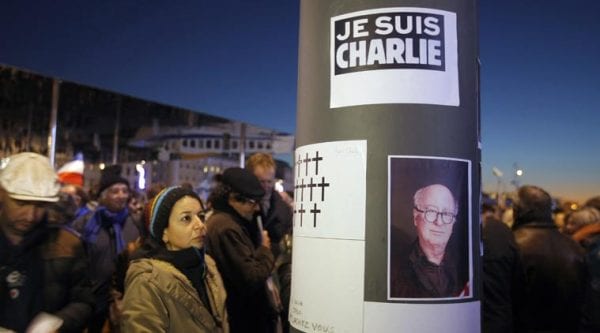
While the killing of the French cartoonists must be condemned in unequivocal terms, I find myself hard pressed to hold a placard and declare “Je suis Charlie”. As the pressure mounts, among friends and colleagues and on social media, to claim ownership of Charlie Hebdo, and by extension, all forms of radical expressions of dissent, freedom of speech and the right to offend, I must say in equally clear terms: “I am not Charlie Hebdo and I am not a terrorist.” I cannot have a choice forced upon me. I cannot be deliberately offensive. And I refuse to revel in puerile ways of ridiculing the “other”.
In the din of outrage evoked by the January 7 killings, moderation seems to have become the first casualty. What’s more, for one — and especially a Muslim — to withhold one’s solidarity for what Charlie Hebdo was and what it consistently stood for is tantamount to being the “other”, not to mention humourless, rigid and untrustworthy, in a deeply polarised world. That the right to dissent works both ways seems lost on the champions of free speech. This seems akin to former President George W. Bush’s famous assertion while launching his “war on terror”: “You’re either with us or against us.” The frightening rightwing-ism of the defenders of subversion and satire is matched by ignorance of what Charlie Hebdo has published — not occasionally but consistently.


Joe Sacco, an acclaimed graphic artist, writes in The Guardian of January 9: “Along with grief came thoughts about the nature of some of Charlie Hebdo’s satire. Though tweaking the noses of Muslims might be as permissible as it is now dangerous, it has never struck me as anything other than a vapid way to use the pen.” Pointing out the “limits” of satire, Sacco goes on to note, “when we draw a line, we are often crossing one too”. Charlie Hebdo was crossing that line repeatedly and doing so with impunity. Of course, its cartoonists did not deserve to die for it. Of course, the sane, sensible reaction to any form of offence is to ignore and disregard. Of course, the right thing to do is to not buy the Charlie Hebdo if you don’t like what it prints.
Refuting charges of Islamophobia and racism, Charlie Hebdo has claimed the right to offend and offend with impunity. While it is true that the newspaper has taken potshots at all religions, including Christianity and Judaism, it is also true that its staff dip their pens in a special vitriol when it came to Islam. It has always derived a perverse pleasure in displaying a gleeful irreverence for Islam and its Prophet. Given that Muslims constitute the single largest — and most visibly distinct — minority in France, its darts have found a perfect target among the immigrant populations crowded in the urban ghettos that skirt Paris. Given also that Muslim immigrants are the poorest and most disenfranchised of French citizens, the consistent attacks in print acquire a sinister xenophobic tinge in a country that is becoming alarmingly rightwing, despite its avowed secular credentials.
It must also be remembered that one of Charlie Hebdo’s staff members, Maurice Sinet, was sacked in 2009 for being anti-Semitic. Sinet had mocked then President Nicolas Sarkozy’s son for marrying a Jewish heiress for her money; he was lambasted by the French intelligentsia and pressure was brought upon the newspaper’s editor to fire him since he refused to apologise. The magazine showed no such sensitivity towards Islam and all Muslims, including the Prophet Muhammad, are routinely depicted as savages and barbarians. The stereotyping is willful and motivated, with a strong political subtext: all cartoons show Muslims as bearded, turban- or hijab-wearing and jellabiya-clad, thus reinforcing the link between Islam and West Asia. All Muslim caricatures have popping eyes and lurid smirks, as though all Muslims are gun-wielding fanatics like the two misguided youth who killed Charlie Hebdo’s staff members. It becomes difficult, therefore, to see Charlie Hebdo as a bastion of leftwing anti-clericalism, a champion of free speech and an equal-opportunity offender. Hence my refusal to extend solidarity for a gratuitous provocateur.
Jalil is a Delhi-based author express@expressindia.com


