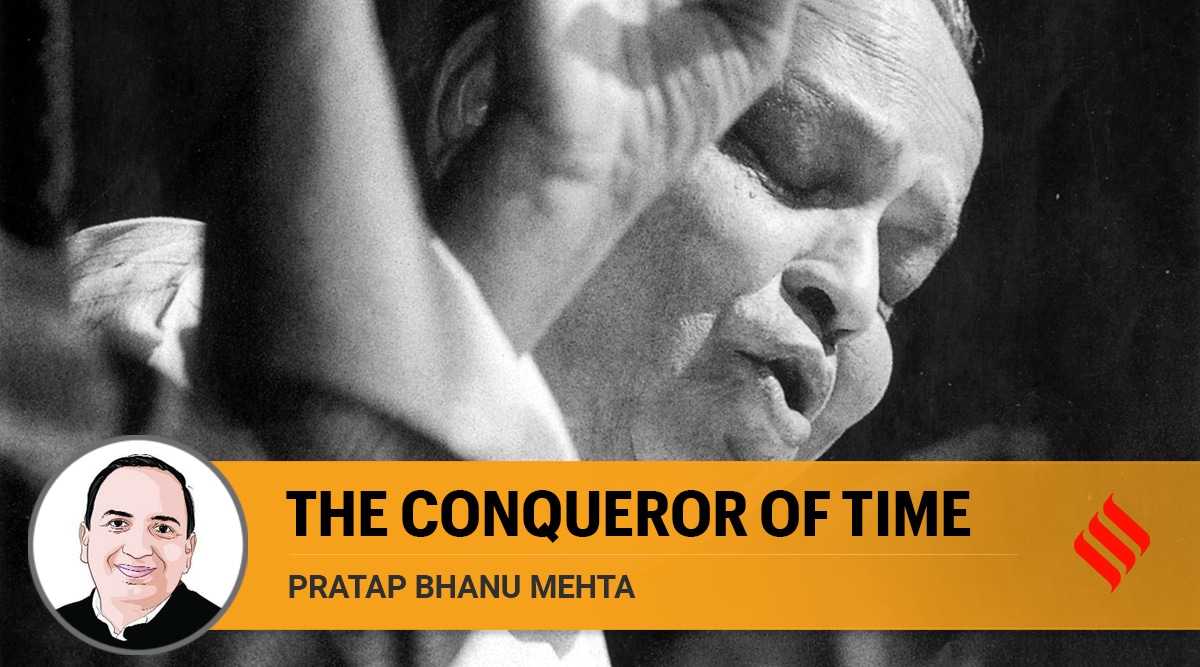
Thirty years ago, on January 12, 1992, it seemed that the pulsating rhythms of the universe had gone silent forever. On this date, Kumar Gandharva drew his last breath. We are yet to fathom the full measure of this loss or take full stock of his legacy. One of the upsides of living in our age is the unprecedented availability of the recorded archive. When we were students in college it was hard to access more than a few stock recordings. Anyone who had access to rare or private recordings became our best friend. His Kabir recordings (the one oeuvre Kumarji was sent to this earth for) were, of course, freely available and widely known. But getting our hands on other cassettes was pure gold.
But now, thanks to newly released archives, his corpus comes into full view. The full range of his nirguna bhajans, Marathi natya sangeet, even his incredibly playful compositions on ordinary life and the seasons, all can be heard in relation to each other. In other artistes, this over availability can be a liability: You have to sift through, to get to the peaks. In Kumarji ’s case, it has the opposite effect: Almost each recording seems like a discovery of a new summit, a different way of capturing a haunting incandescence, and weaving his whole being, and ours, in a melodic current.


A tradition is more like a foundation on which more has to be built; a grammar is meant for expanding language, not constricting it. The second is the constant opposition between the folk and the classical. It was often said he made high classical popular (by departing from convention), and he made popular folk classical. In retrospect, these categorisations, while useful for some pedantic scholarly purposes, seem almost antithetical to the singularity of what he did and the unity of the musical experience he produced.
The title of one poignant set of homages to him, “Kaaljayi”, one who has conquered time, is probably as apt a title as one can give. But conquering time does not mean eternal — a kind of fixity that transcends all flux. In his interviews, he always comes across as impatient with that kind of talk. He also had a particular allergy to the word often used in connection with music, spiritual, as if it were one part of life, not life itself. These are very tempting terms that we lazily use to lock us into the binaries he was always trying to unsettle.
His music has the intense and blazing energy of the whole of creation pulsating through that connection between sabda and raga that only he could produce. He is unusual in how much the bols of the bandish, or the sahitya, is important to him and how much care he took to explain them. Listening to Kumar Gandharva, it is difficult to agree with the great TM Krishna’s claim in A Southern Music that in the musical experience language is important only as sound, not linguistically; words have to be conceived as a musical form not a poetic form. In a sense, this is true; after all it is the raga that shapes the form and the musical experience is accessible even without the linguistic meaning. But in Kumarji — what made all his recordings so exceptional — the music was a vehicle for not just sound but meaning. His particular emphasis in singing was also a vehicle for meaning, not just sound.

Kumarji always acknowledged his debt to the folk traditions, not just for the musical forms they bequeathed to him. But like Tagore, taken in by the Baul singers, what the “folk traditions” offered was not just musical forms to be shaped, but the unity of life and music. Singing or being in communion with a nirgun bhajan was not a matter of just meaning or musical form: It was being in a non-attached carefree state. The timelessness is not a sense of the eternal, it is just the sense that no moment is instrumental to anything else, especially the future. As he once put it, “without having that kind of nature, you cannot put forth that kind of (nirguna) voice. The voice has to match the mind.”
A programme announcement of the Indian State Broadcasting Service in the Indian Listener of June 7 1936 lists Kumar Gandharva as a “boy prodigy.” On August 15, 1947, as India gained independence, if Raghava Menon is to be believed, he was singing Raga Chandrakauns on radio. He then battled with TB and lost his voice for a full six years. By the time he took his last breath, he had not only become one of the greatest musicians of all time, he had arguably become the highest point of Indian culture, embodying its form, meaning and even sense of play. He created a world — free, expansive and liberating, and unsettling in the deepest sense. As Madhu Limaye who listened to Kumarji in jail during the Emergency wrote to him, he gave us a glimpse of the secret vibrations of the universe. But Kumarji would have smiled: “Yeh Khel Roop Ka/Khele Mahadhir. (This play of forms/plays the Mahadhir).”
This column first appeared in the print edition on January 13, 2022 under the title ‘The conqueror of time’. The writer is contributing editor, The Indian Express


