
Opinion In Kashmir, a holiday on July 13 has become a battle over – and from – history
Denigration of the 1931 revolt, which serves as one of the most important events in the collective memory of the Kashmiri people, must be read through historical upheavals that shaped the imagination of Kashmir as a princely state
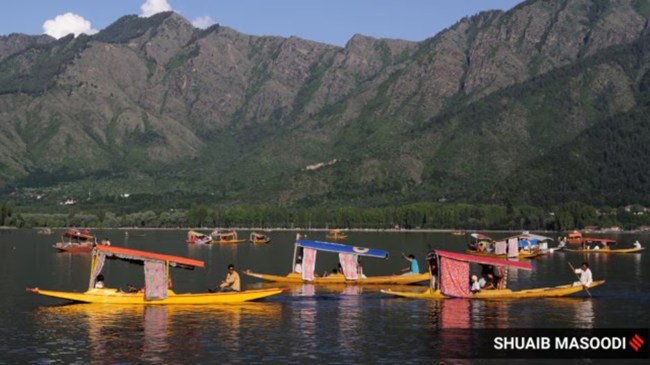 The 1931 agitation was followed by several political developments in J&K, including the formation of the Muslim Conference in 1932. (Express File)


(Written by Raheel Bashir and Aurif Muzafar)
On March 5, Sunil Sharma, a BJP MLA and Leader of Opposition in the Jammu and Kashmir (J&K) Assembly, opposed the resolution demanding the restoration of the July 13 to the list of official holidays in J&K. He referred to the July 13 martyrs as “traitors” who had risen against the Dogra kingdom. July 13, 1931, marks the martyrdom of 22 Kashmiri Muslims who laid down their lives in the compound of Srinagar central jail as the trial of one Abdul Qadir was going on. Qadir had publicly lamented the miserable conditions of Muslim subjects and allegedly incited violence against Dogra State, leading to his trial under the sedition law.
The day is widely commemorated for it was an awakening of the political consciousness of Kashmiri Muslims who defied the orders of the Dogra government to stand for Qadir. The 1931 agitation was followed by several political developments in J&K, including the formation of the Muslim Conference in 1932 and the first arrest of Sheikh Mohammad Abdullah, one of the most prominent leaders heading the anti-Dogra revolt. The day thus served as a catalysing event for the people to campaign for political transformation and a life of dignity.

In response to Sunil Sharma’s comments, the Kashmir-based political parties issued a strong rejoinder, prompting the Speaker to expunge his remarks from the Assembly records. The denigration of the 1931 revolt, which serves as one of the most important events in the collective memory of the Kashmiri people, must be read through historical upheavals that shaped the imagination of Kashmir as a princely state.
Manu Bhagavan, a historian of modern South Asia, in his paper titled ‘Princely States and the Hindu Imaginary: Exploring the Cartography of Hindu Nationalism in Colonial India‘, highlighted the importance of princely states in underpinning the intellectual edifice of Hindutva nationalism. Bhagavan argues that, for Hindu nationalists, the princely states instantiated Hindu sovereignty and “served as portals to a pure, ancient past,” unsullied by the deleterious legacy of Islam and British colonialism. The princely states attended to two forms of imagination – a past of purity and a future nation based on Hinduness. The past of purity refers to the imagined homeland or Akhand Hindustan (undivided India), a term coined by Congress leader K M Munshi. According to Munshi the purity of Hindu cultural heritage was preserved in these small pockets (princely states) of land throughout South Asia. These princely states were repositories of culture as well as the bedrock upon which a future nation must be built.
For the Hindu Mahasabha’s territorial imagination, Jammu and Kashmir’s Muslim majority (in the princely state) was not too relevant. Instead, it was envisioned as a part of a larger Akhand Hindustan, where Hindus constituted the dominant majority. Moreover, the “Hinduness” of the state was a critical element of the legitimacy of Dogra rulers. Orientalist knowledge production about the region coupled with geopolitical imperatives, led the British colonial authorities to vest Dogra rulers with a personalised form of sovereignty. It led to the Dogra dynasty’s alleged obliviousness towards the needs/rights of its majority Muslim subjects. Denial of land ownership rights, extraction of excessive taxation from the peasantry, and restricted access to government employment reinforced the socio-economic marginalisation of the Muslim population of the state. Mounting discontent among the Muslim populace with the Dogra rule culminated in political mobilisations, most notably the July 1931 uprising.
Votaries of the Hindu Mahasabha criticised the revolt by Kashmiri Muslims in Hindu Outlook, the weekly newspaper published from the Mahasabha office in New Delhi. On March 22, 1939, Mahasabha published a piece titled ‘Princes are the principle custodians of their ancient and illustrious heritage’, where they portrayed Hindu princes as bastions of justice and communal harmony while making Muslim agitation ipso facto an instance of Muslim bellicosity. In 1945, amidst consolidated Muslim resistance against the princely rule, they published another article titled ‘New Muslim agitation in Kashmir: A virtual invasion of the Hindu state’ where they denounced the political mobilisation spurred by socio-economic deprivation as the Muslim invasion of the state and its culture.
Sharma’s (mis)characterisation of the 1931 revolt’s martyrs as “traitors” echoes similar notions. Following the abrogation of Article 370 and the bifurcation of the erstwhile state into two Union Territories (UTs), the UT administration dropped Martyr’s Day from its list of public holidays. The enduring perception of Jammu and Kashmir as a historical Hindu domain is underscored by its contestation of the memory of the 1931 revolt. An attempt to overwrite the meaning of the revolt through the communal lens is a strategic move to alter the collective memory. The alternative imaginations of historical narratives also serve as a justification to further deny its distinct identity. History is a crucial battleground in its struggle for cultural and political dominance. In conflict zones such as Kashmir, the significance of history increases manifold, with the past being constantly reinterpreted and reworked to serve the present political agenda. Understanding the complex narratives of the past is a necessary prerequisite to shaping the future.
(Bashir is a research scholar at the Centre for Political Studies, Jawaharlal Nehru University. Muzafar is a research scholar at the National Academy of Legal Studies and Research, Hyderabad.)

 Share
Share


