
Opinion From the Opinions Editor: India, China and the reform deficit
Different reasons impede pickup in their economies. But a reluctance to correct structural shortcomings is common to both.
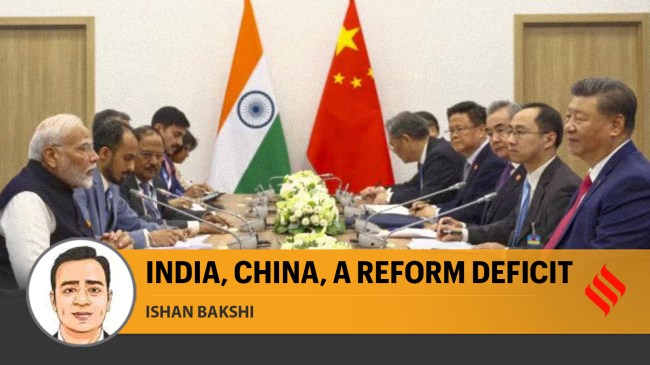 In India, animal spirits remain caged, with a corporate sector that is reluctant to invest, while in China, consumer confidence is near historic lows. (File Photo)

Dear Express Reader,
India and China are a study in contrast. For more than a decade now, the common refrain has been that while India needs to increase the investment rate in the country, China needs to rebalance its economy away from investments towards domestic consumption, with household spending accounting for a greater share.

Both these countries have, for more than a decade, been helmed by leaders who have enjoyed and exercised power in a way that not many before them have. Yet, strangely, both these leaders, who sit at the top of their party structures in two diametrically opposite political systems, have been unable or perhaps unwilling to steer their economies in the direction needed. In India, animal spirits remain caged, with a corporate sector that is reluctant to invest, while in China, consumer confidence is near historic lows.
It is not as if the ruling dispensation in India can be faulted for not taking steps to increase investments and boost manufacturing in the economy. It has, for instance, put in place the production linked incentive schemes, introduced a lower tax rate for new manufacturing facilities, while also ramping up public investments hoping to kickstart a private investment cycle. But, there are few indications of a pickup. In fact, signs point to domestic private capital flowing out of the country. Equally worrying, manufacturing and investment activity remain extremely concentrated. In 2022-23, just four states — Gujarat, Maharashtra, Tamil Nadu and Karnataka — accounted for about half of manufacturing value added in the country.
The challenge to raise the share of manufacturing — in the absence of a broader manufacturing pickup, an investment boom is unlikely — is not peculiar to this government alone. Others have also grappled with this. During UPA rule, the National Manufacturing Policy had aimed to raise the share of manufacturing to 25 per cent of GDP by 2022. The ruling dispensation has also set a similar target. But the sector’s share has more or less remained the same (at constant prices).
The government now appears to have pivoted away from focusing on investments to boosting consumption, via tax giveaways, first by lowering personal income taxes and now by looking to bring down taxes under GST, an approach which only imposes further fiscal constraints on the state to spend on public goods.
In the case of China, rather than attempting to rebalance, Beijing appears to have doubled down on its investment-export strategy. The few steps it has taken to support consumption have been modest at best. President Xi Jinping’s focus has been on developing new quality productive forces in high-tech industries, while not neglecting traditional industries. And the result – China’s investment to GDP ratio stands at around 40 per cent, its exports have risen to $3.58 trillion, and its trade surplus touched almost $1 trillion in 2024.
The varying approaches to the economy also find reflection in the differing strategies the two countries have adopted towards their exchange rates.
Officially, the RBI does not target the level of the rupee. But, by repeatedly intervening in the markets to stem the currency’s fall, the exchange rate management strategy — S&P Global has classified it as a “stabilised arrangement”, a type of soft peg — has tended to adversely impact export competitiveness, while ensuring cheap imports and boosting household purchasing power. But, this approach does mean that the trillion dollar targets set for the economy are more achievable.
On the other hand, China’s currency management has in the past run in the opposite direction. An undervalued currency aids export competitiveness, while keeping imports expensive, and reducing the purchasing power of households.
Rebalancing the Chinese economy away from investment towards consumption would impose costs — growth would slow down as the economy adjusts — costs that the country’s leadership seems reluctant to bear, oddly, in a political system that, unlike a democracy, does not give its citizens a regular channel to express dissatisfaction.
But, in India, where citizen backlash is captured through the never ending cycle of elections, the costs of muted investment growth, that results in poor job creation and subdued wage growth, find reflection in the political calculus via populist measures embraced to assuage discontent.
However, the pivot towards cash transfers — a recent report has pegged unconditional cash transfers at almost 1 per cent of GDP — and the emphasis on other populist and welfarist policies is in contrast to China where Xi Jinping has been quite forthright on the approach to be adopted. “To promote common prosperity, we cannot engage in ‘welfarism,’” he has said, adding that “it is unsustainable to engage in ‘welfarism’ that exceeds our capabilities. It will inevitably bring about serious economic and political problems.”
Only structural reforms can address the structural issues in the two economies. China’s challenges revolve around over investment and excess capacity, low household consumption and high savings, an ageing population and high debt levels, while India’s problems centre around subdued investment activity, which runs alongside the deepening capital intensity of production, a growing workforce that faces inadequate job opportunities in the non-farm sector, low household savings, high levels of informality and low productivity.
While addressing these issues is harder than many appreciate, in recent years, it does seem that the policy focus in both countries has shifted away from prioritising growth. And so, in the absence of deep reforms, China persists with its debt-fuelled investment-export led model of growth, the limits of which are being tested in a world that is either unable or unwilling to absorb its excess capacity, while India, in the face of sluggish manufacturing and investment growth, continues to rely on domestic consumption, fuelled by debt and tax giveaways.
The question is whether the required policy changes can be engineered or will the laws of path dependency make progress difficult.
Till next week,
Ishan

 Share
Share


