
Opinion India’s Ayush systems: Soft power rooted in health knowledge
As the world navigates ecological anxiety, lifestyle diseases and mounting health inequities, India’s traditional knowledge offers not an alternative, but a complement — a pathway to restoring balance for people and the planet
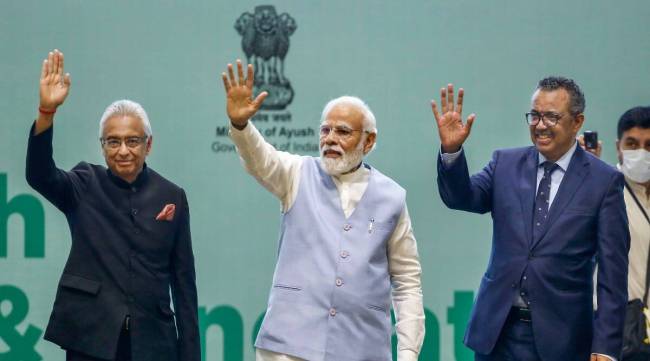 Prime Minister Narendra Modi, Director General of World health organization (WHO) Tedros Adhanom Ghebreyesus and Mauritius Prime Minister Pravind Jugnauth during the 'Global Ayush Investment and Innovation Summit', at Mahatma Mandir, in Gandhinagar, Gujarat. (PTI)


As India prepares to co-host the Second WHO Global Summit on Traditional Medicine in New Delhi from December 17 to 19, it is a moment not only of policy significance but of civilisational resonance. Traditional medicine has always been a bridge between cultures, knowledge systems and societies. Today, under the visionary leadership of Prime Minister Narendra Modi, India has transformed this inherited strength into a global instrument of goodwill, cooperation, and wellness diplomacy. The world increasingly recognises that India’s soft power is rooted not just in culture and spirituality, but in the universal relevance of its health knowledge.
Over the last decade, the Ministry of Ayush has worked with a clear mission: To globalise evidence-based traditional medicine and make it accessible, aspirational, and internationally credible. This work rests on a robust network of partnerships: 25 country-to-country MoUs, 52 institution-level MoUs, 15 Ayush Chairs, and 43 Ayush Information Cells across 39 countries, making Ayush one of the most internationally engaged sectors of Indian governance. These collaborations have strengthened research, training, clinical services, and regulatory cooperation, enabling Ayush to emerge as a trusted global partner.

Beyond diplomacy, Ayush is today a vital pillar of India’s economy. With over 92,600 MSMEs, a thriving domestic market of USD 43.4 billion, and exports worth USD 1.54 billion, the Ayush industry exemplifies how traditional knowledge can catalyse modern enterprise. Ayush and herbal products now reach over 150 countries, and Ayurveda is officially recognised in more than 30 nations. The establishment of AYUSHEXCIL, launched by the PM at the Global Ayush Investment and Innovation Summit (GAIIS) in 2022, has further accelerated global trade by providing market intelligence, regulatory support, B2B platforms, and export facilitation. India is positioning Ayush not only as a health system, but as a competitive, innovation-driven global industry.
India’s commitment to international collaboration is also reflected in transformative initiatives with the World Health Organisation (WHO). From WHO Collaborating Centres at ITRA Jamnagar, MDNIY New Delhi and CCRAS-NIIMH Hyderabad, to the Group of Friends of Traditional Medicine (GFTM), to the globally popular WHO m-Yoga app, India has helped shape the global narrative on integrative health. The inclusion of Ayurveda, Siddha and Unani morbidity codes in ICD-11 Module 2, the Project Collaboration Agreements on benchmarks and terminology, and the Agreement to develop a dedicated Traditional Medicine module under ICHI mark historic milestones in global standard-setting. WHO’s recent brief on AI in Traditional Medicine, recognising India’s pioneering work, further underscores India’s thought leadership in combining traditional knowledge with cutting-edge science.
A particularly powerful expression of India’s health diplomacy is Medical Value Travel (MVT). The introduction of the Ayush Visa in 2023, along with the dedicated digital Visa portal, the BIS’s adoption of ISO 22525 standards, insurance coverage through 27 companies, and ITDC partnerships, has created an enabling ecosystem. Global summits on MVT in Mumbai and Chennai have showcased India as a preferred destination where wellness, authenticity, and affordability converge. This is soft power in its purest form — where healing itself becomes a form of international engagement.
The establishment of the WHO Global Traditional Medicine Centre (GTMC) in India — rooted in the ethos of Vasudhaiva Kutumbakam — stands as a testament to India’s global stewardship. GTMC’s work in evidence, data, sustainability, and innovation resonates deeply with PM Modi’s call for solutions that are both traditional in knowledge and modern in method. As the world navigates ecological anxiety, lifestyle diseases and mounting health inequities, India’s traditional knowledge offers not an alternative, but a complement — a pathway to restoring balance for people and the planet.
The upcoming WHO Global Summit on Traditional Medicine will serve as a pivotal platform to operationalise WHO’s Global Traditional Medicine Strategy 2025–2034. It brings together policymakers, researchers, innovators, industry leaders, and civil society to shape the next decade of integrative, equitable, evidence-driven healthcare. At this Summit, India will share its experiences with humility, learn from partners with openness, and collaborate with the world in the true spirit of global familyhood.
The soft power of wellness is not about influence; it is about inspiration. Not dominance, but shared discovery. India’s health knowledge — centred on balance, compassion, and prevention — has the potential to guide global conversations on well-being in the 21st century. As nations seek sustainable, holistic, and person-centric models of care, India stands ready to walk with the world.
The Second WHO Global Summit on Traditional Medicine is more than an event. It is a collective step toward a healthier future — one where knowledge is shared, innovation is ethical, and wellness becomes a universal right. The Summit will be held at Bharat Mandapam, New Delhi, bringing together global leaders and stakeholders of Traditional Medicine to shape the next decade of integrative, evidence-driven health policy.
The writer is Union Minister of State (IC) for Ayush and Minister of State for Health & Family Welfare

 Share
Share


