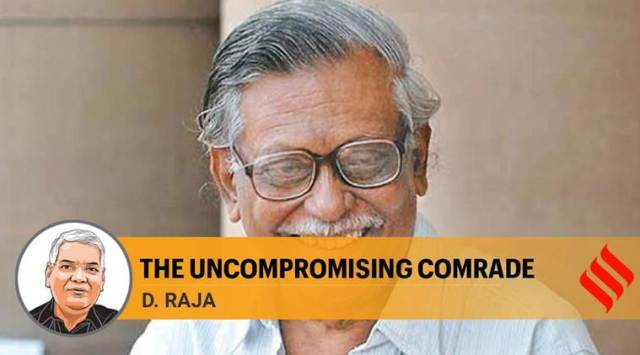


Comrade Gurudas Dasgupta, who passed away on October 31, remained a fighter for the causes of the working class till the end of his days. From the beginning of his active political life as a student, to his leadership of both organised and unorganised labour, his career as a preeminent parliamentarian, and in the leadership of the Communist Party of India (CPI), he remained an uncompromising champion of people’s rights.
Dasgupta made his mark in politics in 1957, when he became the general secretary of the students’ union of the Asutosh College in Calcutta. Thereafter, he continued to be associated with student and youth politics for some time. He served as general secretary of the All India Students’ Federation (AISF), the students wing of the CPI, and was one of the party’s most prominent youth leaders in West Bengal. From the 1970s onwards, he was known on the national stage.


Comrade Dasgupta also served as general secretary of the All India Trade Union Congress (AITUC). The AITUC, a premier Indian trade union, has worked for the welfare of the working classes since 1920, when the communists stood against imperialist rule. Stalwarts such as Indrajit Gupta and A B Bardhan have also served as its past general secretaries. It is a bitter-sweet irony that on the day of Dasgupta’s passing, the centenary commemorations of the AITUC have commenced.
Dasgupta served as the deputy general secretary of the CPI, a position he held till the last party Congress in 2018, in Kollam, Kerala. I have had the pleasure of serving with him both in Parliament and as a colleague in the CPI leadership. His commitment to egalitarian principles remained steadfast in every forum.
When the Congress government in the 1990s introduced the neoliberal economic agenda and implemented it through policy and law, Dasgupta was uncompromising in his opposition. Inside the House, he passionately argued against moves that would go against the peasantry, labour and other sections of society who have suffered as a result. But Dasgupta’s inspiring presence was not limited to Parliament. As a trade union leader, he organised numerous agitations of the working class. Throughout his long life of political and public service, Dasgupta stood against corporate forces and those that further ideas and policies of exclusion and religious bigotry. He had the unique ability to organise and mobilise, as well as motivate the people to fight the status quo, and recognise the fact that such a battle was in their own interest as well as for the benefit of the nation as a whole.
India, today, faces grave challenges. There is a disturbing economic slowdown, which is putting question marks on the fundamentals of the economy. Under the current ruling dispensation, the country is facing an onslaught of communal forces. At a time when we all must stand against these phenomena and those who have unleashed them, we have lost a comrade who has been at the forefront of such battles.
The passing of Gurudas Dasgupta is not merely a loss for the CPI. It is a loss for the communist parties as a whole and all the other socialist and progressive forces. It is a loss for India.
This article first appeared in the print edition on November 1, 2019 under the title ‘The uncompromising comrade’. The writer is general secretary of the Communist Party of India


