
Opinion Fighting To Win
Only Kejriwal stands to gain from the CM-LG face-off, whichever way it goes.
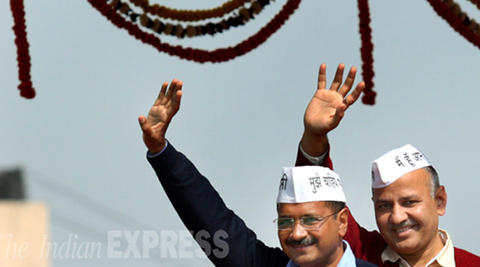

 While he is clearly positioning himself as a Narendra Modi-baiter, Kejriwal may also be laying the foundations of a future partnership with other regional parties.
The enfant terrible of Indian politics, as Arvind Kejriwal is seen by many today, is trying to push the envelope to enhance the powers of the Delhi chief minister and move public discourse towards statehood for Delhi. He knows he will come a cropper without this, with a BJP-ruled Centre not likely to make things easy for him.
The court will clarify the grey areas that the lieutenant governor and the ministry of home affairs tried to reinterpret through a notification, but Kejriwal could end up with “ladoos” in both hands. An adverse judgment will win him sympathy, with abridged powers giving him an alibi for failure to deliver on all promises. A victory, on the other hand, could once again make him the hero of Delhi, achieving what his predecessors could not, and its ripples will be felt outside the state.

Positing the fight as one between the “Big Brother” Centre and the “poor little” state, Kejriwal has evoked sympathy from other leaders and state satraps, who are wary of an overbearing Centre nibbling into their powers. Leaders like Nitish Kumar, Sharad Yadav, Sitaram Yechury and Omar Abdullah have come out in his support.
While he is clearly positioning himself as a Narendra Modi-baiter, Kejriwal may also be laying the foundations of a future partnership with other regional parties — he has struck a rare rapport with Nitish Kumar — though the contours of the new political lineup will become clear only after elections in Bihar later this year and in Uttar Pradesh in 2017. It was, after all, UP and Bihar that between them contributed a whopping 102 Lok Sabha seats to the BJP tally.
In its present gambit, as in its career so far, the Aam Aadmi Party has not been like any other political outfit, though many of its disappointed sympathisers now see it like “any other party”. This was the first time in independent India’s history that a civil society movement against corruption spawned a political party every second Delhiite voted for, decimating the 130-year-old Congress and halting the Modi juggernaut.
It was, after all, not so long ago that highly regarded activists would come a cropper in elections, whether it was someone like Arun Bhatia, who took on powerful interests in Pune, or leaders of the Jayaprakash Narayan initiated Chhatra Yuva Sangharsh Vahini, whose work with the Musahar-Dalits in Bodh Gaya led to the redistribution of land in the name of womenfolk in 1980. When a Vahini leader stood for elections from his “karmabhoomi”, he lost. People did not believe that voluntary workers, dedicated as they were, could become successful politicians.
The Asom Gana Parishad had also enthused the young people of Assam in the early Eighties and gone on to win two elections around the theme of Assamese subnationalism. But the AAP’s appeal cuts across caste, class, community.
The Janata Party had also come out of the womb of the “JP” movement in 1974, also against corruption, rising prices, and for electoral reforms. But given the Emergency Indira Gandhi imposed, throwing JP and opposition leaders in jail, the new party came to be dominated by existing opposition outfits when elections were held in 1977, sidelining the movement component — unlike the AAP, which managed to keep established parties at bay.
The AAP came at a time when middle class India was ready to accept activists in a political role, given their acute disappointment with existing parties. It was the same sentiment at the national level that supported Modi in the 2014 general elections.
The AAP now faces daunting challenges and formidable foes. Its messy split, following the “month of the long knives”, which led to the exit of Prashant Bhushan, Yogendra Yadav and Anand Kumar, and now the charges of forgery and wife-beating against two senior leaders, have only compounded its problems.
Every move Kejriwal has made of late to stay a step ahead of his adversaries — taking on the Centre and the LG, reaching out to Bihar cops for the ACB — has entailed a risk. But then he has never shied away from risks, whether it was breaking away from Anna Hazare, or floating the AAP, or parting company with his senior colleagues to create a “one power centre” party.
Given the expectations it aroused, the AAP will have to deliver and expand to stay relevant, both tasks having become more difficult with the loss of sheen the party has suffered in recent weeks.
The writer is a senior Delhi-based journalist
 Share
Share


