
Opinion Upendra Baxi writes: Adieu, Fali, my friend
A warm and large-hearted human being, he championed the cause of rule of law and constitutionalism.
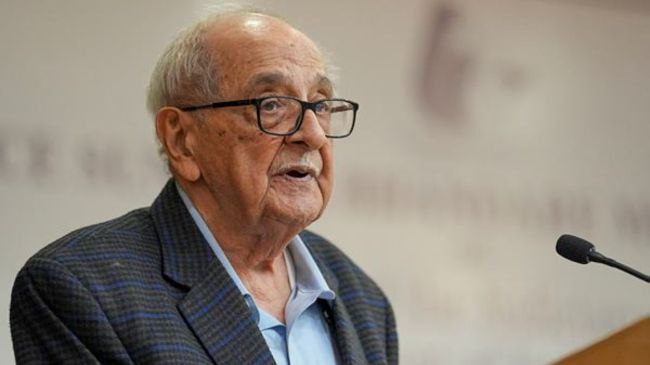 Fali was a warm and large-hearted human being with an ingrained sense of constitutional rule of law but he explicitly stayed away from competitive party politics. (PTI)

Fali Nariman’s sad and sudden demise will leave a permanent void in the heart of the Indian Bar, of which he was among the few towering personalities. It will also deplete the small rank of public intellectuals who actually explain the dynamics of constitutional law and jurisprudence to the non-specialist readers; as a highly acclaimed leader of the Bar, Fali found the time to regularly write for The Indian Express and other media outlets and was always willing and able to give long interviews to the print and digital media. He passionately believed that access to legal and juristic knowledge was a democratic right of all republican citizens.
He also believed in extended, adult, and continuing legal education for lawyers. I first met him at Bhubaneswar where the Bar Council of India had organised an inaugural seminar — a precursor to many such teach-ins. Fali was a core faculty member along with other constitutional law stalwarts (such as Soli Sorabjee, Justice P A Choudary of Andhra Pradesh High Court, P Parameswara Rao) and led a discussion on constitutional adjudication and social change. He also discussed what would today be probably described as constitutional forensics — the role of the high art of rhetoric in skilful lawyerly argumentation.

Fali was a warm and large-hearted human being with an ingrained sense of constitutional rule of law but he explicitly stayed away from competitive party politics. Generations born after the short-lived but cruel authoritarian Emergency of 1975-76 will probably not appreciate the full significance of the fact that he resigned in protest as India’s Solicitor General. Protesting against the state of Emergency from a public office at its onset was an act of considerable courage; in those days, it is well to recall the indictment of L K Advani of the media (which may be generalised to extend to almost all citizens): “You were asked only to bend, but you crawled”. But Fali stood tall in the heat and dust of the Emergency. No one who knew his work would be surprised by this; he championed the cause of the rule of law and constitutionalism, especially at the Geneva-based International Commission of Jurists.
Fali had an abiding faith in the Basic Structure doctrine, despite various politically minded criticisms of it. At the age of 94, he wrote: “I have the full confidence that it will not be watered down…. You can criticise it, but no one must shake the foundation. Then, it becomes like an earthquake”. He has expressed himself unequivocally both about the doctrine and the collegium system “it brought in”: “I still have faith in the judges. Doesn’t matter how they are appointed, why they are appointed”. And the doctrine is now “cemented in the Constitution”. Talking with The Indian Express, he also said: “You can’t alter it because you have to call a new Constituent Assembly and that is impossible in our country” because consensus will elude us as we “have two opinions on every subject”. He was of the firm view that “it is the Constitution that keeps us all, quite frankly, together”. I very much hope that these words will not be allowed to fall and fail on some hearing-impaired unconstitutional ears.
I must mention, in all honesty, that there was a period when we ceased to be friends; that was when as a counsel for the Union Carbide Corporation he was among the persuasive voices for the settlement of the “dispute”. I espoused the cause of the violation by 47 tonnes of methyl isocyanate gas on 17 wards of Bhopal. The Second Circuit Federal Judge Keenan was to describe what happened in Bhopal as the “world’s largest industrial disaster”. Ultimately, the civil suit appealed to by Union Carbide was settled in Chambers by the Chief Justice of India and his companion judges and the Attorney General and Fali Nariman while keeping out the victims’ groups who were lawful parties to the suit, a development that I was led to call the “Second Bhopal Catastrophe” since it contributed severally to re-victimising the Bhopal victims, who were to be caught up in a legal labyrinth. During this period, Fali and I were estranged. But much later, in his acclaimed autobiography Before Memory Fades (2010), he graciously admits that it was a case he ought not to have taken. Such auto-critique is very infrequent among senior counsel and justices, but Fali was brutally frank in retrospect.
Later, we had many exchanges on email, especially on aesthetic and literary matters. He possessed a voracious appetite for new reading. For example, on April 23, 2023, when we began celebrating the Golden Jubilee of Kesavananda Bharati, I invoked Roland Barthes’ famous essay, “Striptease”. Fali wrote instantly: “Brilliant! But this ignoramus would like a peek” at “this famous essay…” which I immediately sent his way. Law and literature, as well as joy and wit, flowed from Fali with effortless ease.
To conclude, Fali would have liked me to invoke Walter Savage Landor’s epigram, Dying Speech of an Old Philosopher:
I strove with none, for none was worth my strife:
Nature I loved, and, next to Nature, Art:
I warmed both hands before the fire of Life.
It sinks; and I am ready to depart.”
Adieu, Fali!
The writer is professor of law, University of Warwick, and former vice chancellor of Universities of South Gujarat and Delhi

 Share
Share


