
Opinion Is a jalebi a ‘mysterious crispy pretzel shaped fried waffle’?
Beyond the silliness of a jalebi’s description on a Pakistani restaurant’s menu are questions that can help us understand what we talk about when we talk about food
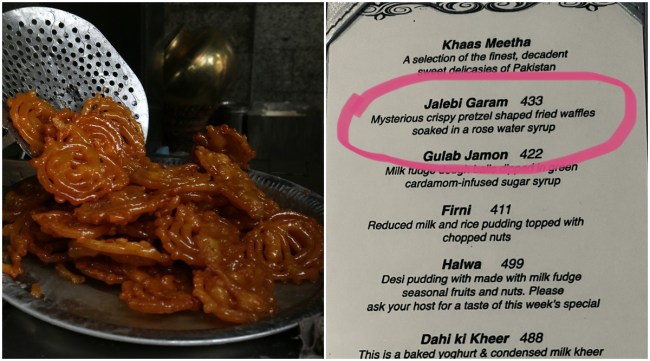 International Booker Prize-winning translator Daisy Rockwell had recently tweeted a photo of the menu from a restaurant in Pakistan describing 'jalebis'. (Photos: Express Archives, Twitter)

The International Booker Prize-winning translator Daisy Rockwell recently tweeted a photo of the menu from a restaurant in Pakistan that she visited with author and publisher Musharraf Ali Farooqi. The two had, she said, come across the “ultimate description of jalebi”, which she had circled in the photo — “Mysterious crispy pretzel shaped fried waffles soaked in a rose water syrup”. The description had Twitter in splits thanks mostly to the intriguing use of the word “mysterious”, but beyond the joke is an entire range of questions that one might ask to understand what we talk about when we talk about food.
One obvious question might be: Why use waffles to describe jalebis? Why not, let’s say, churros — they’re at least tubular preparations made with batter that is deep-fried, like jalebi. How do we decide which familiar food preparation can be used to explain a foreign dish? Are tortillas the same as rotis? Are pierogies just Polish gujiyas or are gujiyas just Indian handpies? Can one describe risotto as an Italian khichdi? It is clear that using a food item from one culture to describe a food item in another is about as straightforward as, well, a jalebi.

Friends, @microMAF and I have just come across the ultimate description of jalebi! 🥨 🧇 pic.twitter.com/YXgSPYmRFP
— Daisy Rockwell ڈیزی راکویل डेज़ी राक्वैल (@shreedaisy) February 28, 2023
Which leads to the second question: How easy is it to translate a food preparation from one culture to another, without losing a vital aspect of its meaning which might only make sense in one context? Jalebi, for example, is not just a mithai —- it is also a metaphor for a complicated way of being or doing things, a roundabout-ness that, let’s be honest, cannot be explained by substituting the word “pretzel” for jalebi.
A third question that one might ask is: Who exactly is the food being described for? This description of jalebi was found on the menu of a restaurant in Pakistan where, one assumes, the local clientele would require no explanatory notes. Obviously, then, the words “mysterious crisply pretzel shaped fried waffles soaked in rose water syrup” are meant to put a non-Pakistanti — a non-South Asian — clientele at ease. A deeply unfamiliar food becomes a little less foreign when explained this way. At the same time, one might ask, is the dish becoming “exoticised”, and therefore somehow more attractive or desirable, to those already familiar with it? If it were the other way around — if, say, a pretzel were to be described as a “baked jalebi” — would German or American diners find the exoticisation attractive? Given the clear cultural hierarchies that decide what kind of “exotic” food is acceptable, it might be safe to assume that this would not be the case. A jalebi, in other words, can be a “pretzel shaped fried waffle”, but a pretzel will always be a pretzel and a waffle will always be a waffle.
pooja.pillai@expressindia.com
 Share
Share


