
Opinion Can it hit the road?
Rahul’s challenge is not to become party president but to make a party out of Congress.

 Rahul Gandhi’s challenge is not to become party president but to make a party out of Congress.
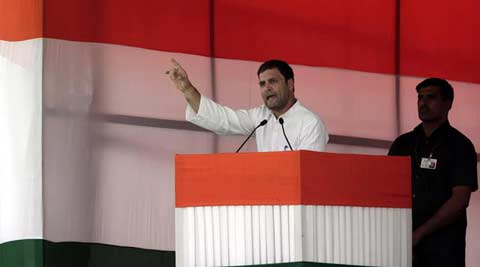
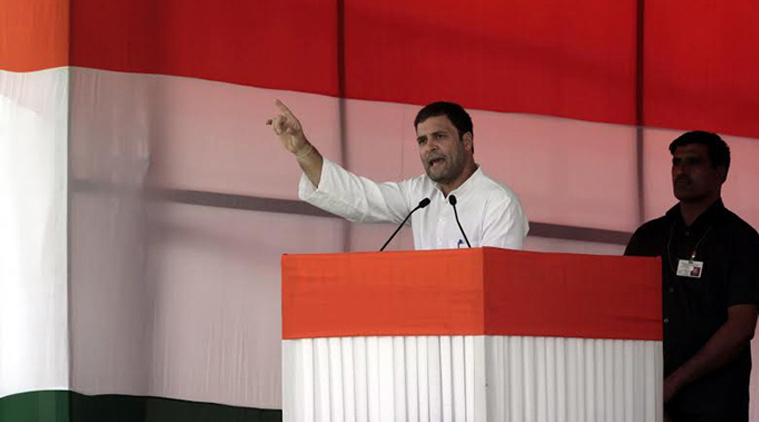
The Rahul Gandhi rally has hit the headlines alright. After almost a year in hibernation, the Congress seems to be awakening to the role of an Opposition. But the choice of Delhi for the rally and the contents of Rahul’s speech suggest that he and his party are still only engaged in a half-hearted politics based on a limited imagination. The rally was a show of strength. It grabbed media attention and projected a tough image for Rahul. But the core issues facing the party remain unattended to and it can hardly afford to postpone dealing with them. While the deeper issues relate to party organisation and ideology, the leadership issue seems central at the moment as it will shape the party’s ability to do politics.
The farcical manner in which the party has been handling the leadership issue ever since it lost in 2014 only indicates that it has not learnt any lessons, nor is it willing to learn them. Leadership is indeed a key factor in rebuilding the party. But the 2014 defeat was not just about leadership. Just as the party didn’t win the 2004 election because of Sonia Gandhi, 2014 was not an election it lost because of Rahul. The crucial question is whether the party wants leadership to evolve or be parachuted down.

It is true that the Congress party is hopelessly dependent on the Gandhi family. A family leading a party is not extraordinary in India. From Kashmir to Kanyakumari, there are parties galore that hinge on one family. But when a party is controlled by a single leader or family, they have to win elections for the party. As senior scholars of Indian politics, Susanne and Lloyd Rudolph, put it in 2008, dynastic leadership can be hard to sustain in the face of losses and the inability to win elections. Rajiv Gandhi could not win an election for the party in 1989 and almost couldn’t in 1991 either. After Sonia’s rise, the Congress skirted this issue by believing that she brought victory to the party in 2004 and 2009.
The Congress has repeatedly been presented with opportunities to fill the leadership vacuum in a different manner and move away from the dynasty-dependent model of leadership. In the past, such opportunities came along with a tragedy — the assassination of Indira Gandhi and then of Rajiv. In the case of the first tragedy, a palace coup ensured that the opportunity was lost — Rajiv was rushed into the post of prime minister. The second time tragedy struck, the party remained leaderless for nearly a decade (1991-99). That was when other leaders and state bosses could have negotiated among themselves and evolved a different leadership model. Instead, many chose to leave the party and form their own limited versions of the Congress. When she finally agreed to lead the party, Sonia made an innovation of sorts by separating the party leadership from the office of prime minister (after a long time). However, that innovation was killed by the choice of a non-political person as prime minister. This ended the possibility of the evolution of a new leadership in the party which would result in more genuine power-sharing.
Now, it is Rahul’s turn to take a call. Will he, as is rumoured, be anointed party president? Following what his mother did with governmental power in 2004, he should ideally desist from leading the party as its formal head. Rahul could commit himself to working for the rejuvenation of the Congress and still keep away from running it as president. If done sincerely, this could mean that the party opens up to real politics — leaders with a strong base and support across states could lead the Congress. By declining to be a minister during the last 10 years, Rahul had already taken a critical step. He faltered when he took over as party vice president. Now is his moment. He can either succumb to the dynastic routine of “saving the party and the country” or rewrite the history of the Congress and, in the process, initiate the process of rebuilding the party. As Congress vice president, Rahul could announce that he will preside over the election of a party president (in which he won’t be a candidate) in the next six months. This would stir the party out of its current state of paralysis.
The rejuvenation of the party does not mean giving tough speeches from a Delhi dais. It involves hard work — as Rahul once sought to do in UP. It is not enough for the party to be on television screens. It has to be present in cities and towns — and of course, where farmers live and work. For the last two generations, the party has consistently alienated the ordinary worker because local-level leadership was never predicated on networks of workers but on networks of family and social power.
During the period of governmental power up to 1989, the Congress party’s politics consisted of running governments, brokering power between diverse claimants and presiding over the distribution of private and public patronage. And when in opposition, so-called Congresspersons have only laboured to protect their small fiefs and local patronage networks, occasionally by joining the new centre of power. Long years of this style of politics have meant that the ability of current Congresspersons to undertake politics in the real sense — to mobilise, define and raise issues, align with specific social sections, and, above all, give meaning to being a party member — has almost disappeared.
With the Delhi rally, the Congress has made an effort to don the role of an opposition. How genuine this is will be known only when it takes the next logical step — mobilising people locally, not just arranging for their travel to Delhi or state capitals. Given its organisational disarray and the lethargy among its workers as far as oppositional politics is concerned, it is doubtful whether the Congress can really hit the road beyond Delhi and select metros. So, the real task before Rahul is not to become party president but to make a party out of the present Congress. The average Congressperson today has never done politics in the real sense. They have mostly been patrons and brokers. The political wilderness is now bound to force a new phase of politics. The challenge is to build a party out of the middlemen, patrons and brokers that the Congress has harboured all these years. Whether as president or not, Rahul will have to search for the disappearing tribe of the Congress worker. Pushing a non-dynastic agenda from the top may be one way of finding and relating to such workers.
The writer teaches political science at Savitribai Phule Pune University
editpage@expressindia.com
 Share
Share


