Journalism of Courage
 5 min read



EVEN after former Prime Minister PV Narasimha Rao8217;s death, his trademark pout8212;the pout that won him the endearing epithet of Chanakya8212;continues to be politically dissected. And, to think, it was a very forgiving Indian interpretation.
In the larger world of decision-makers, re-delineated by younger corporate czars as the territory of workaholics in their 40s, the pout could have been easily interpreted as a loser8217;s naive confession that he is in deep trouble.
Rao, elected Prime Minister after he had touched 70, had really managed the public discourse on that pout to his advantage. The media said, 8216;8216;Look, we have a thinking Prime Minister. He is not going to give away his thoughts. He is so un-transparent.8217;8217; It was great manipulation, a publicity coup. What was probably a sign of age and anxiety was carefully portrayed as a triumph over naivete. The nation was predictably gullible. His predecessors Rajiv Gandhi and VP Singh8217;s acts of political inexperience had helped Rao8217;s cause.
Age-management has been a key aspect of our Prime Ministers since the 1990s. The decade earlier had experienced the Age of Innocence. Rajiv Gandhi had taken charge when he was 40. VP Singh was 58 when he was sworn in as PM. His successor Chandrashekhar8217;s short-lived reign began when he was going on 69.
After an encounter with serious gerontocracy in the late 1970s, age had become a factor again in Indian politics. Rao was not in poor health but neither was he keeping exceptionally well. Hypertension is the minimum perk that comes with the PM8217;s post in complex, diverse India.
Like Rao, Atal Behari Vajpayee made it absolutely clear that age may have weakened his knee joints but his skull had preserved a widely-revered, politically matured brain. Like the pout, Vajpayee8217;s longer oratorical pauses became a symbol of Prime Ministerial sagacity and wisdom, politically significant body language of a man who would not commit in a hurry.
His Red Fort rampart stumble in 1998 was cause for concern but was dispelled with strong protests from his spin doctors. There are no simple solutions to this debate on whether politicians should retire. Neither Vajpayee nor Narasimha Rao showed any evidence of mental exhaustion. They enforced their policies with care, both endowed with a sense of history and wanting to leave an imprint of their respective reigns in the nation8217;s history. Even their critics testify that both were great listeners and sounded out their compatriots before they clamped down a policy decision.
If they erred in political judgement, it was in their assessment of their own body language. Rao8217;s pout created a remoteness, which became quite unpopular and which hardly benefitted his image when he was photographed with a smiling Bill Clinton on the White House lawns. The Vajpayee wobble did not portray a very photogenic personality especially in the company of Clinton or even Pervez Musharraf, but the former PM used his acceptability to portray himself as the nation8217;s patriarch, and everybody8217;s loving grandpa.
True, there were moments of embarrassment. In May 2000, Vajpayee was attending the first Indo-European Union summit in Lisbon, Portugal. The function was yet to begin. Indian journalists had taken their seats. Vajpayee was on the dais. Suddenly, he lifted the sheaf of papers in his hand and saw the almost indecent length of the speech he would have to read out. He turned around and asked one of his aides, 8216;8216;Itni lambi speech likhne kaun kaha tha?8217;8217; The microphone had long been switched on. Those who knew Hindi understood what the Prime Minister with a troubled knee was complaining about.
At least, Vajpayee did not shut his eyes and travel to the realm of shameful reveries, like HD Deve Gowda, Arjun Singh and ND Tewari.
But these sleeping political honchos did not infuse raw senility into their workplaces, as Ram Prakash Gupta, former BJP chief minister of Uttar Pradesh, had. Gupta suffered from amnesia. He forgot names, frequently lost his chain of thought and spoke incoherently. Yet, his party tolerated him for quite a long time.
Senile politicians can cause a political party immense trouble, as the CPIM found out when former Tripura chief minister Nripen Chakraborty poured out his heart in public with sheer malice towards one and all.
Interestingly, Jyoti Basu remained chief minister till the age of 86, but had not kept a single portfolio with him for almost five years before that final retirement. His vocabulary during those later years comprised more pronouns than nouns. And Surjeet has been excused from attending Politburo meetings only when his tiring vocal cords would not let him read out even a printed speech. Sometimes, senior leaders have been flattered into accepting longer tenures because their presence itself has been a unifying factor.
India has just begun gymming. We don8217;t as yet subscribe to the idea that physical fitness is a key element in politics. We don8217;t need to be told how many minutes George W Bush jogs daily or the kind of weights that Al Gore or John Kerry lifts in the morning. We don8217;t want Manmohan Singh to report a perfect 120/80 BP reading without medicines at the end of a stressful working day. Till that happens, let8217;s not rack our brains if that pout, that pause or even that rusted kneecap is going to be our political nemesis.

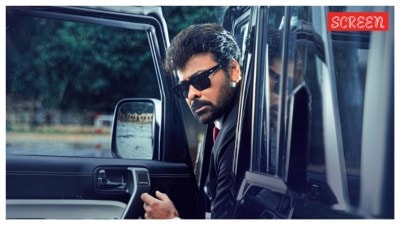
Anil Ravipudi’s action thriller Maha ShankaraVaraprasad Garu, starring Chiranjeevi and Nayanthara, has emerged as the winner among this year’s Sakranthi releases across the Telugu and Tamil film industries. The film’s unconventional release on a Monday, two days before the mid-week festival, has worked in its favour as it crossed the Rs 165 crore mark at the domestic box office.