


Tags:


From the electric sitar to the iTanpura,classical instruments are getting a makeover
The sarod that Kolkata-based musician Prattyush Banerjee balances in his hands looks disarmingly familiar: the slimmer bridge for the strings soars out of the round wooden shell. Its when he plugs the wire attached to the base into a socket that you see and hear the difference. As Banerjee plucks the strings,the sound that fills the room is not that of the deep,introspective sarod but a cross between an electric guitar and a veena.
Banerjee,who has been in the music industry for over 15 years,was trying to coax newer sounds from his acoustic sarod when he hit upon his innovation. He removed the goat skin membrane that covers the sarods round base,fitted an electric pick-up inside and replaced it with a wooden cover. For every fusion show that he now plays,Banerjee connects his electric sarod,which he calls the jyotidhwani,into a processor used for electric guitars and amplifies the sound. The good part is that the processors allow me to play a variety of sounds,like distortions and delays, says Banerjee,who modified the instrument five years go.


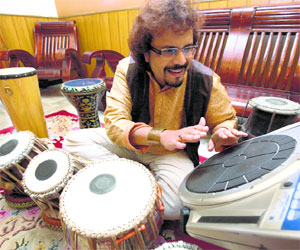
Ghosh uses Handsonic,a Japanese hand drum,which often substitutes for his baya while he plays the traditional tabla with his right hand. The sound changes are more by way of frequencies achieved but the modulation of the baya is lost. Hence,I use both, says Ghosh. He says the idea of electric instruments has picked up over the years and is much more rampant now.
Musicians electrify their instruments to amplify volume and increase sustenance. But in the process,do the instruments cease to be classical? There are bound to be changes in technique and approach. The sound definitely changes and with such a big shift,the style of playing is bound to change too. There is no doubt that this may herald some serious changes in the style of playing classical music on these instruments, says Ghosh.
Classical music is not just about playing an instrument,it is a technique,says Banerjee. Raga music has been played on the saxophone and the piano as well,so its about developing an instrument,not distorting a sound, he says.
But its still unthinkable to play these instruments in a regular classical concert. If you play an electric instrument,a regular tabla or tanpura doesnt gel. That is why for electric instruments,even classical,the preferred accompaniments are keyboards and maybe a drum kit, says Banerjee. Most of the artists also practise on their acoustic instruments.
Classical instruments are also getting compactthe tanpura is now an applications on your iPhone. The iTanpura has been manufactured by Prasad Upasani,a software engineer based in the US,using digitally recorded,high-fidelity samples of actual tanpura sound. The application is already being downloaded and used across the globe by the users of iPhone and iTouch,one of whom is singer Shubha Mudgal. One does not really have to lug around a cumbersome tanpura or hunt for an electrical socket for the electric tanpura every time. The iTanpura is a portable solution that can run for up to 10 hours on a single charge, says Upasani.
Sitarist Niladri Kumar,who has been playing his zitar,an electric sitar,for seven years now,also believes that its the musician and not the instrument that determines the music. Kumar plays the acoustic sitar for classical concerts and strums the zitar for fusion shows. Classical music depends on how the musician interprets it and not the instrument or the sound. Many non-mainstream instruments have made it to the list of classical instruments, he says.
Its a long way ahead before these electric instruments get accepted by mainstream classical musicians. This is the immediate premise of classical based new-age music. It remains to be seen how many instruments make it to the classical world like the mandolin, says Ghosh.
Inputs by Suanshu Khurana


